What's in the case
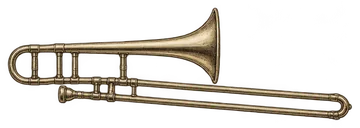
A trombone comes out of the case in three parts: the slide, the bell section and the mouthpiece [5].
| Part | What to know |
|---|---|
| Slide | The long U-shaped section. The outer slide moves over two inner tubes. It has a brace for your right hand and a rubber bumper on the end [1][6]. |
| Slide lock | A lock ring at the top of the slide that keeps the outer slide from coming off [1][5]. |
| Bell section | The bell and the tuning slide, plus the slide receiver where the slide attaches [1]. |
| Water key | The spit valve at the far end of the slide, for letting out water that collects as you play [5]. |
| Mouthpiece | Fits into the mouthpiece receiver at the top of the slide [1]. |
The slide is the part to protect. Even a small dent can make a slide unusable and hard to repair, according to Weidner's brass pedagogy textbook [6], and Yamaha's manual says never to play a trombone with a damaged slide [1]. Nearly every step below is about keeping the slide from hitting anything, or from sliding off its own tubes.
Before you start
Lay the case flat and lift the parts out with both hands. Yamaha's manual says to hold the slide with two hands, because one hand can damage it, and to hold both braces together if you carry the slide by itself [1]. Lift the bell section by the bell and the tubing together. Holding the tubing alone can damage the bell [1].
Check the slide before you put anything together. If it feels dry, Yamaha's manual says to put a light coat of slide cream on the slightly wider sections at the bottom of the inner tubes (or use slide oil), and after cream, to mist the slide with water from a spray bottle [1]. Tuning slide grease never goes on the hand slide [1][4]. The brass care guide covers how much cream to use and how to spread it.
Putting it together
- Check the slide lock. Make sure the lock ring is fully locked before you lift the slide, so the outer slide can't come off [1][7].
- Stand the slide on its bumper. Hold it by the slide brace and rest the rubber bumper on the floor so the slide stands upright [1][6]. In James Madison University's setup, the water key faces you [7].
- Pick up the bell section near the receiver. With your other hand, hold it close to the slide receiver [1].
- Fit the bell onto the slide. The bell section goes on the receiver on the longer side of the slide [6]. It should go on smoothly. If it takes force, Weidner suggests a little lubrication: a graphite pencil scribbled on the inner tubing gives a light coat [6].
- Set the angle. Turn the bell so the angle between bell and slide is slightly less than 90 degrees [6]. JMU's setup uses 90 degrees [7], and Yamaha just says to set the angle that suits you when you play [1]. Start just under a right angle and let your teacher fine-tune it.
- Tighten the bell lock. The lock nut sits on the inner side of the joint [5]. Turn it until it's finger tight, and never put a tool on it [6].
- Put the mouthpiece in. Slide it into the mouthpiece receiver with a gentle twist [2] until it's snug and no longer loose [1]. Don't force it [1], and never smack it in: a mouthpiece jammed in that way has to come out at a repair shop [5].
- Carry it by the slide brace. Once it's together, hold it by the slide brace and keep it from bumping into anything [1].
Holding it
The left hand carries all the weight [6]. Make an L with your thumb and index finger. The thumb goes under the bell tubing just above the bell brace, the index finger rests along the mouthpiece brace pointing toward the mouthpiece, and the other three fingers wrap around the tubing between the mouthpiece brace and the slide brace [6].
The right hand only moves the slide. Hold the slide brace lightly between the tips of your thumb, index and middle fingers, and let the other fingers curl toward your palm [6]. Beginners often wrap a whole fist around the brace, which stiffens the wrist so it can't pivot [6].
Teachers differ on the shoulder. Sweetwater's quickstart has you rest the trombone on your left shoulder [5]. Both brass pedagogy texts cited here want the left hand and arm holding it up, with the bell section off the shoulder [6][7], because slumping onto it restricts the air and slows the slide [6]. Go with whatever your band director teaches.
Worked example: setup and Hot Cross Buns
Here's a first session, from the case to a song.
- Slide lock on [1]. Slide upright on its bumper, held by the brace [1].
- If the slide feels dry, a light coat of slide cream on the wider bottom sections of the inner tubes, then a mist of water [1].
- Bell section on, held near the receiver [1]. Angle just under 90 degrees [6]. Bell lock finger tight [6].
- Mouthpiece in with a gentle twist [2].
- Try the mouthpiece on its own first. Press it to the middle of your lips without pushing hard, take a deep breath and blow. If your lips vibrate and you hear a blowing sound, that's enough for now [2].
- Hold the trombone as described above, release the slide lock, and play Hot Cross Buns. The site's trombone version is written in B♭ major and uses three positions: D in 4th, C in 6th and B♭ in 1st, with the slide all the way in.
- Check the B♭ on the trombone tuner. The tuning guide explains which slide to move and which way.
The move from C in 6th back to B♭ in 1st is the longest in the song. Positions get farther apart as the slide goes out, from about 3 inches between 1st and 2nd to just over 4 inches between 6th and 7th, and the wrist should lead every move [6]. The slide positions guide maps every position to its notes.
Taking it apart
- Empty the water. Open the water key and blow a few puffs of air through the mouthpiece without buzzing [5][1]. A rag on the floor catches the drips [5].
- Lock the slide [5][6].
- Mouthpiece out. Twist it gently out of the receiver.
- Bell off. Loosen the bell lock and lift the bell section off, the reverse of putting it on [5], holding it near the receiver [1].
- Clean the slide. Wipe the slide cream and moisture off the inner tubes with gauze [1]. If you use a cleaning rod, wrap it in gauze so no bare metal shows, since exposed metal can damage the inside of the slide [1]. Hold the slide brace the whole time, and grip both the rod and the gauze as you pull out so no gauze is left in the tube [3]. Yamaha's manual adds a warning: a leadpipe sits inside the slide stopper, and gauze can get stuck in it [1].
- Wipe the outside with a polishing cloth [1][3].
- Into the case. Yamaha's manual says to put the trombone in its case when you finish, and during breaks too [1].
Common mistakes
- Lifting the slide with the lock open. The outer slide can slide right off [1][7].
- Carrying the slide by one tube in one hand. Use both hands, or hold both braces together [1].
- Holding the bell section by its tubing alone. That can damage the bell [1].
- Forcing the bell onto the slide. It should go on smoothly [6].
- Putting pliers on the bell lock. Finger tight is enough [6].
- Smacking the mouthpiece in [5]. Snug is enough [1].
- Tuning slide grease on the hand slide. It's too thick and sticky [4]. Use slide cream or a slide lubricant [1][5].
- Too much slide cream. A slide that feels gummy and slow needs a full cleaning and a thin fresh coat [4].
- Emptying the water key during a quiet passage, or over someone. Sweetwater warns against both [5].
- Setting the trombone down somewhere unstable. It can fall and bend [1].
If the slide still drags after it has been cleaned and lubricated, or you can see a dent, get it to a repair technician as soon as possible [4]. Yamaha's manual says a damaged slide shouldn't be played at all [1].
Sources
- Trombone Owner's Manual (PDF), Yamaha
- How to Play the Trombone, Yamaha Musical Instrument Guide
- Care and Maintenance of a Trombone, Yamaha Musical Instrument Guide
- How to Lubricate Trombone Slides, Yamaha Music
- Trombone Quickstart Guide, Sweetwater
- The Trombone, Brass Techniques and Pedagogy (Brian N. Weidner), LibreTexts
- Trombone Set-up, Brass Pedagogy, James Madison University