
Oboe · treble clef
Oboe Fingering Chart
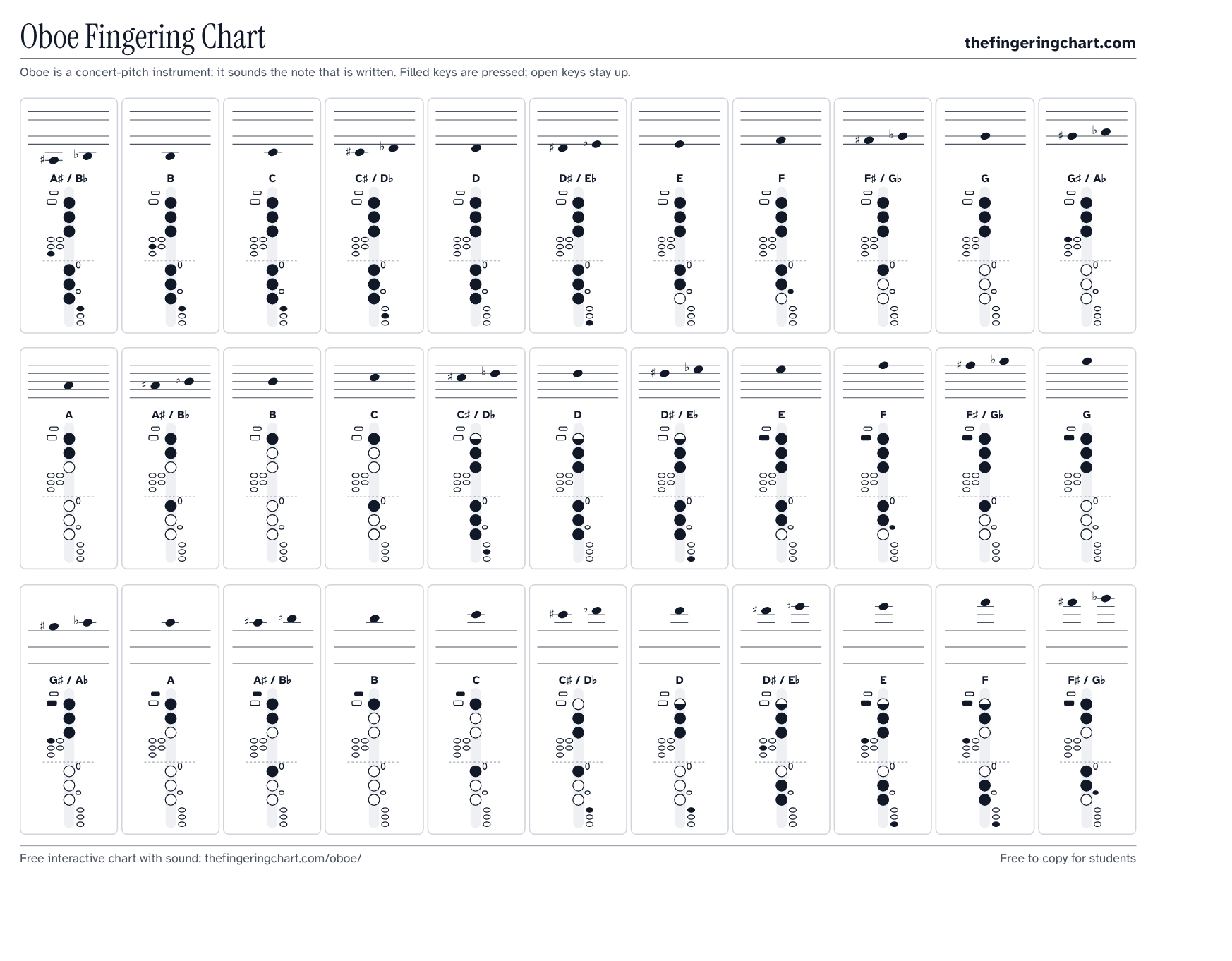
Oboe has more ways to play the same note than most band instruments, and that is what trips up new players. This chart shows 33 notes from low B♭ to high F♯, including all three F fingerings and every note that needs the half-hole. It is written for school oboists in their first few years, and for parents trying to help with practice. Nothing transposes: oboe reads at concert pitch, the same as piano.
Oboe is a concert-pitch instrument: it sounds the note that is written.
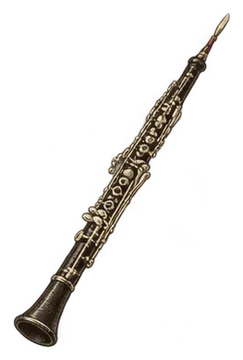
 Free 74-page oboe book: every note, all 12 scales and 28 songs, ready to print. Get the free PDF
Low register
Hold down the low C key with the right pinky as well as the low B♭ key. Some student oboes stop at low B and have no B♭ key.
Hold down the low C key with the right pinky as well as the low B key.
Cover every hole fully; small leaks make low notes crack.
Use the left E♭ key when the right pinky is busy on low C or C♯.
Regular F: the right ring finger presses the F key instead of covering its hole. Next to notes that use the right ring finger (low D, E♭, C, C♯), use forked F, or left F if your oboe has that key.
Second octave
Roll the left index finger down to open the half-hole; don't slide it. No octave key.
Half-hole, no octave key; same fingers as low D.
Half-hole, no octave key.
Close the half-hole and press the thumb octave key.
Same F choices as low F, plus the thumb octave key.
Switch from the thumb octave key to the side octave key, pressed with the side of the left index finger.
Top notes
Lift the left index finger completely; no octave key.
Half-hole open, no octave key, right pinky on low C.
Half-hole open with the left pinky on the low B key.
Thumb octave key plus half-hole; G♯ key with the left pinky, E♭ with the right.
Like high E but lift the left ring finger.
Index finger fully closed (no half-hole); like F with the left ring finger lifted, plus the thumb octave key.
Free book
The Oboe Fingering Chart Book
Every note from low B♭ to high F♯ with its fingering, all 12 major scales, and 28 songs with the fingering under every note. 74 pages.
Download the free PDFPrint it yourself
- At home: print it double-sided (flip on the long edge) and put it in a binder or folder. On A4 paper, choose “fit to page”.
- At a print shop: take the file to Staples, Office Depot, FedEx Office or a local shop and ask for black-and-white, double-sided, coil bound.
- Teachers: you may print this book and copy it for yourself and your students. Please don’t sell it or post the file on other sites; link to this page.
Want a cover for the binder? Print the color cover page (it uses a lot of ink).
Half-hole notes crack
Roll the left index finger instead of sliding it, so the small hole opens cleanly. Look at the half-filled circle on the C♯5, D5 and E♭5 cards to see what to leave open.
Low notes honk or won't speak
Relax the embouchure, keep the air steady, and start low B♭, B and C softly. If they still won't sound, a pad on the lower joint may be leaking, which a repair tech can check.
F sounds stuffy
You may be using forked F without the E♭ key on an oboe that needs it. Try regular F or add the E♭ key as the alternate card shows.
- High notes are flat or won't start. Check which octave key you are using. From A5 up the card switches to the side octave key, and staying on the thumb key makes those notes weak.
Range and where to start
This chart covers written A♯3 (low B♭) up to F♯6. Oboe is in C, so the written note is the sounding note: B♭3 sounds at about 233 Hz. A few student oboes stop at low B and have no B♭ key, which the low B♭ card points out. Notes from C♯5 to E♭5 use the half-hole, then the thumb octave key takes over from E5, and the side octave key starts at A5. Most band books start with concert B♭, C, D, E♭ and F, the same five notes as the rest of the band. Played in the staff, D and E♭ are half-hole notes, so oboists meet the half-hole early.
Worked example
Open the F4 card. That F sits on the bottom space of the treble staff. The main diagram shows L1, L2 and L3 down, R1 and R2 down, and the right ring finger on the F key, the small key left of the column between the second and third holes, instead of covering its hole. That is regular F. Tap the card to see the other versions. Forked F keeps the right ring finger on its hole and lifts the middle finger, and some oboes need the E♭ key added to keep it in tune. Left F uses a key under the left pinky, if your oboe has it. Use regular F most of the time. Switch to forked or left F when the note next to F needs the right ring finger, such as low D or E♭, so you never slide a finger. F4 sounds at about 349 Hz.
Common questions
Why does the oboe have three ways to play F?
Regular F uses the right ring finger on a key. When the note next to F also needs that finger, you would have to slide it, which is clumsy. Forked F and left F avoid the slide by using a different finger or the left pinky. Pick the one that keeps your fingers from jumping in the passage you are playing.
What is the half-hole on an oboe?
The left index finger key has a small hole in it. For C♯5, D5 and E♭5, you roll that finger so the small hole opens while the rest of the key stays down. It works like a small octave key. The chart draws it as a half-filled circle. Higher up, the half-hole comes back for D6 through F6.
Does oboe need to transpose?
No. Oboe is a concert pitch instrument, so a written note sounds the same as on piano. You can read flute or violin music directly, as long as the notes fit the oboe's range. The transposition chart helps if you are reading parts for a different instrument.
Keep going
Once the notes on this chart feel familiar, put them to work: the oboe scales page has all twelve major scales, and the easy oboe songs use the first notes most band books teach, and the oboe Christmas songs page has 14 carols with letter notes and words. For Veterans Day, Memorial Day and the Fourth of July, the oboe patriotic songs page has Taps and 6 more.
Printable oboe chart
 Woodwind careHow to Clean a Clarinet, Flute and SaxophoneWhat to do after every practice, and which jobs to leave to a repair technician.Read the guide →
 TechniqueAlternate Fingerings: When the Chart's First Answer Isn't the Best OneMost notes have more than one fingering, and the right one depends on the notes around it, the tuning, and the sound you want.Read the guide →
 Reading chartsHow to Read a Fingering ChartWhat the circles, numbers and labels on a woodwind or brass chart mean, and how to turn a diagram into a note you can play.Read the guide →
Gear for oboe players
As an Amazon Associate we earn from qualifying purchases. These are paid links that search Amazon; prices are the same for you. Disclosure.