Bassoon · bass clef
Bassoon Fingering Chart
Every note on the bassoon, from low B♭ to high E♭, including whisper key, half-hole and flick key notes.
Concert pitch, bass clef. High notes are usually written in tenor clef; here they are shown in bass clef with ledger lines.
Low register
Press all four low keys with the left thumb; this is the lowest note.
Add the C♯ key with the left pinky.
Add the E♭ key with the left pinky.
Right thumb presses the E key.
Use the pinky F♯ key when the right thumb is busy on a nearby note.
Use the thumb A♭ key next to notes that need the right pinky, such as F or F♯.
Left thumb presses the C♯ key while the whisper and low D keys stay down.
Middle register
Leave the second left-hand hole open. The right thumb B♭ key and R2 steady held notes; drop them in fast passages.
Only the whisper key is held; all holes are open.
Half-hole: leave a little more than half of the first hole open. Use the pinky F♯ version next to notes that need the right thumb.
Half-hole: cover about half of the first hole.
Half-hole: cover a little more than half of the first hole. Use the thumb A♭ version next to notes that need the right pinky.
Let go of the whisper key from A3 up to F♯4; it comes back for G4 and G♯4.
Left thumb on the C♯ key, no whisper key. R2, R3 and the pinky F key steady the note.
The first left-hand hole stays open.
Half-hole and whisper key come back for this note.
High register
Half-hole: cover a little more than half of the first hole.
Hold the high A key down with the C♯ key.
Hold the high C key down.
Half-hole the second left-hand hole, not the first.
The left first finger presses the small high E♭ key instead of its hole.
Printable chart
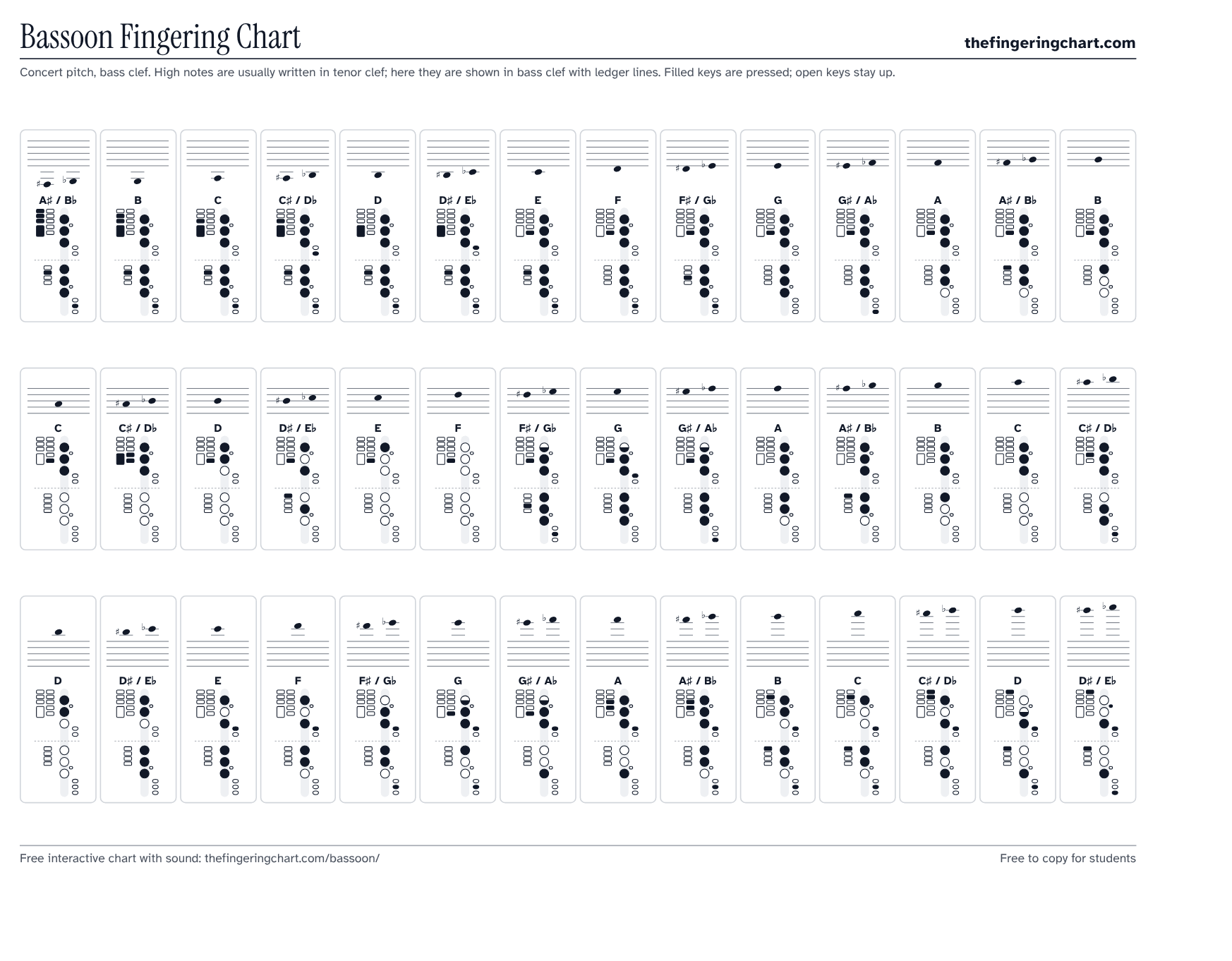
How to read this chart
Filled keys are pressed. A half-filled hole means a half-hole.
The left-thumb keys are the two columns at the upper left. The outer column holds the low B♭, B, C and D keys. The inner column holds the high D, C and A flick keys, the C♯ key and the whisper key (W).
Flick keys: on A3, B♭3, B3, C4 and D4, the left thumb taps the flick key shown in the alternate as the note starts, then lets go. Some student bassoons have no high D key; use the high C key instead.
The right-thumb keys sit at the left of the right hand. The right pinky keys are at the bottom right.
Which notes come first
Beginners start around F and G in the staff and work down to low B♭. The flick keys help the notes from the A on the top line of the staff up to the D above middle C speak cleanly.
Next: Bassoon scales