
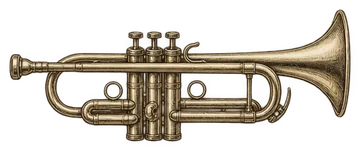
Trumpet · treble clef
Trumpet Fingering Chart
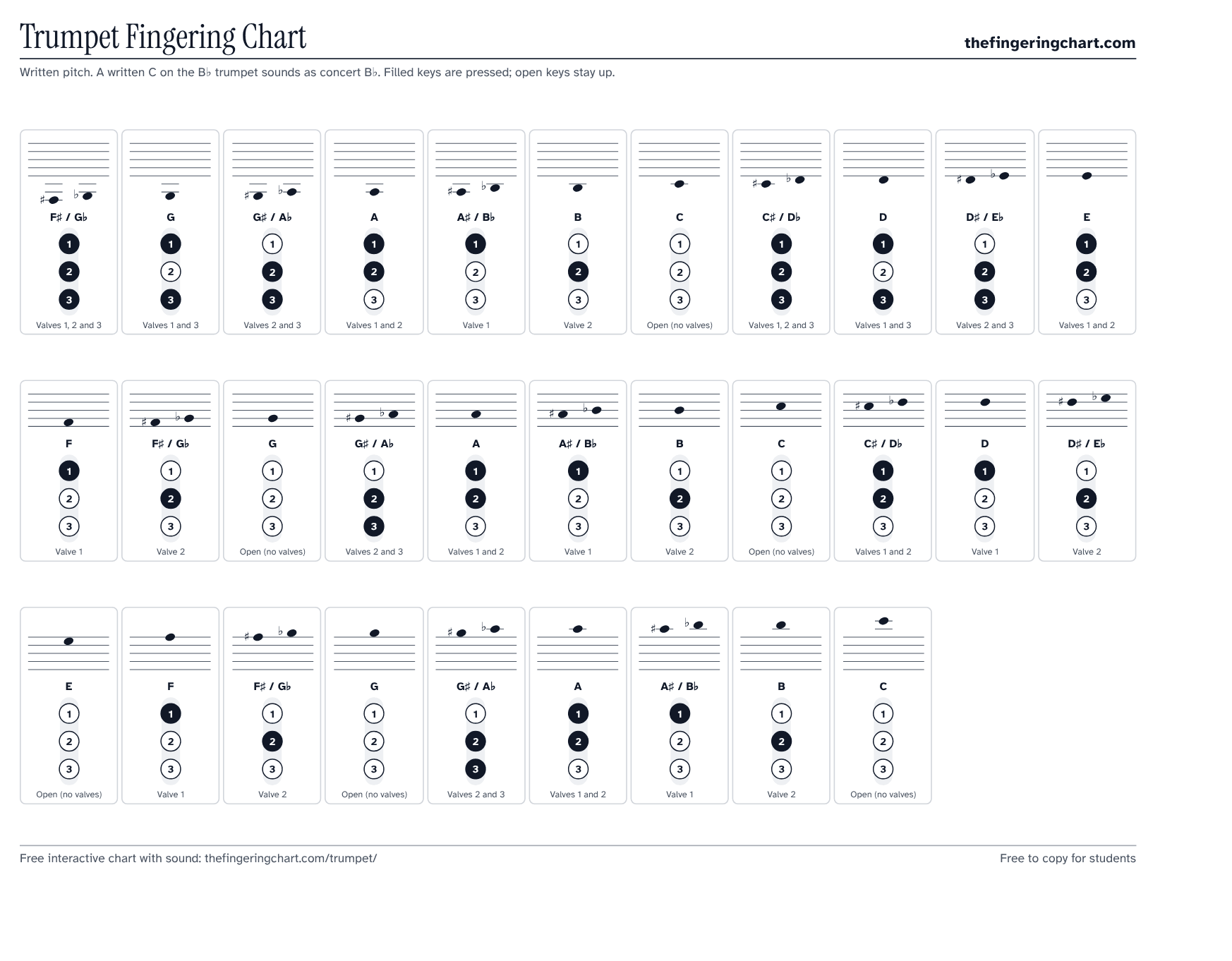
Thirty-one notes on the B♭ trumpet, from low F♯ under the staff to the high C above it, are on this chart, each with its valve combination. It is the range a school trumpet player needs for the first several years. The same fingerings work for cornet and flugelhorn, so a brass band or jazz band player can use it too. The cards show written pitch. The play button sounds the concert note, a whole step lower, so you can check your pitch against the recording.
Written pitch. A written C on the B♭ trumpet sounds as concert B♭.
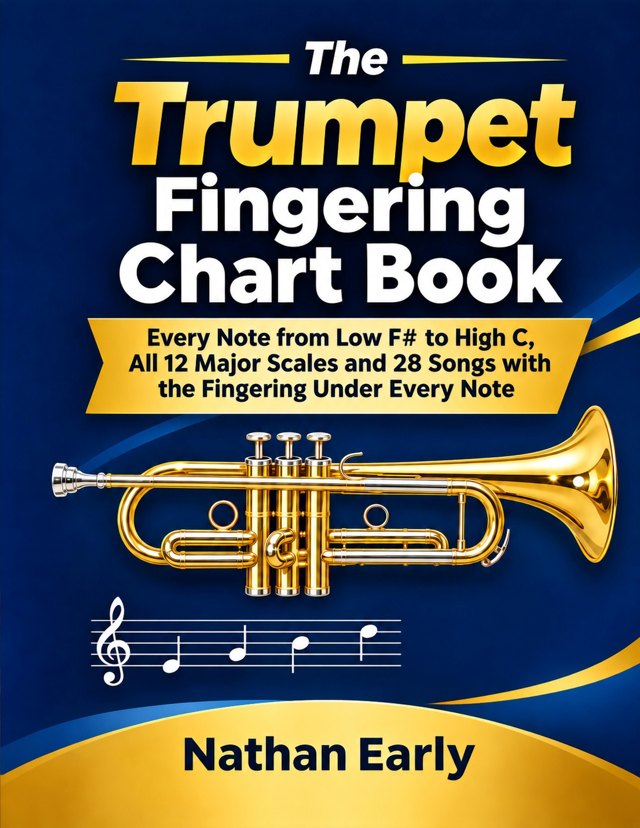 Free 66-page trumpet book: every note, all 12 scales and 28 songs, ready to print. Get the free PDF
Low notes
Lowest standard note. It plays very sharp: push the third valve slide out farther than for low G.
Push the third valve slide out to bring this note down in tune.
Middle notes
Open, no valves. One of the first notes most beginners learn.
This note is very sharp. Push the third valve slide out farther than for low D.
Push the third valve slide out to bring this note down in tune.
Open, the same as low C. Faster air and firmer lips raise the pitch.
High notes
Open, the same as low C and G, one step higher in the overtone series.
Open fingering on the top space. It can sit a little flat; listen and adjust.
Free book
The Trumpet Fingering Chart Book
Every note from low F♯ to high C with its fingering, all 12 major scales, and 28 songs with the fingering under every note. 66 pages.
Download the free PDFPrint it yourself
- At home: print it double-sided (flip on the long edge) and put it in a binder or folder. On A4 paper, choose “fit to page”.
- At a print shop: take the file to Staples, Office Depot, FedEx Office or a local shop and ask for black-and-white, double-sided, coil bound.
- Teachers: you may print this book and copy it for yourself and your students. Please don’t sell it or post the file on other sites; link to this page.
Want a cover for the binder? Print the color cover page (it uses a lot of ink).
Hitting the wrong partial on open notes
C4, G4 and C5 all use no valves, so the note depends on lip and air. Sing or buzz the pitch first, and use the play button to hear what you are aiming for.
Low D and C♯ are sharp
Push the third valve slide out with the left ring finger for those notes. Practice the motion at home until it happens without thinking.
Valves stick or feel slow
Oil the valves and make sure each one is in the right casing with its guide clicked into place. A valve put in backward will block air completely.
- Pressing the mouthpiece too hard to go higher. Heavy pressure works for a few notes and then cuts off the sound. Use faster air and a firmer lip corner instead; the guide on playing higher on trumpet walks through it.
Range and where to start
Written F♯3 is the bottom card and C6 the top. Trumpet is in B♭: every written note sounds a whole step lower, so written C is concert B♭ and the low F♯ sounds as E3, about 165 Hz. Band books start trumpets low, usually somewhere between written C4 and the G on the second line. Those first notes use the easiest partials and let you build an embouchure without pinching. From there most players add low notes down to F♯ and then work toward the top of the staff. The cards from G♯5 up to C6 are marked as advanced in the enlarged view, since they need a strong embouchure that takes time to build.
Worked example
Written D4 is a good test note. It sits just under the lowest line of the staff. Its card shows valves 1 and 3 filled. Press the first and third valves together, keep the second up, and play with the same relaxed setting you use for C4. Tap play and the sound is concert C4, middle C, about 262 Hz. D4 with 1 and 3 is one of the notes that tends to play sharp on most trumpets. That is why the third valve slide has a finger ring: push the slide out a little with your left ring finger while you play D4, and check the result on a tuner. Low C♯ (1, 2 and 3) needs the slide out even more. Once D4 is in tune, slur it to F4 (valve 1) and back without moving the slide.
Common questions
Why do so many trumpet notes use the same fingering?
A trumpet with no valves pressed can still play a whole series of notes, called partials, by changing lip tension and air speed. Each valve combination lengthens the tubing and shifts that whole series lower. So written C4, G4 and C5 are all open, and the player chooses between them with the embouchure.
What concert pitch is a written C on trumpet?
On a B♭ trumpet, written C sounds as concert B♭, a whole step lower. To find the concert name of any trumpet note, go down a whole step: written D is concert C, written G is concert F. The transposition chart lists every note side by side.
Which valve is number 1 on a trumpet?
Valve 1 is the one closest to you, nearest the mouthpiece, under the right index finger. Valve 2 is in the middle and valve 3 is farthest away, under the ring finger. The chart numbers them the same way, top to bottom, on every card.
Keep going
Once the notes on this chart feel familiar, put them to work: the trumpet scales page has all twelve major scales, and the easy trumpet songs use the first notes most band books teach, and the trumpet Christmas songs page has 14 carols with letter notes and words. For Veterans Day, Memorial Day and the Fourth of July, the trumpet patriotic songs page has Taps and 6 more.
Printable trumpet chart
 TrumpetHow to Play Your First Notes on TrumpetBuzz first, set the mouthpiece lightly in the middle of your lips, then carry that sound onto open C, D and E.Read the guide →
 TrumpetPlaying Higher on TrumpetHigh notes come from changing partials on the same fingering, with fast air and light pressure, built a few notes at a time over weeks.Read the guide →
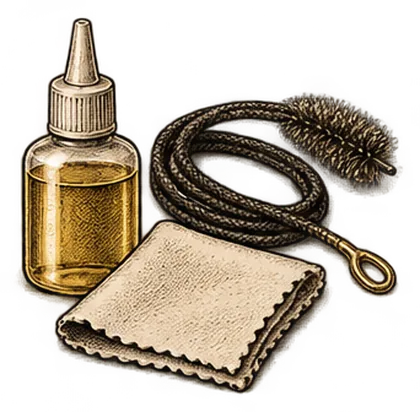 Brass careCleaning and Caring for a Brass InstrumentWhat to do after every rehearsal, what to do once a month, and the few jobs that belong to a repair shop.Read the guide →
Gear for trumpet players
- Trumpet valve oil
- Trumpet cleaning kit
- Trumpet practice mute
- Trumpet method book for beginners
- Clip-on chromatic tuner
As an Amazon Associate we earn from qualifying purchases. These are paid links that search Amazon; prices are the same for you. Disclosure.