After every time you play
Most brass damage comes from water left sitting in the tubing. Yamaha's trumpet guide warns that moisture left in a slide for a long time leads to corrosion [1]. So the daily routine is mostly about getting the water out.
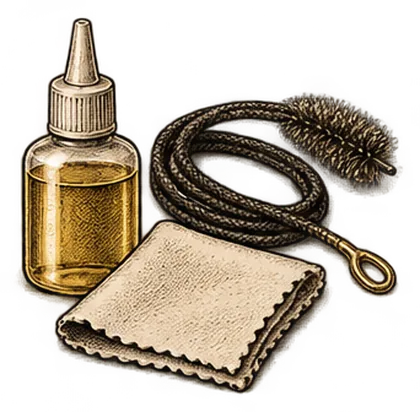
- Empty the water. Open the water key and blow it out. On trumpet, Yamaha also has you pull the slides one at a time and dump each [1]. Hold down the matching valve as you pull. If you hear a pop, you're pulling it the wrong way [1].
- Swab if you have time. A cleaning swab through the main tubing takes out water and grime that the water key misses [1].
- Wipe the outside. Run a polishing cloth over the finish before it goes in the case [1].
- Close the case. Yamaha's owner's manuals say to keep the instrument in its case during breaks, in transport and after playing, and away from heaters [2][3].
Trombonists: Yamaha's manual has you drain the water key and clean the slide after each session too [3].
Valve oil
Piston valves (trumpet, euphonium, most tubas and baritones) need regular oil. Yamaha's method for trumpet is to loosen the top cap, lift the piston about halfway without letting it turn, and put two or three drops on it. Then screw the cap back down and work the valve a few times to spread the oil [1]. Larger valves need more oil. Yamaha's low brass manual calls for about 10 drops per piston on euphonium and tuba [4]. Don't overdo it on any instrument [2][4].
A Pressbooks brass methods text suggests oiling valves and slides about once a week. Oil sooner if a valve starts to feel like it's dragging [5].
Stick with one brand and type of oil. Yamaha warns that oils of different viscosity can turn sticky or separate when mixed. Before switching, wipe the old oil off and clean the valves [6].
Horns and rotary-valve tubas use different oils. Put rotor oil on the spindles and bearings, and lever oil on the linkage, then wipe off what runs out [7]. Rotor oil is slightly thinner than valve oil [5].
Slide grease, slide oil and slide cream
These three products don't swap.
| Product | Where it goes | Instruments |
|---|---|---|
| Slide grease (thick) | Tuning slides and valve slides that you don't move while playing | All brass |
| Tuning slide oil (thin) | 1st and 3rd valve slides that have triggers or rings | Trumpet |
| Slide cream plus water spray, or a liquid slide lubricant | Inner tubes of the trombone hand slide | Trombone |
On trumpet, Yamaha puts a thin coat of grease on the main tuning slide and second valve slide. The first and third trigger slides get tuning slide oil instead [8][2].
Never put tuning slide grease on a trombone hand slide. It's too thick and sticky [9], and Yamaha's trombone manual says the same thing [3]. For the hand slide, Yamaha's educator site suggests a pea-sized drop of cream on each inner tube. Start at the stocking (the slightly wider bottom end of each inner tube), spread it along the tube, then wipe most of it back off. If you can still see cream, you used too much. Then mist the inner tubes with a spray bottle of water before and during playing [9]. A gummy, slow slide usually means too much cream, and the fix is a full cleaning and a fresh thin coat [9]. Liquid slide lubricants are an alternative. They go on faster but need to be reapplied more often [9].
If a clean, freshly lubricated slide still catches, look for a dent or a bend. A trombone slide has to be clean, straight and dent-free to work, and that repair belongs to a technician [9].
The bath
A full bath washes out the gunk that oil and swabbing don't reach. Schedules vary by source:
- Yamaha's trumpet manual lists cleaning the instrument as a monthly job [2].
- Yamaha's trombone and low brass manuals call for a full wash twice a year [3][4].
- The Pressbooks brass methods text says once every other month [5].
A trumpet that's played daily and taken out to marching rehearsal belongs at the monthly end of that range. A tuba played twice a week is fine at twice a year.
Water temperature. Yamaha's soap mix is one part brass soap to 10 to 15 parts warm water at 30 to 40 °C (86 to 104 °F) [3][4][6]. That's bath-warm, not hot. The Pressbooks text warns never to use boiling water, especially on lacquered instruments, because it can damage the lacquer [5]. A UK brass retailer's care sheet gives the same warning for hot water [10].
What comes out first. Take out the pistons, valve caps and slides before the body goes in the water [2][4]. Keep pistons in order on a towel. One middle school band's instructions have students clean trumpet and baritone valves by hand instead of putting them in the tub [11].
What never soaks:
- Valve felts and corks. Keep them dry, since wet felts can grow mold. If you wash pistons, keep the felt ends out of the water [5][11].
- Rotary valves. Leave rotors in place. Yamaha says never to take the rotors apart [4], and both Yamaha and the Pressbooks text send rotor cleaning to a dealer or shop [3][5].
- Lacquered finishes in anything harsh. Never use benzene or thinner on lacquer [3][2]. Metal polish wears down the finish's top coat [2].
Worked example: a monthly trumpet bath
About 50 minutes start to finish. You need a tub or deep sink, brass soap or mild dish soap, a flexible snake brush, a valve casing brush or a cleaning rod with gauze, a mouthpiece brush, towels, valve oil and slide grease.
0:00 to 0:05. Take it apart. Lay a towel on the counter. Remove the three pistons and line them up 1, 2, 3. Unscrew the bottom valve caps. Pull the main tuning slide and the three valve slides, holding down each valve as you go [1][2].
0:05 to 0:08. Run the water. Put a towel in the bottom of the tub so the bell doesn't scratch. Fill with water at 30 to 40 °C, which feels warm on your wrist without stinging. Mix in brass soap at about 1 part soap to 10 to 15 parts water, or follow the soap label [6][2].
0:08 to 0:18. First soak. Lay the body and slides in the water for at least 10 minutes [5]. While they soak, clean the pistons by hand. Wipe the metal with a soapy cloth, keep the felt ends dry, rinse, and set them back in order on the towel [5][11].
0:18 to 0:25. Snake it. Run the flexible brush through the leadpipe, the main tubing and each slide. Work from both ends where you can. Brush the valve casings with a gauze-wrapped rod. Don't let bare metal on the rod touch the casing walls [6].
0:25 to 0:35. Second soak. Ten more minutes [5]. Meanwhile, brush the mouthpiece throat in the same soapy water and rinse it clean [8].
0:35 to 0:40. Rinse. Flush everything with clean water so no soap is left inside [2][3].
0:40 to 0:45. Dry. Shake and turn the body to get water out of the tubes [11]. Dry the slides and the inside of the valve casings with gauze [6].
0:45 to 0:50. Lubricate and test. Thin coat of grease on the main slide and second slide, oil on the first and third slides [8]. Two or three drops of valve oil on each piston, then set them back in order [1][11]. Screw on the caps, play a scale, and dump the last of the water from the water keys [11].
Stuck mouthpieces
Mouthpieces get stuck when the instrument is dropped or bumped with the mouthpiece in, when the mouthpiece is pushed in too hard, or when it's left in for a long time [3][2]. Yamaha's manuals say never to force it in [2][4]. A gentle quarter turn as you insert it is enough [5].
If one sticks, don't use pliers, and don't twist and yank. That can break braces or twist the leadpipe [5]. Take it to someone with a mouthpiece puller [5], or contact your dealer as Yamaha advises [3][4].
When to see a repair technician
- Dents or bent tubing [5]
- Rotors that are stiff or sticking [4][5]
- A slide that won't move after one careful attempt with grease and gentle pressure [5]
- A valve that stays stuck after a few gentle taps [5]
- A trombone hand slide that catches even when clean and lubricated [9]
- A water key cork gone soft and leaking. Yamaha points out that moisture breaks corks down over time [6]
Common mistakes
- Hot water in the tub. It can damage the lacquer [5][10].
- Grease on a trombone hand slide. It's too thick and slows the slide [9][3].
- Too much cream. It makes the slide gummy. Wipe it until you can't see it [9].
- Mixing valve oils. Different viscosities can gum up [6].
- Soaking felts or rotors. Felts mold and rotors need a shop [5][4].
- Pliers on a stuck mouthpiece. You can break braces that way [5].
- Metal polish on lacquer. It wears down the finish [2]. On silver, darkening is normal and doesn't affect the sound [1].
After a bath, a horn's long coils keep holding water. One band program has students spin French horns and baritones to empty the tubing [11]. Do that before you oil the rotors and levers [7]. The French horn chart, trumpet chart, trombone chart, euphonium chart and tuba chart each show the slides and valves you'll be greasing and oiling. Once everything is back together, play through the trombone slide positions or a scale on your instrument to check that every valve and slide moves freely.
Sources
- Care and Maintenance of a Trumpet: After Playing, Yamaha
- Trumpet Owner's Manual, Yamaha
- Trombone Owner's Manual, Yamaha
- Alto (Tenor) Horn/Baritone/Euphonium/Tuba/Sousaphone Owner's Manual, Yamaha
- Instrument Care, Brass Techniques and Pedagogy, Pressbooks (PALNI)
- Care and Maintenance of a Trumpet: Monthly Care, Yamaha
- Care and Maintenance of a Horn: Weekly Care, Yamaha
- Care and Maintenance of a Trumpet: Weekly Care, Yamaha
- How to Lubricate Trombone Slides, Yamaha Music Educator Hub
- Looking After Your Valve Brass Instrument, Dawkes Music
- Brass Bath Instructions, Herbert Akins Road Middle School Band