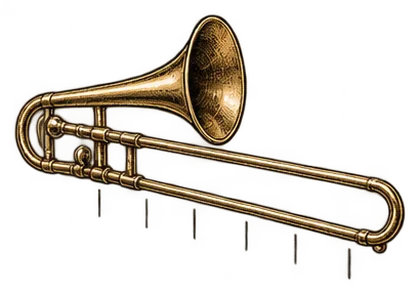
A trombone slide works like a set of seven valve combinations rolled into one tube. Pull it out and the tubing gets longer, which lowers the pitch [5]. The tenor trombone in B♭ uses seven chromatic positions, and moving from one position to the next lowers the pitch by one half step [1].
Nothing on the slide marks where the positions are. Players learn them by feel and by ear [5], and every trombonist adjusts them all the time.
The seven positions and how far apart they are
Position 1 is the slide all the way in, toward you. Position 7 is the slide nearly at full extension [5]. Each step outward is roughly 3¼ inches (about 8 cm) farther than the last [1].
That spacing is not perfectly even. The farther out you go, the longer the tubing already is, so it takes more slide travel to lower the pitch by the same amount. At 6th position the instrument is about 1.333 times the length of 1st position, so a given pitch correction there needs about a third more slide movement than it would near 1st [4].
Because nobody can see 3¼ inches while playing, teachers use landmarks. These vary with the trombone and the player's arm, so check them against a tuner:
- 1st: slide fully in.
- 2nd: about a finger's width of inner tubing shows past the 1st position spot [2].
- 3rd: the slide stops just short of your fingers when you reach them toward the bell [2].
- 4th: near the end of the bell [2]. One teacher warns that lining the slide up with the bell rim usually makes 4th sharp, and that true 4th sits a little below it [3].
- 5th: between the bell and full reach.
- 6th: near full arm extension [2].
- 7th: full extension, plus a little reach from the shoulder. It is used mainly for low E and B♮ [2].
Students' arms grow, so these spots move. Recheck the outer positions often, especially F♯/G♭ in 5th, low C in 6th and low B in 7th [3].
The harmonic series on each position
Each position gives you a whole series of notes. You choose between them with your lips and air: tighter lips and faster air move you up to the next note in the series [1][5].
In 1st position the playable series starts on B♭2, then F3, B♭3, D4 and F4, with A♭4 and B♭4 above [1][7]. Those notes follow the standard harmonic series: an octave, then a fifth, another fourth to the double octave, then a major third, a minor third, and a flat minor seventh [7]. Every position has the same pattern, shifted down a half step per position [1]. The fundamental below all of these (B♭1 in 1st position) is called the pedal tone [1].
Positions to notes, first two octaves
This table covers the 2nd through 6th partials, from low E2 up to F4. Notes are at concert pitch, which is what the trombone reads in bass clef. Middle C is C4.
| Position | 2nd partial | 3rd partial | 4th partial | 5th partial | 6th partial |
|---|---|---|---|---|---|
| 1 | B♭2 | F3 | B♭3 | D4 | F4 |
| 2 | A2 | E3 | A3 | C♯4 | E4 |
| 3 | A♭2 | E♭3 | A♭3 | C4 | E♭4 |
| 4 | G2 | D3 | G3 | B3 | D4 |
| 5 | G♭2 | D♭3 | G♭3 | B♭3 | D♭4 |
| 6 | F2 | C3 | F3 | A3 | C4 |
| 7 | E2 | B2 | E3 | A♭3 | B3 |
Read down any column and you get a chromatic scale, one half step per position. Read across any row and you get one harmonic series. Notes that appear twice (F3, B♭3, D4, C4, B3) are your alternate positions.
Below E2 there is a gap. On a plain tenor trombone nothing standard sits between pedal B♭1 in 1st and E2 in 7th [1].
Alternate positions and when to use them
The usual position for a note is almost always the one closest to 1st. Shorter tubing gives a fuller sound and less resistance [6]. Alternates exist for the times when the closest position makes your slide work harder than it needs to.
Three alternates to learn early [3]:
- F3 in 6th (the 4th-line F). Use it when the notes around it are in long positions, such as C3 in 6th or G3 in 4th.
- B♭3 in 5th (top line of the staff). Use it next to A3, A♭3 or G3 in the outer positions.
- D4 in 4th (first ledger line above the staff). Use it next to G3, C4 or E♭4 in 3rd and 4th.
Good reasons to reach for an alternate [6]:
- Shorter slide motion. Fewer long trips and fewer direction changes mean cleaner, faster passages.
- Natural slurs. If two notes sit on different partials, you can move between them without the tongue, for example B♭3 in 5th going to other notes in 4th or 5th.
- Tuning. D4 in 4th usually sits a little sharp of D4 in 1st, which helps when D is the fifth of a G major chord.
Alternates sound slightly less full, so avoid them on long, exposed notes [3].
The F-attachment
Many intermediate trombones have an F-attachment: a valve worked by the left thumb that adds tubing and drops the instrument from B♭ to F [1]. B♭ down to F is five half steps, so with the trigger down, 1st position plays what 6th position plays without it [1]. Low C3, for example, becomes a 1st-position note with the trigger instead of a 6th-position note [6].
The extra tubing is about a third of the horn's length, so with the trigger down the positions spread about a third farther apart and only six fit on the slide [1]. That fills most of the low gap, reaching down to C2 [1]. Trigger plus about 2nd position matches the tubing length of 7th, which gives an easier route to B♮2 [2].
Tuning: which notes run flat or sharp
The harmonic series is not tuned to the piano. The 5th partial is naturally about 14 cents flat and the 7th about 31 cents flat [7]. On the trombone that means [2][3]:
- 5th partial (D4, C♯4, C4, B3, and B♭3 in 5th): flat. Bring the slide in a little, roughly ¼ inch shorter than standard.
- 6th partial (F4, E4, E♭4, and D4 in 4th): tends sharp. Pull out a little, roughly ½ inch longer.
- 3rd partial (F3 in 1st through B2 in 7th): tends sharp on many trombones. Go slightly farther out.
- 7th partial (A♭4 in 1st and the notes above it): very flat. These notes are normally taken in positions that are a step closer than written; A♭4 is usually played in 3rd instead of 1st [6].
There is one exception to the short-is-better habit. In 1st position you cannot go shorter, so a flat D4 can only be raised with the lips. That is one more reason the 4th-position D4 earns its place [2]. Lipping a note into tune works, but the tone is better when the slide does the correcting [3].
Slide technique and legato
Hold the slide with a relaxed right hand and let the left hand carry the weight of the instrument [8]. The slide should move fast between positions and arrive in time for the note, since the time between notes is short [3].
The trombone has no real slur: if you blow while the slide moves, you get a glissando. Most teachers use a light legato tongue (a soft "du") to cover the moment the slide is moving [3]. Too hard a tongue loses the legato; too soft a tongue lets the glissando through [3].
Natural slurs are the other tool. When two neighboring notes sit on different partials, the jump between partials separates them cleanly, so you can slur without the tongue [6]. Sometimes a long slide move cancels out that benefit, and a short move with a legato tongue sounds better [6].
Worked example: F–B♭–D–F and the notes before it
Take this phrase in B♭ major: C3, F3, G3, A3, F3, B♭3, D4, F4.
Step 1. Primary positions. C3 is 6th, F3 is 1st, G3 is 4th, A3 is 2nd, then F3, B♭3, D4 and F4 are all 1st (see the table).
Step 2. Count the motion. 6 to 1 is five positions inward. 1 to 4 is three outward. 4 to 2 is two inward, and 2 to 1 is one. That is 11 positions of travel and three changes of direction, all in the first four notes.
Step 3. Look for alternates. The first F3 sits between C3 in 6th and G3 in 4th. Play it in 6th. Now the path is 6, 6, 4, 2, 1: 0 + 2 + 2 + 1 = 5 positions of travel, all moving inward, with no direction changes.
Step 4. Leave the arpeggio alone. F3, B♭3, D4 and F4 are the 3rd, 4th, 5th and 6th partials of 1st position. The slide does not move at all; only your lips and air change. Do not swap in alternates where none are needed.
Step 5. Tune the result. The F3 in 6th is a 4th-partial note and is usually close. D4 in 1st is a 5th-partial note and runs flat, so lift the air and listen [2]. If the phrase continued from D4 down to G3, switch D4 to 4th, pulled out slightly, so the slide is already sitting at G3's position.
Total savings: more than half the slide travel removed from the opening, and the hard part of the phrase becomes a single inward sweep.
Common mistakes
- Treating 4th as "at the bell." It usually lands sharp there [3].
- Using positions from memory, not from the ear. Positions shift with partials, temperature and arm growth. Check with a tuner [3].
- Lipping instead of moving the slide. You get an "okay" tone at best [3].
- Reaching for alternates on prominent notes. They sound slightly weaker [3].
- Moving the slide slowly. That smears into a glissando. The slide has to travel fast between notes [3].
- Ignoring the 5th partial. D4, C♯4 and C4 in standard positions go flat if you never adjust [3].
Scale practice is where these choices become habits. Work through the trombone scale pages and mark one alternate position in each scale, then check the full trombone fingering chart for notes above F4. If you also play euphonium, the euphonium chart shows the same bass-clef notes with valve fingerings in place of positions.
Sources
- Trombone, Wikipedia
- Trombone Slide Positions Chart, Low Brass Life
- Pocket Guide to Teaching Trombone (Josh Reynolds), Marching Arts Education
- The Amount of Slide Adjustment Needed for a Given Pitch Change, Galvanized Jazz
- The Structure of the Trombone, Yamaha Musical Instrument Guide
- The Nuances of Alternate Positions (Micah Everett), The Instrumentalist
- Harmonic series (music), Wikipedia
- How to Play the Trombone, Yamaha Musical Instrument Guide