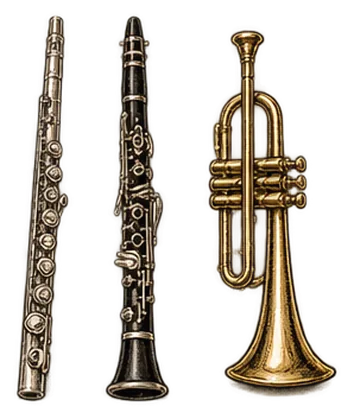
Concert pitch is the note you would hear from a piano playing the same sound. Written pitch is the note printed in a player's part. For flute, oboe, trombone and tuba the two match. For clarinet, trumpet, saxophone and horn they do not, and that mismatch is what a band director means by a transposing instrument: one whose music is not written at concert pitch [1].
When a clarinetist plays a written C, the sound is a concert B♭ [1]. Nothing is wrong with the clarinet. Its part was written a step higher on purpose so that the fingering and the printed note line up the way the player learned them.
Why B♭, E♭ and F instruments exist
Instruments come in families of different sizes. If every size were written at concert pitch, a player switching from alto sax to tenor would have to learn a new fingering for every printed note. Instead, music for these families is transposed so the same written note uses the same fingering on any instrument in the family [1]. All saxophones share one set of written fingerings, which is why one alto sax chart and one tenor sax chart look identical [2]. Brass works the same way, which makes it easier for a brass player who reads music to move between instruments [3].
Transposition also keeps parts in a readable range. Writing a low instrument's part higher keeps it on the staff and cuts down on ledger lines [4].
The name of the instrument tells you its key: the concert pitch that sounds when the player reads a written C. A B♭ trumpet reading C sounds B♭. An E♭ alto sax reading C sounds E♭ [1]. A horn in F reading C sounds F.
The interval for each band instrument
| Instrument | Key | Sounds compared with written | Written note for concert B♭ |
|---|---|---|---|
| Flute, oboe, bassoon | C | As written | B♭ |
| Trombone, bass-clef euphonium, tuba | C | As written | B♭ |
| Piccolo | C | Octave higher | B♭ |
| Soprano recorder | C | Octave higher | B♭ |
| B♭ clarinet, trumpet, soprano sax | B♭ | Major 2nd lower | C |
| Tenor sax, bass clarinet, treble-clef euphonium | B♭ | Major 9th lower (octave + 2nd) | C |
| Alto sax | E♭ | Major 6th lower | G |
| Baritone sax | E♭ | Octave + major 6th lower | G |
| Horn, mellophone | F | Perfect 5th lower | F |
The B♭, E♭ and F intervals in the table come from standard references [5][4]. The tenor sax and bass clarinet both sound a major ninth below written [5][4]. Horn in F sounds a perfect fifth lower [6], and the mellophone, usually pitched in F, does the same and uses trumpet fingerings [7]. Piccolo sounds an octave higher than written [1], and soprano recorder parts are notated an octave below where they sound [8].
Euphonium is the instrument with two answers. In concert bands it is usually written in bass clef at concert pitch, but in British brass bands it is written in treble clef as a B♭ instrument sounding a major ninth lower [9]. Same horn, different part. The transposition chart on this site lists all of these in one place.
Converting in both directions
The direction is the part people get backwards, so it helps to keep one rule in mind. The instrument sounds lower than it reads, so going from concert to written you go up, and from written to concert you go down.
Concert to written
- B♭ instruments: up a major 2nd. Concert B♭ becomes written C [10].
- Tenor sax and bass clarinet: up a major 9th, an octave plus a step [4].
- Alto sax: up a major 6th, or down a minor 3rd if the result sits too high [11].
- Baritone sax: up an octave plus a major 6th [4].
- Horn and mellophone: up a perfect 5th [4].
Written to concert
Reverse the move. A trumpet's written E5 sounds concert D5, a whole step down. An alto sax's written A4 sounds concert C4, a major sixth down. A horn's written G4 sounds concert C4, a fifth down.
Key signatures
Transpose the key signature along with the notes. The part for a transposing instrument ends up in a different key with a different signature from the C instruments [4]. The shortcut rules:
- B♭ instruments. If the concert key has two or more flats, remove two. With one flat, the written key has one sharp. With no flats, add two sharps [10]. Concert C major becomes D major for trumpet [5].
- E♭ instruments. If the concert key has three or more flats, remove three. With two flats, write one sharp. With one flat, write two sharps. With no flats, add three sharps [11].
- F instruments. Take away one flat, or add one sharp if there are no flats. Concert B♭ major, with two flats, is F major for horn, with one, which matches the written notes horn players use for the concert B♭ scale [12].
So the familiar concert B♭ major scale, two flats, is C major for clarinet and trumpet, G major for alto sax, and F major for horn.
Worked example 1: "Tune to concert B♭"
Bands usually tune to B♭ rather than the orchestra's A because most band instruments are pitched in B♭ [13]. When the director calls for concert B♭, here is what each section reads and plays:
- Flutes, oboes, bassoons, trombones, bass-clef euphoniums and tubas play a written B♭. Their written and concert notes match.
- Clarinets, trumpets, soprano sax, tenor sax, bass clarinet and treble-clef euphonium play a written C. One step above B♭ is C, so the written C sounds as concert B♭.
- Alto and bari saxes play a written G. A major sixth above B♭ is G.
- Horns and mellophones play a written F. A perfect fifth above B♭ is F.
A beginning band handout from a Georgia school district lays out the same answer for the first five notes of the concert B♭ scale: clarinet, tenor sax and trumpet start on C, alto sax on G, horn on F, and flute on B♭ [12].
Concert B♭ suits trumpets, trombones, euphoniums and B♭ tubas well, but some directors avoid it for horns, where it falls on first valve and makes a poor reference [14]. The same writer tunes on concert F instead because it gives the horns a better reference [14]. Horns read that concert F as a written C.
Worked example 2: a four-note concert melody
Here is a short concert-pitch melody in F major (one flat): F4, G4, A4, B♭4.
For alto sax
- Interval: up a major 6th.
- F4 up a major 6th is D5. G4 becomes E5. A4 becomes F♯5. B♭4 becomes G5.
- Key signature: concert F major has one flat, so the alto part gets two sharps (D major) [11].
- Check: the F♯ in the third note is already covered by the new key signature, so no accidental is needed.
Written alto part: D5, E5, F♯5, G5. If that sits higher than the player is comfortable with, the same line an octave down (D4, E4, F♯4, G4) uses the down-a-minor-third route [11]. It sounds an octave lower than the concert melody, which is usually fine in a band arrangement.
For horn in F
- Interval: up a perfect 5th.
- F4 becomes C5. G4 becomes D5. A4 becomes E5. B♭4 becomes F5.
- Key signature: one flat minus one flat leaves none (C major).
Written horn part: C5, D5, E5, F5. Play those on the horn chart and the sound matches the concert melody note for note.
Common mistakes
- Transposing trombone, tuba or bass-clef euphonium. These read at concert pitch. The trombone is not usually considered a transposing instrument and reads bass clef [15], and the same goes for tuba in orchestras and concert bands [16] and for euphonium written in bass clef [9]. A trombonist who adds a step to a concert part ends up a step off from everyone else.
- Getting the tenor sax octave wrong. Tenor sax is a B♭ instrument, but it sounds a ninth below written, not a second [4]. If you write a concert melody up only a whole step for tenor, the fingerings are right but the line sits an octave lower than the arranger intended. Bass clarinet has the same trap [5].
- Going the wrong direction. Concert to written goes up. Written to concert goes down. Saying "B♭ instruments are a step lower" without saying which side you started on causes most of the confusion in rehearsals.
- Forgetting the key signature. Moving the notes and leaving the signature alone produces wrong accidentals everywhere. Change the signature first, then move the notes.
- Treating treble-clef euphonium like bass-clef euphonium. A treble-clef baritone or euphonium part is transposed like a tenor sax, and on this site it uses the trumpet chart's fingerings. Check the clef on the part before you decide.
- Naming notes by written pitch in a mixed group. When a clarinet and a flute compare notes, one of them has to translate. Saying "concert" before the note name, as directors do, avoids it.
When in doubt during a rehearsal, ask what concert note the passage starts on, then find that note's row on the transposition chart for your instrument. It takes five seconds and settles the argument.
Sources
- Transposing instrument, Wikipedia
- Saxophone, Wikipedia
- Transposing Instruments, NTBIS Brass Music Intro
- Transposing Instruments, OpenCurriculum
- Transposition Chart Guide, Music Theory Practice
- French horn, Wikipedia
- Mellophone, Wikipedia
- Recorder (musical instrument), Wikipedia
- Euphonium, Wikipedia
- How to Transpose for a B-flat Instrument, FluteTunes
- How to Transpose for an E-flat Instrument, FluteTunes
- Beginning Band: First Five Notes in Concert B♭ Major, Richmond County Board of Education
- Why do orchestras tune to an 'A'?, Classic FM
- A Practical Path to Better Tuning, The Instrumentalist
- Trombone, Wikipedia
- Tuba, Wikipedia