Many programs let beginners hear each instrument before they choose [2]. The sound a student likes matters a lot, and some directors treat it as the main factor [1]. The physical fit and the cost matter too, and they are easier to sort out before the instrument comes home than after.
What each instrument asks physically
Band directors look at a short list of physical traits when matching students: arm and finger size, lip and teeth structure, and overall size [2]. None of these rule a student out on their own. They shift the odds of an easy first year.
Flute
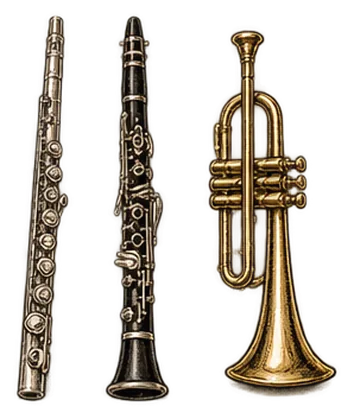
Sound comes from blowing a stream of air across the embouchure hole [3], so a lot depends on the shape of the top lip. One music retailer's beginner guide prefers a flute student without a pronounced "tear drop" point in the middle of the top lip, and with even teeth and no strong overbite [4]. Arms need to be long enough to hold the flute out to the side without strain [4].
Clarinet
The fingers cover open tone holes directly, so they need to seal fully. Very flexible, double-jointed fingers make that harder [4]. It uses a single reed, and the same retailer lists it as one of the better choices for students in braces [4].
Saxophone
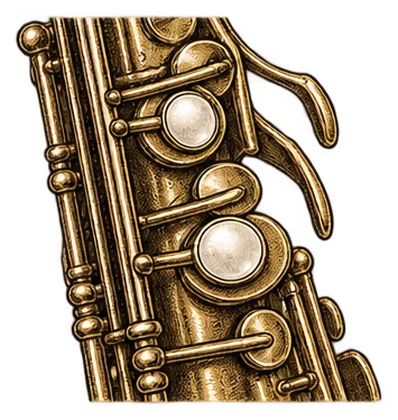
Like clarinet, a single-reed instrument that tends to suit students with orthodontics, and a slight overbite or underbite is usually fine [4]. Larger hands are a plus [4].
Oboe and bassoon
Both use a double reed. The oboe reed is often called the part that makes the instrument hard, and beginners rarely make their own [5]. The bassoon accepts a wide range of lip, jaw and teeth shapes, but size counts: the left hand has a wide stretch between the middle and ring fingers, and the student must cover the holes fully [6]. Short-reach bassoons are built for smaller hands [7].
Trumpet
Thin to medium lips tend to settle into a trumpet embouchure more easily, and a slight overbite is fine, but an underbite is a problem [4]. The right hand needs to move three fingers independently on the valves [4].
Horn
The horn has the smallest mouthpiece of any brass instrument, and students with thick lips may find it harder to set up a controlled embouchure at first [8]. The bigger hurdle is the ear. In the range beginners play, the available notes sit close together, so it is easy to land a second or third away from the intended pitch [8].
Trombone
The slide has seven positions [9], and students need arms long enough to reach the outer ones. It is common for beginners not to reach them yet [9]. Grip extenders exist for that, though they change how the instrument handles [9].
Euphonium and tuba
Lung capacity is the biggest factor for tuba, and building it can take a year or more [10]. Size is less of an issue than it looks: many schools use half or three-quarter size tubas, and the instrument can rest on the leg or on a stand [10]. Hand spread is the one real size concern [10].
Comparison table
| Instrument | Reed or mouthpiece | Physical points | With braces | Rental tier in one US district |
|---|---|---|---|---|
| Flute | None, air across a hole | Top lip shape, even teeth | Wax on brackets is common | $30 to $45 a month |
| Clarinet | Single reed | Fingers must seal open holes | Good choice | $30 to $45 a month |
| Alto sax | Single reed | Larger hands help | Good choice | $50 to $80 a month |
| Oboe | Double reed | Finger coordination | Reed players adapt fastest | School-provided |
| Bassoon | Double reed | Hand stretch, size | Reed players adapt fastest | School-provided |
| Trumpet | Brass mouthpiece | Thin to medium lips, no underbite | Slowest to adapt | $30 to $45 a month |
| Horn | Smallest brass mouthpiece | Strong ear for pitch | Slowest to adapt | School-provided |
| Trombone | Brass mouthpiece | Arm length for outer positions | Slowest to adapt | $30 to $45 a month |
| Euphonium, tuba | Brass mouthpiece | Air capacity, hand spread | Slowest to adapt | School-provided |
The rental tiers come from one Nevada school district's band page [11]. The braces column comes from a survey of wind players in orthodontic treatment [12], and the physical points from the sections above.
Braces
Braces are common in beginning band, and they are not a reason to skip it. In a survey of wind players in braces, brass players had more trouble than woodwind players. Reed woodwind players usually adjusted within a month, while brass players took one to three months on average [12]. Wax on the brackets was the most popular fix [12]. Trumpet players in braces may feel pain, and wax or a mouthguard on the teeth helps [13].
If braces are coming in the next year or two, that is worth telling the director when instruments are assigned.
Rent, buy, and what you keep paying for
Rent-to-own is the usual path. In one Nevada district, the approximate rate for flute, clarinet, trumpet and trombone was $30 to $45 a month, with saxes and larger instruments around $50 to $80 [11]. Some online rental programs apply all rental payments toward buying the instrument and have no minimum term [14]. Read the contract for how long it takes to own the instrument and what happens if the student quits.
Many schools own the big or unusual instruments. That same Nevada district provides oboe, bassoon, bass clarinet, tenor and bari sax, horn, euphonium, tuba and percussion, and families who need a school instrument pay $50 for the year [11].
Ongoing costs depend on the family:
- Reeds. One Alberta school's cost sheet expects one or two reeds a month, more at the start. It listed a clarinet reed at $1.25 and an oboe or bassoon reed at $13.00 [15]. The exact prices will differ where you live, but the gap of roughly ten to one between single and double reeds holds up as a planning number.
- Valve oil. The same sheet puts a bottle at about $2 and says it should last the year [15].
- Care kits. It lists a start-up maintenance kit at about $20 [15].
How schools usually assign instruments
Directors use several kinds of information. A widely used method from the Standard of Excellence band series suggests a music aptitude test, a listening session where students pick their favorite sounds without seeing the instruments, a check of physical traits, a look at eye-hand coordination, and input from the classroom teacher and parents [2]. Flute, oboe, clarinet, bassoon and percussion are rated as needing high coordination, and the other winds moderate [2].
Some programs put extra conditions on oboe and horn. One school's beginning band sheet asks for a good ear and a strong academic record for both, and strongly advises weekly private lessons [16]. Double reeds are often added later: one music retailer's advice to directors is to start them with students who already have a year on another woodwind [17].
Instruments that need players
Some sections run short almost everywhere, and a student who is willing to play one of them gets something for it.
- Oboe and bassoon. There are not enough double reed players worldwide, and nearly all schools struggle to find them [18].
- Horn. A University of Alberta music educator has seen fewer school band students playing horn, partly because it seems hard at the start and partly because students do not know much about it [19].
- Euphonium and tuba. Many teachers struggle to recruit low brass students [20].
The practical payoff is that these are often the school-owned instruments, which can drop the cost of band to a yearly fee [11]. They also tend to be the parts with fewer people on them, so each player matters more. Low brass players in small groups get pulled out of the back row and given melodies [20]. Bassoon is also a common switch later: flute and sax players often make the move easily because their embouchures are round and flexible [6].
Worked example: braces and a small budget
A sixth grader just got braces, likes the sound of both trumpet and clarinet, and the family wants to keep the year's band costs around $400.
- Braces. Brass players in braces took one to three months to adjust, reed woodwind players usually under one [12]. That tips toward clarinet or sax.
- Rental. In the Nevada district's price ranges, a clarinet at $30 to $45 a month comes to $270 to $405 over nine months. An alto sax at $50 to $80 comes to $450 to $720 [11]. Only the clarinet fits the budget.
- Reeds. At one or two reeds a month and $1.25 each on the Alberta list, nine months of clarinet reeds runs about $11 to $23 [15]. Prices vary, so treat that as a floor.
- The school-instrument option. If the director needs a bassoonist and the student's hands are big enough, a school bassoon at $50 for the year [11] becomes the cheapest path, and reed players adapt to braces quickly [12]. Double reeds cost more: at $13 each, the same one or two a month runs $117 to $234 [15]. Many directors also start bassoon only after a year on another woodwind [17].
- Decision. Clarinet now, with the year's total near $280 to $430 depending on the store's rate, and a conversation with the director about bassoon in seventh grade.
Common mistakes
- Choosing on looks or a friend's pick alone. Sound preference and physical fit predict a better first year [1][2].
- Avoiding band because of braces. Players adapt, and wax handles most of the discomfort [12].
- Buying a cheap online instrument without asking the director. Ask which brands the local repair shop will service before buying.
- Skipping a school-owned instrument because it was not the first choice. It is often the cheapest way into band and a section that needs you.
- Forgetting the supplies line. Reeds, oil and a care kit are small monthly costs, but double reeds change the math.
Before the first lesson, print the chart for the instrument from the printables page and look at the first five notes. For a clarinet beginner, those notes are in the low register section of the clarinet chart, where the chart notes that beginners usually start.
Sources
- Selecting the Right Band or Orchestra Instrument, Beginband
- Matching Students to Instruments, Bruce Pearson, Kjos Band News
- Western concert flute, Wikipedia
- Beginner Instrument Guide, Paige's Music
- Oboe, Wikipedia
- Bassoon Pedagogy, Day One Handout, Jason Worzbyt, The Midwest Clinic via Bandworld
- A Strong Start for Bassoonists, Ryan D. Romine, The Instrumentalist
- The Horn, Brass Techniques and Pedagogy, Brian Weidner, PALNI Open Press
- The Trombone, Brass Techniques and Pedagogy, Brian Weidner, PALNI Open Press
- The Tuba, Brass Techniques and Pedagogy, Brian Weidner, PALNI Open Press
- Local Music Stores and Rental Info/Pricing, Washoe County School District
- The Effects of Orthodontic Appliances on Wind-Instrument Players, N.A. Raney, Journal of Clinical Orthodontics
- The Trumpet, Brass Techniques and Pedagogy, Brian Weidner, PALNI Open Press
- Sweetwater Rental Flyer 2025, Sweetwater
- Instrument Cost and Maintenance Information, Rocky View Schools
- Beginning Band Instruments, FHPS
- It's Time To Add Some Double Reeds, Amanda Meyer, Palen Music
- Australian oboe and bassoon players in drastic decline, Celia Craig, Limelight
- On the Dilemma of Horns, Tom Dust, The Instrumentalist
- Recruiting and Retaining Low Brass Players, Heather McWilliams, Yamaha Music Australia