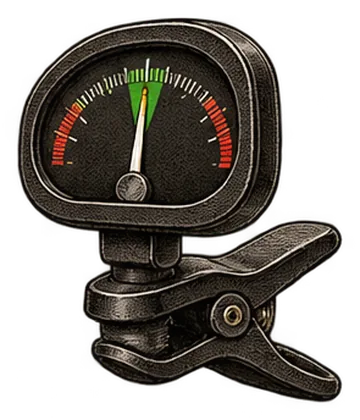
A tuner tells you one thing: how far the note you are playing sits from a reference pitch. It cannot tell if your instrument is still cold, if you were biting, or if that one note is always sharp on your horn. The tuner is accurate. Your job is to give it an honest note and then make a sensible adjustment.
The reference: A = 440
The international standard sets the A above middle C (A4) at 440 Hz [1]. That pitch was agreed at a conference in London in 1939, adopted by the International Organization for Standardization in 1955, and formalized as ISO 16 in 1975 [2]. Band instruments are built around A440, sometimes A442 [3], and a few orchestras deliberately tune a little higher [2]. Unless your director says otherwise, check that the tuner's calibration reads 440.
What cents are
Tuners show how far off you are in cents. An equal-tempered half step is 100 cents, and an octave is 1200 [4]. So a reading of -15 means you are 15 hundredths of a half step flat. A plus sign means sharp.
How close is close enough? Under good conditions, listeners can notice a pitch difference of about 5 to 6 cents [4]. One saxophone pedagogue suggests marking any note that averages more than 5 cents off when you map your instrument's tendencies [5]. That makes ±5 a sensible target for a tuning note.
Which tuning note your section plays
Concert bands traditionally tune to concert B♭, because most band instruments are pitched in B♭ [6]. Orchestras tune to A, partly because every string instrument has an A string [6].
Some directors use more than one note. One approach assigns concert F to horns, clarinets and bassoons; concert A to flutes, oboes and saxophones; and concert B♭ to trumpets, trombones, euphoniums and BB♭ tubas, choosing each note by how open the instrument is on it [7].
Concert pitch and written pitch differ on transposing instruments. Here is what you actually read and finger for concert B♭:
| Instrument | Transposition | Written note for concert B♭ |
|---|---|---|
| Flute, oboe, trombone | Concert pitch | B♭ [8] |
| B♭ clarinet, B♭ trumpet | Written C sounds B♭ | C [8] |
| Alto saxophone | Sounds a major sixth lower [9] | G |
| Horn in F | Sounds a perfect fifth lower [8] | F |
For every other instrument, use the transposition chart.
Warm up before you tune
A cold instrument gives you a false reading. Pitch depends on the speed of sound in the air inside the bore, and that air changes as you play: warm breath raises the pitch, humidity raises it, and carbon dioxide from your breath lowers it [10]. The changes can add up to a 1% or larger shift in the speed of sound, and a half step is only about a 6% change [10]. Flutes and piccolos warm up fairly fast, while a tuba takes a long time to fill with breath [10]. Play for several minutes, then tune. A saxophone method makes the same point in plain words: warm up first, then tune to A440 [5].
Temperature and the room
About 6°C of air temperature change shifts the speed of sound by roughly 1%, which is around 17 cents [10]. Wind instruments go sharp as they get warmer, while strings and percussion go the other way [7]. A hot stage with bright lights can push a band higher as a concert goes on [7]. If you tuned in a cold band room and the auditorium is warm, expect to pull out a little.
What to adjust on each instrument
The rule is the same everywhere: making the instrument longer lowers the pitch, and shorter raises it.
Woodwinds
- Flute and piccolo: move the headjoint where it enters the body. A common starting point is fully in, then out about 1/8 to 3/16 inch. Push in to raise pitch, pull out to lower it. Don't use the crown for tuning [3].
- Clarinet: move the barrel at the upper joint, starting about 1/8 to 3/16 inch out. The mouthpiece stays all the way into the barrel [3].
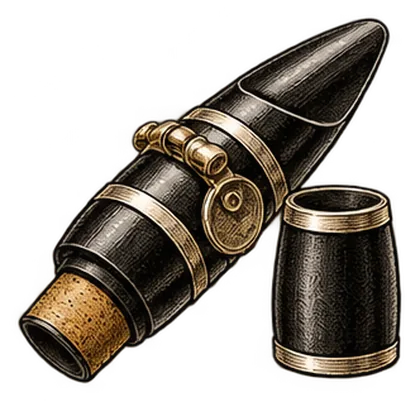
- Saxophone: move the mouthpiece on the neck cork. A starting point is about 3/4 inch onto the cork for alto and about 1 inch for tenor and baritone. Pushing on raises pitch; pulling off lowers it [3].
- Oboe: the reed's cork moves in or out of the reed well, and reed lengths differ by brand [3].
- Bassoon: the bocal moves in the receiver, but only a little, because the whisper key pad must still cover the bocal's vent. Bocals also come in different lengths [3].
Brass
The main tuning slide is usually the first bend of tubing after the mouthpiece [11]. Pull it out to lower the pitch, push it in to raise it [12].
- Trumpet: use the main tuning slide. Brass instruments are built to play a little sharp, so a common starting point is about 3/4 inch out [12].
- Trombone: use the main tuning slide, starting around 3/4 inch out. After that, each note can be adjusted with the hand slide [12].
- Horn: on a student double horn, start with the main slide and the F slide each pulled out about 1 to 1 1/8 inches. Tune the B♭ side with the main slide (thumb key down), then the F side with the F slide [13]. The right hand in the bell matters too: without it placed correctly, the horn plays sharp [13]. For true beginners, one horn teacher advises setting the slides by ear at room temperature rather than chasing an electronic tuner [13].
- Euphonium and tuba: same idea as trumpet, using the main tuning slide [11].
Notes that tend to be out of tune
Tuning one note does not tune every note [12]. Each instrument has notes that lean sharp or flat.
Trumpet. Valve combinations get sharper as you add tubing, and 1-2-3 stays noticeably sharp even with the manufacturer's slide compromises [14]. That is why you extend the third valve slide on notes fingered 1-3 or 1-2-3, such as low D and low C♯ [11] [15]. Fourth-line D and fourth-space E♭ tend to be flat; since pulling a slide can only lower pitch, these get lipped up slightly [16]. See the trumpet chart for the fingerings involved.
Saxophone. Most saxophones run flat on third-space C♯ and sharp on fourth-line D, D♯ and E, and the palm-key notes from D to F run sharp too [5]. It is easier to bring a sharp note down with the embouchure than to push a flat note up [5]. The alto saxophone chart has the alternate fingerings that help on held notes.
Flute. On flute, leaving the thumb on the B♭ side makes third-octave F♯ very flat [17], so check your thumb before blaming the headjoint. Full fingerings are on the flute chart.
Worked example: alto sax reading -15 cents on concert B♭
Your band tunes to concert B♭. On alto, concert B♭ is written G, because the alto sounds a major sixth lower than written [9]. You play the written G in the middle of the staff, and the tuner shows B♭ with the needle at -15.
- Check the setup. Tuner calibrated to 440. You have played for at least five minutes, so the instrument is warm [10].
- Play it again properly. Hold the note for four slow counts at mezzo forte, with a straight tone and no vibrato [7]. Louder playing tends to pull a sax flat and softer playing tends to push it sharp [5], so a medium dynamic gives the fairest reading. Read the needle where it settles, not the first flicker.
- Interpret the number. -15 is about three times the noticeable threshold of 5 to 6 cents [4]. That is worth fixing.
- Adjust. The note is flat, so make the instrument shorter: push the mouthpiece a little further onto the cork [3]. Twist gently as you push, and move a small amount at a time.
- Retest. Play the same written G at the same dynamic. Say it now reads -4. That is inside ±5, so you are done with the tuning note.
- Spot-check one more note. Play fourth-line D. If it reads sharp now, that is the normal tendency for that note [5], and it is fixed by voicing, not by moving the mouthpiece back.
If your director tunes saxophones to concert A instead [7], the same steps apply to written F♯.
Common mistakes
- Tuning cold. The reading changes as the bore fills with breath [10]. Warm up first.
- Starting too sharp and pulling down. Directors often have players start flat and come up to pitch, since that is easier to judge [7].
- Tuning with vibrato. Use a straight tone [7].
- Clarinet mouthpiece pulled out of the barrel. Leave it all the way in and adjust the barrel [3].
- Flute crown used as a tuning knob. Use the headjoint [3].
- Moving the slide for every note. The tuning note sets the instrument. The rest is done with your ear, embouchure and alternate fingerings.
- Watching the tuner through rehearsal. A tuner is for private practice; in the ensemble, listen [16].
- Pushing or pulling a long way. Moving far from the normal setting changes the instrument's internal scale and creates new problems [3]. If you need a huge adjustment, check the mouthpiece, reed or slide position first.
On trumpet, once the tuning note is set, play low D with the third slide out and the same note with it in, while watching the tuner. Seeing how far it moves teaches the ear what those cents sound like.
Sources
- ISO 16:1975 Acoustics: Standard tuning frequency (Standard musical pitch), International Organization for Standardization
- A440 (pitch standard), Wikipedia
- Basic Tuning Tips for Woodwinds, Paige's Music
- Cent (music), Wikipedia
- Saxophone Intonation: Tendencies, Voicing, Embouchure, and Alternate Fingerings, DANSR
- Why do orchestras tune to an 'A'?, Classic FM
- Mastering Intonation and Balance, The Instrumentalist
- Transposing instrument, Wikipedia
- Alto saxophone, Wikipedia
- 'Warming up' a wind instrument, Music Acoustics, UNSW Sydney
- Slides & Valves: Tuning Your Brass Instrument, The Music Studio
- Basic Tuning Tips for Brass Instruments, Paige's Music
- Tuning Horns, The Instrumentalist
- Why the Math Doesn't Add Up, Brass Pedagogy, James Madison University
- Trumpet, Wikipedia
- Trumpet Intonation, The Instrumentalist
- To Thumb B-Flat or Not to Thumb B-Flat, Texas Tech University Flute Studio