A fingering chart gives one fingering per note because that is the one you should learn first. Turn the page in any method book, though, and the same B♭ shows up three different ways. Those extra fingerings are not tricks. Each one exists because it solves a specific problem.
Why alternate fingerings exist
There are three reasons, and most alternates serve at least one of them.
Technical ease. The goal is efficient motion. One saxophone teacher's rule is to keep motion in one hand when possible, and to avoid fingerings that make you press some keys while lifting others at the same instant [1]. Every time two hands have to move together, there is a chance one arrives early and a stray note sounds in between.
Intonation. On a trumpet, any note fingered 1-2 can also be played with valve 3 alone, because each lowers the pitch a step and a half, and players switch for facility or to fix tuning [2]. On woodwinds, closing more keys lowers a note's pitch and opening keys raises it, which is why a slightly different fingering can fix a sharp or flat note on a long tone [3].
Tone. Some fingerings sound better than others for the same pitch. The oboe's forked F, for example, tends to sound muted or fuzzy next to the regular F [4]. On saxophone, bis B♭ is usually the most resonant B♭ among the left-hand notes, which makes it a strong choice for slow, lyrical lines [1].
Widely taught alternates by instrument
Clarinet
The left and right pinky keys give you two ways to play low E/F and clarion B/C. The rule is to alternate hands when several pinky notes come in a row, and to avoid sliding one pinky between keys, which is hard to do cleanly at speed [5]. In an E major scale, for example, play low E with the right pinky, F♯ with the left, then G♯ with the right [5]. When only one pinky note appears, pick the hand that has to move next in the passage anyway [5].
Throat B♭ (written B♭4, played with the A key and register key) is often called the clarinet's most troublesome note. For long notes, many teachers use the Bonade fingering: add the left second and third fingers, put all the right-hand fingers down, and add the low F key, which brings the pitch down [6]. For a fast A to B♭ trill, finger A and use the second side key from the top instead [6].
See the full clarinet chart for both pinky options on each note.
Saxophone
Saxophone has three B♭ fingerings in common use.
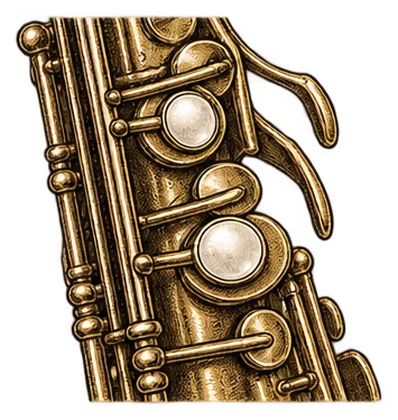
- Bis B♭ (sometimes called button B♭): this works well when B♭ is in the key signature, since you can leave it on [7]. It is best for leaps into and out of B♭ from A♭ or G [1].
- Side B♭: finger A and add the side B♭ key [7]. This is the choice for chromatic A, A♯, B, and for A to B♭ trills [1].
- 1 and 4, or 1 and 5: B♭ fingered with the left first finger plus a right-hand finger. These are fast in certain technical spots, such as F to A♯ to B, but have less resonance than bis [1].
Side C adds one side key to a regular B, so it is made for B to C and back to B [7]. Avoid it in plain chromatic scales, and never trill to side C from bis B♭: the result sits close to a quarter tone flat [1].
Chromatic F♯ (play F and add the side F♯ key) is useful in any chromatic run through F♯, but avoid it when F♯ moves to D or D♯ [1]. The alto saxophone chart shows each of these keys.
Flute
Flute has three standard B♭ fingerings [8]:
- Thumb B♭ is the first choice for B♭ or A♯ wherever B♮ isn't right next to it. It is especially useful in flat keys, except G♭ major and E♭ minor.
- Lever B♭ (finger B and press the side lever) is for B♭ next to B♮ when the neighboring note doesn't use the right index finger, as in G, B♭, B♮.
- 1 and 1 B♭ (add the right index finger) is for B♭ next to B♮ when the neighbor does use the right index finger, as in F, B♭, B♮.
Sliding the left thumb between thumb B♭ and B♮ at speed tends to sound uneven [8]. Leaving the thumb on the B♭ side also makes third-octave F♯ very flat [8]. The flute chart has all three.
Oboe
The regular right F should be used whenever possible, since it matches the surrounding tone best [4]. It only works when the notes before and after it don't use the right ring finger on its hole; otherwise the finger has to slide and an extra note sounds [4]. Oboes with a left F key offer a second F that should sound the same as the right F on a well-adjusted instrument [4]. The forked F (usually played with the E♭ key added) is the fallback, and it tends to sound muted [4]. A common teaching order is right F first, then left F, then forked F [4]. See the oboe chart for all three.
Trumpet
Every valve combination is a compromise. Combinations get progressively sharper as valves are added, and 1-2-3 stays noticeably sharp even after manufacturers adjust the slide lengths [9]. That is why the third valve alone is a useful stand-in for 1-2 [2]. High A (written A5, above the staff) often sounds out of tune with 1-2, and the third valve alone is a common fix [10].
Upper-register alternates exist too. The Arban method lists 1-2-3 for high F♯ and 1-3 for high A, and warns that many of these substitutes are out of tune and need slide or lip adjustment [11]. Use them for fast passages and trills, not long held notes. The trumpet chart lists the standard fingering for each note.
Trombone
Trombone alternates are slide positions instead of keys. The goal is to keep positions close together so legato lines don't jerk and the arm doesn't waste motion [12]. Two widely taught examples: F above the bass staff (F4) in sharp 4th position instead of 1st, which can also save endurance in heavy music, and B♭3 in sharp 5th position for E♭ arpeggios [12]. In those E♭ patterns, though, skip the alternates if the line also contains E♮ [12]. An F attachment adds a second position for nearly every note above low E [12]. The trombone chart shows the standard positions.
Quick reference table
| Instrument | Note | Standard | Alternate | Use the alternate when |
|---|---|---|---|---|
| Clarinet | Low E/F, clarion B/C | Either pinky | Other pinky | Two pinky notes in a row [5] |
| Clarinet | Throat B♭ | A key + register | Bonade (add fingers + low F key) | Long, exposed notes [6] |
| Alto sax | B♭ | Bis | Side B♭ | Chromatic A, A♯, B; A to B♭ trills [1] |
| Alto sax | C | Front C | Side C | B to C and back [1] [7] |
| Alto sax | F♯ | Middle finger F♯ | Chromatic (side) F♯ | Chromatic runs, not before D or D♯ [1] |
| Flute | B♭ | Thumb B♭ | 1 and 1, or lever | B♭ next to B♮ [8] |
| Oboe | F | Right F | Left F, then forked | Right ring finger busy on neighbors [4] |
| Trumpet | Written A4, A5 | 1-2 | 3 | Facility or tuning [2] [10] |
| Trombone | F4 | 1st | Sharp 4th | Legato lines, endurance [12] |
| Trombone | B♭3 | 1st | Sharp 5th | E♭ arpeggios [12] |
Worked example: a chromatic line on alto saxophone
Here is a written passage for alto sax, all eighth notes at a moderate tempo:
E4, F4, F♯4, G4, G♯4, A4, A♯4, B4, C5, B4, C5, B4, B♭4, A4
Work through it note by note.
- E4 and F4. Regular fingerings.
- F♯4. Keep the F fingering down and add the chromatic F♯ side key. You add one key instead of switching fingers, and the next note is G, not D or D♯, so the rule allows it [1].
- G4 and G♯4. Regular fingerings.
- A♯4. This is chromatic A, A♯, B, the textbook case for side B♭: hold A, tap the side key with the right hand [1].
- B4, C5, B4, C5, B4. Five notes rocking between B and C. Side C turns each change into one side key added to the B fingering [1] [7]. With front C, every change swaps fingers in the left hand.
- B4, B♭4, A4. Going down, use side B♭ again for the B to B♭ to A step [1].
The result: the left hand only has to move between the regular E, F, G, G♯, A and B fingerings, and every chromatic in-between note comes from a single side key. If the same line were slow and ended on a held B♭, you would switch that last B♭ to bis for its fuller sound [1].
Once the fingerings are chosen, pencil them into the part (a small "S" above the note works) so you play them the same way every time.
Common mistakes
- Using one B♭ for everything. Side B♭ handles quick B♭ to B♮ moves better than bis, and bis is better for lyrical lines [1] [7]. Pick per passage.
- Trilling from bis B♭ to side C. The C comes out badly flat [1].
- Using thumb B♭ in chromatic flute passages. The thumb slide makes the line uneven [8].
- Leaving tuning-fix fingerings in fast music. For quick passages, standard fingerings with air and voicing adjustments usually work better than alternates chosen only for pitch [3].
- Sliding a clarinet pinky when you could alternate. Alternating hands takes priority over keeping motion in one hand [5].
- Trusting high trumpet alternates on held notes. Many are out of tune and need adjustment [11].
- Practicing the alternate only in the passage. Run it slowly in a scale first so the hand learns the move before it has to happen at tempo.
On sax, test side C and front C against a tuner on a long tone before a concert. If side C reads noticeably different on your instrument, save it for the B to C trills and fast figures it was built for.
Sources
- Alternate Fingerings: Utilizing Situational Rules to Simplify Difficult Passages, DANSR
- Trumpet, Wikipedia
- Saxophone Intonation: Tendencies, Voicing, Embouchure, and Alternate Fingerings, DANSR
- Information overload: oboe F fingerings, Bret Pimentel
- Those Pesky Pinkies: Strategies for Clarinetists, The Instrumentalist
- Alternate Fingerings for the Clarinet's Chalumeau Register, The Instrumentalist
- Saxophone Fingerings: The Ultimate Guide, Dawkes Music
- To Thumb B-Flat or Not to Thumb B-Flat, Texas Tech University Flute Studio
- Why the Math Doesn't Add Up, Brass Pedagogy, James Madison University
- Slides & Valves: Tuning Your Brass Instrument, The Music Studio
- Arban Complete Method for Trumpet, sample page 47, Hickey's Music
- Advantages of Alternate Slide Positions, BANDWORLD Magazine