
Trombone · bass clef
Trombone Slide Position Chart
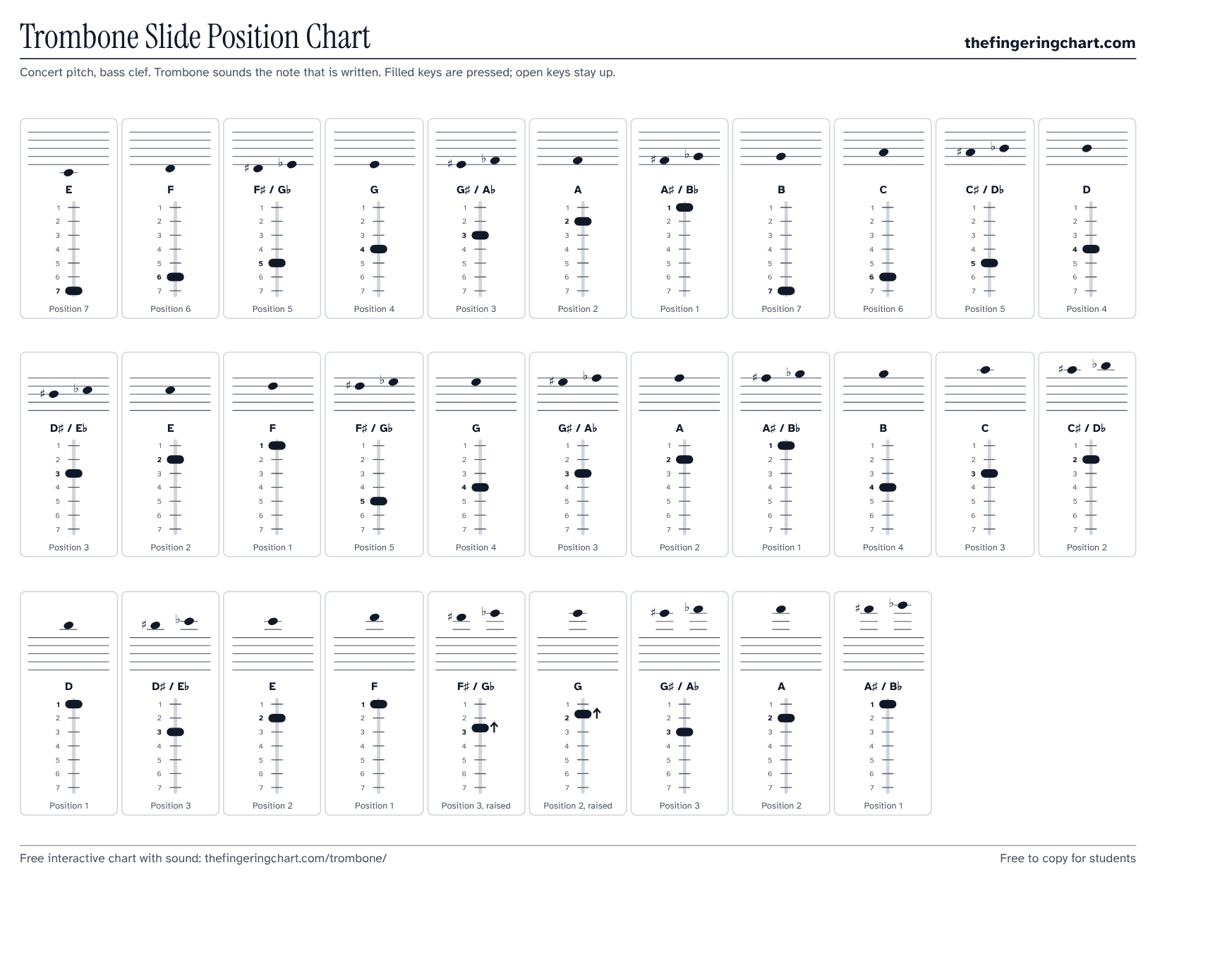
Trombone has a slide instead of valves, so this chart gives a position number for each note: 31 notes from low E to the B♭ above the bass staff. The range fits a tenor trombone without an F attachment, the kind most school bands start on. Where a note has a useful second position, the card shows that too. Trombone reads in concert pitch, in bass clef, so the play button sounds exactly the note you see.
Concert pitch, bass clef. Trombone sounds the note that is written.
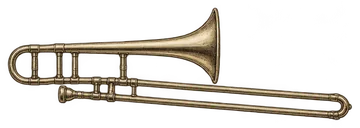
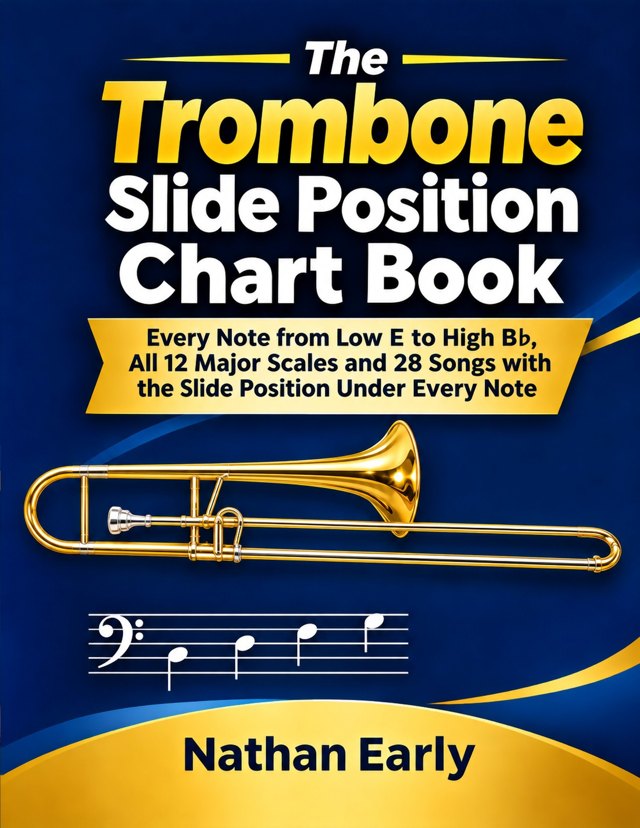 Free 66-page trombone book: every note, all 12 scales and 28 songs, ready to print. Get the free PDF
Low notes
Lowest note on a straight tenor trombone (no F attachment): the slide goes all the way out.
First position, slide all the way in.
Middle notes
Many bands tune to this F as well as to concert B♭.
The usual tuning note for brass: first position.
High notes
Bring the slide in slightly from the normal 3rd position spot.
Bring the slide in slightly from the normal 2nd position spot.
Free book
The Trombone Slide Position Chart Book
Every note from low E to high B♭ with its slide position, all 12 major scales, and 28 songs with the slide position under every note. 66 pages.
Download the free PDFPrint it yourself
- At home: print it double-sided (flip on the long edge) and put it in a binder or folder. On A4 paper, choose “fit to page”.
- At a print shop: take the file to Staples, Office Depot, FedEx Office or a local shop and ask for black-and-white, double-sided, coil bound.
- Teachers: you may print this book and copy it for yourself and your students. Please don’t sell it or post the file on other sites; link to this page.
Want a cover for the binder? Print the color cover page (it uses a lot of ink).
Positions are guesses
Use a tuner and the play button to find each position by ear, then notice where the slide is against the bell. Most players find 3rd just before the bell and 4th about even with it.
Notes smear between positions
Move the slide quickly and tongue at the moment it arrives. For slurs, use a soft "doo" tongue on each new note so the trombone does not glissando.
Gripping the slide with the whole hand
Hold the slide brace lightly between the thumb and first two fingers. A tight fist makes the slide jerky and slows down long moves to 6th and 7th.
- The slide drags. Clean the slide and inner tubes, then apply slide cream or slide oil with a water spray. The guide on cleaning and caring for brass covers the steps.
Range and where to start
From E2, the lowest note on a straight tenor trombone with the slide fully out, the cards climb to B♭4 above the staff. Trombone is non-transposing in bass clef: written E2 sounds E2, about 82 Hz, and the top B♭ sounds 466 Hz. Most beginners start on B♭ and F in first position (B♭2 and F3), then add D in fourth, C in sixth, and E♭ in third. Those five notes fill the first pages of many band books. The notes above F4 are in the advanced group and depend on embouchure strength as much as slide position. The guide on trombone slide positions covers the spacing between positions in more detail.
Worked example
Find F3, on the fourth line of the bass staff. Its card shows position 1, with the slide all the way in. Rest your right hand lightly on the slide brace and keep it in against the stops. Play with a relaxed, open sound. Tap play to hear the pitch, about 175 Hz. Now open the enlarged card and look at the alternate: 6th position. That gives the same F3 on a different partial, with the slide far out. You would never choose 6th for a long F3 on its own, but in a passage like C3 (6th) to F3 to C3, staying near 6th saves a long trip back up to first. Play both and compare them on a tuner: the 6th position version needs the slide placed carefully, so check it.
Common questions
How do I know where each trombone slide position is?
Position 1 is the slide fully in. Each position out lowers the note by a half step, and the distance between positions grows a little as you go out. Many players find 3rd just before the bell and 4th about even with it, though arm length and the instrument vary. Check each one with a tuner until your arm learns the spot.
Is trombone a transposing instrument?
No. Tenor trombone in bass clef reads concert pitch, so a written B♭ sounds concert B♭. That is why the chart's play button sounds the same note you see on the staff. Treble-clef trombone parts in brass bands are a different case and are read as B♭ transposing parts.
Do I need a trombone with an F attachment?
Not as a beginner. A straight tenor trombone plays everything on this chart, and most band music for the first few years stays in that range. An F attachment fills in most of the low notes between E2 and the pedal B♭ and gives shorter alternates for low C and B. Players often move to one in high school.
Keep going
Once the notes on this chart feel familiar, put them to work: the trombone scales page has all twelve major scales, and the easy trombone songs use the first notes most band books teach, and the trombone Christmas songs page has 14 carols with letter notes and words. For Veterans Day, Memorial Day and the Fourth of July, the trombone patriotic songs page has Taps and 6 more.
Printable trombone chart
 TromboneHow to Play Your First Notes on TromboneBuzz on the mouthpiece, find B♭ and F with the slide all the way in, then move out to 4th and 6th position for your first song.Read the guide →TromboneHow to Put a Trombone Together and Take It ApartThe slide lock, the angle and the bell lock, in the order that keeps the slide safe, and how to hold the trombone once it's together.Read the guide →
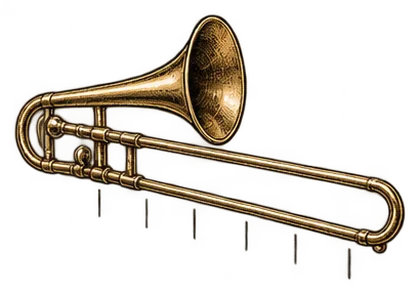 TromboneTrombone Slide Positions ExplainedEach position lowers the horn by a half step, and each one holds a whole stack of notes, which is why the same pitch can live in more than one place.Read the guide →
Gear for trombone players
- Trombone slide oil
- Trombone slide cream
- Trombone cleaning kit
- Trombone method book for beginners
- Clip-on chromatic tuner
As an Amazon Associate we earn from qualifying purchases. These are paid links that search Amazon; prices are the same for you. Disclosure.