Before the first note
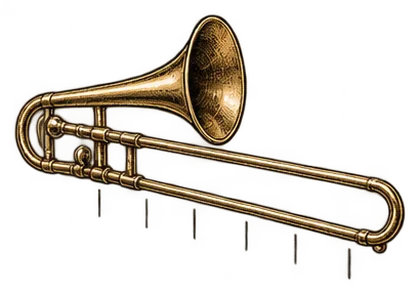
Get the trombone together and in your hands first. The trombone assembly guide covers the slide lock, the bell angle and how to hold it: the left hand carries the weight, and the right hand only steers the slide [3][6].
Two equipment notes for the first week:
- Mouthpiece. A method from Bandworld recommends a Bach 6½ AL, or an equivalent, for most beginners [4]. Whatever came in the case, stick with it. Sweetwater's advice is that beginners shouldn't switch to a different mouthpiece size or material [2].
- Trigger. If your trombone has a thumb trigger (an F-attachment), you can leave it alone for now. Weidner's brass textbook describes the F-attachment as a feature of more advanced trombones [3], and the Bandworld method says a trigger can be too heavy for a small student [4].
Step 1: Buzz without the trombone
A straight trombone has no keys or valves to make a note for you. Every sound starts as a buzz in your lips [1], and the slide decides which notes that buzz can find.
To get a free buzz, bring your lips together as if you were saying "M" [4]. Keep the corners of your mouth about as firm as a friendly handshake, then blow a fast, steady stream of air, the way you'd blow out candles [4]. Yamaha's guide adds one warning: don't puff out your cheeks or let your lips change shape while you blow [1].
Trombone notes are low, so the buzz should be slow and relaxed. Sweetwater puts the rule simply: the slower you buzz, the lower the pitch [2].
Step 2: Add the mouthpiece
Hold the mouthpiece by its thin end, between your thumb and first finger, and set it gently on your lips [5].
- Where. Centered left to right, and centered top to bottom as a starting point [4]. Weidner's textbook describes the ideal as roughly half on the top lip and half on the bottom, notes that many professionals end up closer to two thirds on top, and says the best placement is the one that gives that student the fullest tone [3].
- How hard. Only enough to seal the rim against your lips [4]. Yamaha also says not to press the mouthpiece firmly against your lips [1]. Pushing hard, especially into the bottom lip, stops one lip from buzzing at all [5].
- What counts as success. On the first try, Yamaha says it's enough if your lips vibrate and you hear a blowing sound [1].
Sweetwater suggests about a minute of mouthpiece buzzing before you play, which may help you match the note the trombone wants to play [2]. Two exercises from the Bandworld method work well here [4]:
- Sirens. Start low and slide the buzz up and back down like a siren.
- Tunes. Buzz a simple song you know on the mouthpiece alone, such as Mary Had a Little Lamb.
Step 3: First notes in first position
Put the mouthpiece in the trombone, take the slide lock off and leave the slide all the way in. That's first position.
Now take a full breath and blow the same buzz into the instrument. According to the Bandworld method, a steady buzz in first position will give you one of three notes [4]:
| Note | Where it is in bass clef | How it feels |
|---|---|---|
| B♭2 | Second line from the bottom | Low and wide. A slow, relaxed buzz |
| F3 | Fourth line | The middle of the three |
| B♭3 | Just above the top line | Higher. A faster buzz |
Use the trombone tuner to find out which one you played [4]. Trombone reads concert pitch, so the tuner shows the same note name that's on your music.
Then try to move between them without touching the slide. Speed up the buzz and the pitch jumps up to the next note; slow it down and it drops [2]. Yamaha's buzzing exercise uses three syllables for this: "toh" for low, "tay" for the middle and "tee" for high [1]. If B♭2 keeps popping up to F3, think "toh" and let the air slow down a little.
This is how every slide position works. Each one holds a stack of notes [3][4], and your lips and air pick which one sounds. The slide gives you seven of these stacks, each a half step lower than the one before [3].
Step 4: Start each note with the tongue
So far the notes have started with a puff of air. Next, start them with the tongue. The Bandworld method uses the syllable "dah," with the tip of the tongue touching the upper gums just above where they meet the teeth [4]. Keep your chin and jaw still while the tongue moves [4].
Practice it in four stages: say "dah dah dah dah" out loud, whisper it, tongue it without any voice, and then do it on the mouthpiece [4]. Now play four tongued B♭s in first position.
Step 5: Move the slide for D and C
Hold the slide brace between the tips of your right thumb, index finger and middle finger, and let the other two fingers curl toward your palm [3]. The wrist leads every move. The elbow joins in for longer moves, and the shoulder should barely move at all [3]. If you've been gripping the brace with your whole fist, practice moving between first and second position with the wrist alone [3].
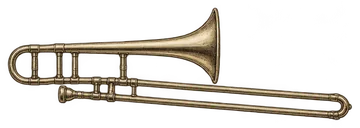
The positions aren't evenly spaced. They're about 3 inches apart near the top of the slide and just over 4 inches apart at the far end [3]. Don't feel for the bell with your fingers to find 3rd or 4th position. Weidner's textbook warns that it strains the wrist and gives a false sense of confidence; learn the spots by feel and by listening [3]. The slide positions guide has every position mapped to its notes.
Your first song needs two new positions:
| Note | Position | Where it is in bass clef |
|---|---|---|
| D3 | 4th | Middle line |
| C3 | 6th | Second space |
| B♭2 | 1st | Second line |
Worked example: a 10-minute first session
- Minute 0 to 1. Free buzz on "M", corners firm, cheeks flat [4][1].
- Minutes 1 to 3. Mouthpiece alone: a minute of steady buzzing [2], then three slow sirens [4].
- Minutes 3 to 5. First position. Play a long note and check it on the tuner. You'll most likely get B♭2 or F3 [4]. Rest, then try to reach the other one by changing the speed of the buzz [2].
- Minute 5 to 6. Four tongued B♭s on "dah" [4].
- Minutes 6 to 8. Slide out to 4th position for D3 and hold it. Then 6th position for C3. Keep the right hand loose and let the wrist lead [3]. Check both on the tuner, and nudge the slide if the needle sits off to one side, since the slide is how a trombonist tunes [3].
- Minutes 8 to 10. Play Hot Cross Buns. The site's trombone version uses exactly these three notes, D, C and B♭, so the slide goes 4th, 6th, 1st.
The jump from 6th back to 1st is the longest move in the song. The Bandworld method's rule is that the slide should move as fast from 1st to 6th as it does from 1st to 2nd [4]. Tongue each note on "dah" [4] and make the move quickly, so the slide is already in place when the next note starts.
When the sound isn't right
| What you hear | Likely cause | Try this |
|---|---|---|
| Only air, no buzz | Pressing too hard, not enough air, or the middle of the lips pinched shut [5] | Lighten the pressure, use more air and relax the center [5] |
| Air leaking at the corners | Corners too loose [5] | Firm the corners. Sirens build them up [5] |
| A fuzzy, thin sound | Too much pressure, or an opening between the lips that's too big [4] | Hold the mouthpiece lightly [4] |
| A smear between notes | The slide moving too slowly [4] | Move the slide faster, not the air slower [4][3] |
| High notes won't come | Mouthpiece sitting too low [4] | Move it up slightly [4] |
| Low notes won't come | Mouthpiece sitting too high [4] | Move it down slightly [4] |
If you can't reach 6th position comfortably, you're not alone: Weidner notes that beginners often can't reach the outer positions yet [3]. Seventh position, with the slide fully out, is the farthest [4]. The Bandworld method suggests pushing the right shoulder forward and opening the right hand to reach it [4].
Range comes slowly on trombone. Weidner's textbook says beginners often have a range of about an octave [3], so a first-week student playing B♭2 to B♭3 is right on schedule.
Common mistakes
- Pressing the mouthpiece in. It shuts down the buzz [1][5].
- Puffing the cheeks [1].
- A fist on the slide brace. Fingertips only, and let the wrist do the moving [3].
- Slow slide moves. The note smears into a glissando [3][4].
- Feeling for the bell to find 3rd and 4th [3].
- Moving the jaw to start a note. Only the tongue moves [4].
- Swapping mouthpieces in the first months [2].
- Practicing with a practice mute from the start. Weidner warns that practice mutes add back pressure that can cause bad habits [3].
Once D, C and B♭ feel steady, add two more notes: E♭3 in 3rd position and F3 back in 1st. With them you have the first five notes of the B♭ major scale, B♭, C, D, E♭ and F, in positions 1, 6, 4, 3 and 1. Mary Had a Little Lamb on the trombone songs page adds the F, and the trombone scales page has the rest of the scale.
Sources
- How to Play the Trombone, Yamaha Musical Instrument Guide
- Trombone Quickstart Guide, Sweetwater
- The Trombone, Brass Techniques and Pedagogy (Brian N. Weidner), PALNI Open Press
- A Trombone Experience (PDF), Bandworld
- Tone Production Fundamentals on the Mouthpiece, Brass Techniques and Pedagogy (Brian N. Weidner), PALNI Open Press
- Trombone Set-up, Brass Pedagogy, James Madison University