
Piccolo · treble clef
Piccolo Fingering Chart
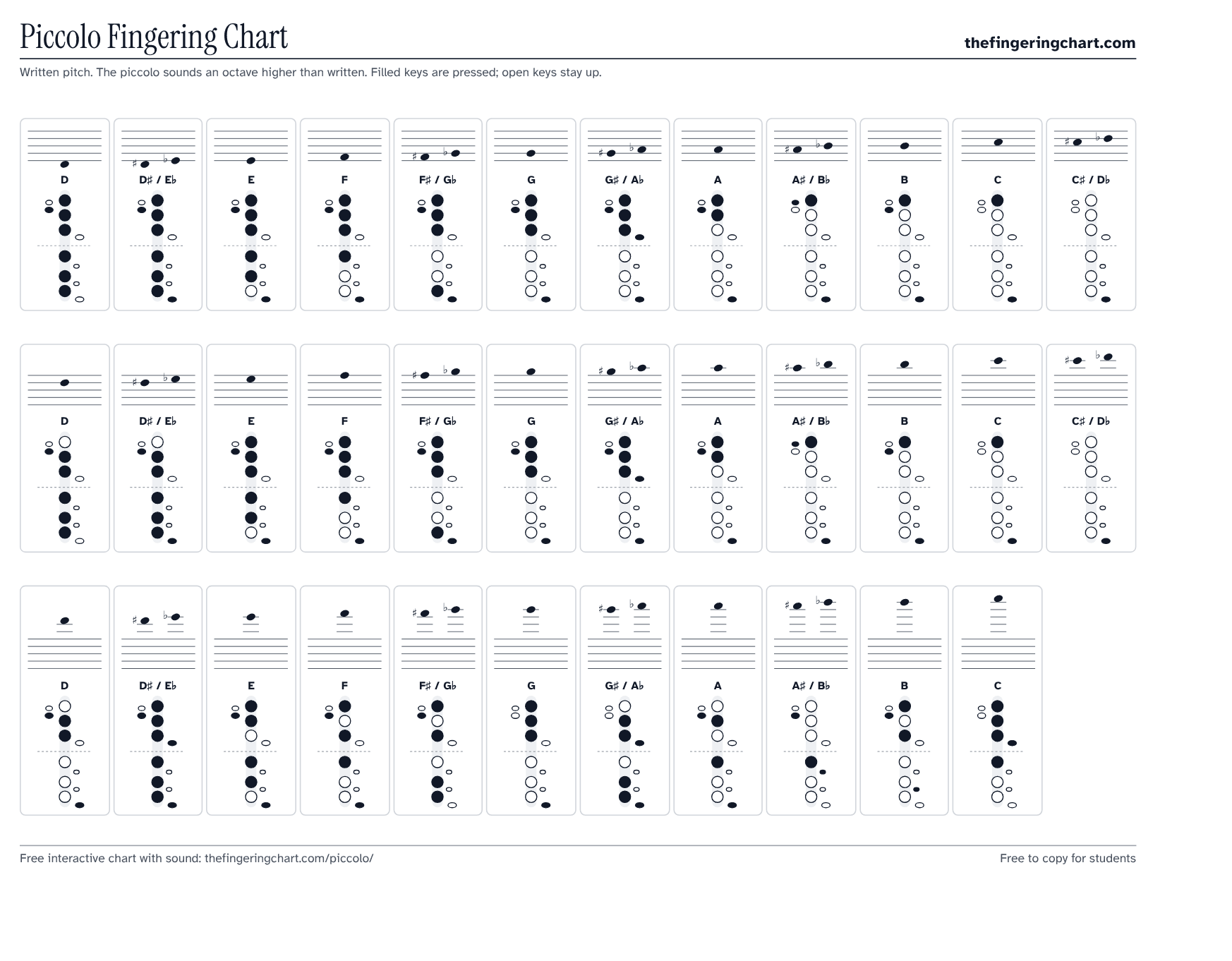
A piccolo plays the same fingerings as the flute for most of its range, which helps flutists who get handed one for marching season or a concert piece. This chart covers 35 notes from low D to written C7. The first two octaves match flute fingerings. Several notes in the third octave change, because the piccolo's smaller tube responds differently, and those cards show the piccolo version. Each card plays the real sounding pitch, one octave above what is written.
Written pitch. The piccolo sounds an octave higher than written.
 Free 78-page piccolo book: every note, all 12 scales and 28 songs, ready to print. Get the free PDF
First octave
Lowest note on the piccolo: cover every hole and use gentle air. The right pinky stays up.
Use the right ring finger, not the middle finger.
Left pinky presses the G♯ key.
Thumb B♭ sounds clearer and more in tune on piccolo than one-and-one.
The left thumb comes off.
Only the right pinky stays down; this note can sound weak, so keep the air focused.
Second octave
Like low D, but lift the left index finger.
Like low D♯, but lift the left index finger.
Uses the same fingering as low E; blow faster air.
Uses the same fingering as low F; blow faster air.
Uses the same fingering as low F♯; blow faster air.
Uses the same fingering as low G; blow faster air.
Uses the same fingering as low G♯; blow faster air.
Uses the same fingering as low A; blow faster air.
Same as the lower B♭; blow faster air. Thumb B♭ sounds clearer and more in tune on piccolo than one-and-one.
Uses the same fingering as the lower B; blow faster air.
Same fingering as the C in the staff (C5); blow faster air.
Pitch on this note varies from piccolo to piccolo, so check it with a tuner. If it is sharp, the right-hand-down alternate brings it down.
Third octave
Like the D in the staff (D5), but lift the right index, middle and ring fingers and put the pinky down.
Every finger down plus the G♯ key; not the same as the lower D♯ fingerings.
Left ring finger is lifted, unlike the lower E.
Left middle finger is lifted.
Piccolo F♯ uses the right middle and ring fingers with the pinky up; it responds better than the flute fingering.
Same as the lower G but with the thumb off.
Add the right middle and ring fingers to the flute fingering for better response and pitch.
Uses the first trill key; the right pinky lifts off the D♯ key.
Uses the second trill key; the right pinky lifts off the D♯ key.
Thumb off and right pinky up. Some players rest the pinky on the end of the piccolo without covering the opening.
Free book
The Piccolo Fingering Chart Book
Every note from low D to high C with its fingering, all 12 major scales, and 28 songs with the fingering under every note. 78 pages.
Download the free PDFPrint it yourself
- At home: print it double-sided (flip on the long edge) and put it in a binder or folder. On A4 paper, choose “fit to page”.
- At a print shop: take the file to Staples, Office Depot, FedEx Office or a local shop and ask for black-and-white, double-sided, coil bound.
- Teachers: you may print this book and copy it for yourself and your students. Please don’t sell it or post the file on other sites; link to this page.
Want a cover for the binder? Print the color cover page (it uses a lot of ink).
Upper notes are very sharp
Players often overblow on piccolo. Use less air than on flute, keep the lips relaxed, and pull the head joint out a few millimeters if the whole instrument is sharp.
Low D and E won't sound
The lowest notes need gentle, slow air and fully sealed holes. Check that the right pinky is up for low D, as the card shows.
Third-octave note cracks
Open that note's card and look for a piccolo fingering that differs from flute. Using the flute version is a common cause of unstable high notes.
Range and where to start
Written range on this chart is D4 to C7. Piccolo music is written an octave below where it sounds, so written D4 sounds D5, about 587 Hz, and written C7 sounds C8, the same C as the top key on a piano. The octave transposition keeps the music on the staff instead of buried in ledger lines. The play button gives the actual sounding pitch, so expect it to be high. Most students come to piccolo after a year or more on flute and start with second-octave notes such as A and B♭, which speak easily, rather than the lowest D and E.
Worked example
Tap the A5 card, written on the first ledger line above the treble staff. The diagram shows the left thumb on the B key, left index and middle fingers down, and the right pinky on D♯. That is the same fingering as the A an octave lower (A4). The only difference is the air: faster and more focused. This written A5 sounds A6, about 1760 Hz. If it cracks down to the lower A, the lip opening is probably too large, so make the aperture smaller rather than blowing harder. Check it on a tuner. Many piccolos run sharp in the upper register, and the usual fix is to relax the air speed slightly or adjust the head joint a little rather than pinching the lips.
Common questions
Is piccolo fingering the same as flute?
For the first two octaves, yes. A flutist can play most band piccolo parts with the fingers they already know. Some third-octave notes use different fingerings on piccolo because the flute versions can be sharp or hard to start. This chart marks those cards. The biggest adjustment is usually the embouchure, since the piccolo needs a smaller opening and less air.
Why is piccolo music written an octave lower than it sounds?
If piccolo parts were written at sounding pitch, almost every note would sit above the staff on a stack of ledger lines. Writing it an octave lower puts the music in the same place on the page as flute music, so flutists can read it easily. The written D4 on this chart sounds D5.
Can a beginner start on piccolo?
Band directors usually start students on flute and add piccolo later. The fingerings carry over, but the piccolo's tone and tuning are harder to control without some flute experience. A year or two on flute first makes the switch much easier. When you do switch, use the flute chart and this one side by side to spot the fingerings that change.
Keep going
Once the notes on this chart feel familiar, put them to work: the piccolo scales page has all twelve major scales, and the easy piccolo songs use the first notes most band books teach, and the piccolo Christmas songs page has 14 carols with letter notes and words. For Veterans Day, Memorial Day and the Fourth of July, the piccolo patriotic songs page has Taps and 6 more.
Printable piccolo chart
 FluteHow to Put a Flute Together and Take It ApartWhere your hands go on each of the three pieces, how to line them up, and a quick tuning check before the first song.Read the guide →
 FluteGetting a First Sound on the FluteStart on the headjoint alone, find where the air splits on the far edge of the hole, then carry that setup onto B, A and G.Read the guide →
 TheoryConcert Pitch vs Written PitchWhy a clarinet's C is a piano's B♭, how far each band instrument transposes, and how to move a melody or key signature from one to the other.Read the guide →
Gear for piccolo players
As an Amazon Associate we earn from qualifying purchases. These are paid links that search Amazon; prices are the same for you. Disclosure.