
Piccolo · treble clef
How to Play B♭ on Piccolo
B♭ on the piccolo is written on the middle line. It is the same note as A♯, so the fingering below works for both.
Sounds an octave higher
B♭
Press: thumb on the B♭ lever, left first finger and right pinky on the D♯ key.
Thumb B♭ sounds clearer and more in tune on piccolo than one-and-one.
Alternate fingering
Nearby notes
Left pinky presses the G♯ key.
The left thumb comes off.
About this note
On the piccolo this note is written as B♭. The piccolo sounds an octave higher than written. The sound you hear is B♭5, about 932 Hz.
Where you'll meet B♭
B♭ is in the key signature of these major keys: F major, B♭ major, E♭ major, A♭ major, D♭ major, G♭ major. If your music has one of those key signatures, every B is played as B♭ unless a natural sign cancels it. You can practice it in context with the piccolo scales.
Written B♭ on other instruments
If you switch instruments or help a section, here is the same written note on the other instruments on this site. A written note sounds at a different pitch on each transposing instrument.
| Instrument | Fingering | Sounds as |
|---|---|---|
| Alto sax | Press: left first finger, left second finger and side B♭ key. | concert D♭ |
| Baritone sax | Press: left first finger, left second finger and side B♭ key. | concert D♭ |
| Bass clarinet | Cover or press: register key (left thumb) and A key. | concert A♭ |
| Bassoon | Cover or press: whisper key, left first finger, left second finger, left third finger, right thumb B♭ key, right first finger and right second finger. | As written |
| Clarinet | Cover or press: register key (left thumb) and A key. | concert A♭ |
| Euphonium | Open (no valves). | As written |
| Flute | Press: left thumb on the B key, left first finger, right first finger and right pinky on the D♯ key. | As written |
| French horn | Valve 1. | concert E♭ |
| Mellophone | Valve 1. | concert E♭ |
| Oboe | Press: left first finger, left second finger and right first finger. | As written |
| Recorder | Cover or press: thumb hole, left first finger, left third finger and right first finger. | An octave higher than written |
| Soprano sax | Press: left first finger, left second finger and side B♭ key. | concert A♭ |
| Tenor sax | Press: left first finger, left second finger and side B♭ key. | concert A♭ |
| Trombone | Position 1. | As written |
| Trumpet | Valve 1. | concert A♭ |
| Tuba | Open (no valves). | As written |
Tips for playing it
Most flute sharps and flats have one standard fingering, but a few, such as B♭, have alternates using the thumb key or a trill key. Use whichever connects most smoothly to the next note.
Always check a new note against a tuner or a reference pitch. The play button above gives you the note to match.
See every note on one page in the piccolo fingering chart.
Getting there from the notes next to it
In music, this note is usually approached from a neighbor a half step away. Here is what changes on piccolo:
- Half step below: A4. 3 keys change from this note. Press: left thumb on the B key, left first finger, left second finger and right pinky on the D♯ key.
- Half step above: B4. 2 keys change from this note. Press: left thumb on the B key, left first finger and right pinky on the D♯ key.
Practice the move slowly between the two notes, back and forth, until both sound clean at the same volume.
Where you will play B♭4
Easy songs: Hot Cross Buns, Mary Had a Little Lamb, Twinkle Twinkle Little Star, Ode to Joy, Jingle Bells, Happy Birthday, When the Saints Go Marching In, Amazing Grace, Row, Row, Row Your Boat, London Bridge Is Falling Down, Frère Jacques.
Christmas carols: Jolly Old Saint Nicholas, Good King Wenceslas, Up on the Housetop, Away in a Manger, Auld Lang Syne, The First Noel, O Come, All Ye Faithful, Joy to the World, O Christmas Tree, We Wish You a Merry Christmas, Deck the Halls, Hark! The Herald Angels Sing, Angels We Have Heard on High, Silent Night.
Patriotic songs: Taps, Yankee Doodle, My Country, 'Tis of Thee, Battle Hymn of the Republic, Anchors Aweigh.
Major scales: B♭, E♭, F, A♭, D♭, G♭, B. It is also in the chromatic scale.
Common questions
What does this note sound like on piccolo?
It sounds an octave higher than written. The play button plays the sounding pitch.
Is there more than one way to finger it?
Yes. The alternate is shown above; most players use the main fingering for long notes and the alternate in fast passages where it saves a finger move.
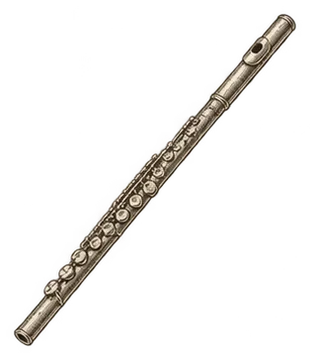 FluteHow to Put a Flute Together and Take It ApartWhere your hands go on each of the three pieces, how to line them up, and a quick tuning check before the first song.Read the guide →
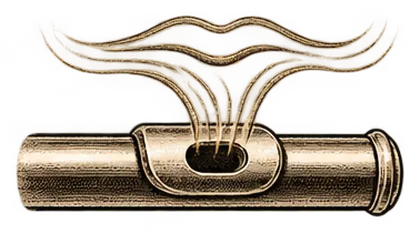 FluteGetting a First Sound on the FluteStart on the headjoint alone, find where the air splits on the far edge of the hole, then carry that setup onto B, A and G.Read the guide →