
Trombone · bass clef
Patriotic Songs for Trombone
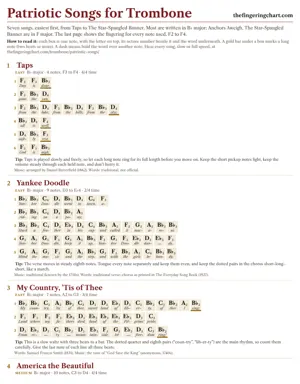
Seven patriotic songs for trombone, easiest first, from Taps to The Star-Spangled Banner, with the letter names, the words and the fingering for every note. Tap a letter to see how to finger it, or press play and follow the highlighted notes.
Five of them are written in B♭ major for trombone, the same concert key the rest of the band uses; Anchors Aweigh, The Star-Spangled Banner are in F major to keep their range comfortable.
Printable PDF of all 7 songs US Letter, 4 pages, free to copy for students
Taps
Tip: Taps is played slowly and freely, so let each long note ring for its full length before you move on. Keep the short pickup notes light, keep the volume steady through each held note, and don’t hurry it.
The slide uses 1 position in this tune (1). The longest single move is 0 positions; move the slide quickly and smoothly there so the note does not smear.
The widest jump is a sixth, down from D4 to F3 in line 3.
Music: arranged by Daniel Butterfield (1862). Words: traditional, not official. About this song
Fingering chart for every note, line by line
Line 1
Line 2
Line 3
Line 4
Line 5
Line 6
Yankee Doodle
Tip: The verse moves in steady eighth notes. Tongue every note separately and keep them even, and keep the dotted pairs in the chorus short-long-short, like a march.
The slide uses 4 positions in this tune (1, 2, 3, 4). The longest single move is 3 positions; move the slide quickly and smoothly there so the note does not smear.
The widest jump is a fifth, down from C4 to F3 in line 1.
Music: traditional (known by the 1750s). Words: traditional verse; chorus as printed in The Everyday Song Book (1927). About this song
Fingering chart for every note, line by line
Line 1
Line 2
Line 3
Line 4
Line 5
My Country, 'Tis of Thee
Tip: This is a slow waltz with three beats to a bar. The dotted quarter and eighth pairs (“coun-try”, “lib-er-ty”) are the main rhythm, so count them carefully. Give the last note of each line all three beats.
The slide uses 5 positions in this tune (1, 2, 3, 4, 6). The longest single move is 5 positions; move the slide quickly and smoothly there so the note does not smear.
The widest jump is a fifth, up from B♭2 to F3 in line 2.
Words: Samuel Francis Smith (1831). Music: the tune of “God Save the King” (anonymous, 1740s). About this song
Fingering chart for every note, line by line
Line 1
Line 2
Line 3
America the Beautiful
Tip: Every line starts with the same short-long pattern (“O beau-ti-ful”). Keep the eighth note short, then breathe at the end of each line so the next one starts on time.
The slide uses 5 positions in this tune (1, 2, 3, 4, 6). The longest single move is 5 positions; move the slide quickly and smoothly there so the note does not smear.
The widest jump is an octave, up from C3 to C4 in line 2.
One note falls outside the key: B3 in line 2, played in position 4.
Words: Katharine Lee Bates (1895, revised 1911). Music: “Materna” by Samuel A. Ward (1882). About this song
Fingering chart for every note, line by line
Line 1
Line 2
Line 3
Line 4
Battle Hymn of the Republic
Tip: The verse is almost all dotted-eighth and sixteenth pairs. Make the long note of each pair three times as long as the short one, not a lazy swing. Then let the Glory, glory, hallelujah chorus broaden out.
The slide uses 4 positions in this tune (1, 2, 3, 4). The longest single move is 3 positions; move the slide quickly and smoothly there so the note does not smear.
Words: Julia Ward Howe (1861). Music: “John Brown’s Body”, from a camp-meeting tune credited to William Steffe (1856). About this song
Fingering chart for every note, line by line
Line 1
Line 2
Line 3
Line 4
Line 5
Line 6
Anchors Aweigh
Tip: It is a march counted in two big beats per bar, so the whole notes are long. Hold “boys”, “aweigh” and “foam” for their full length. Then tongue the quick notes near the end (“here’s wishing you a happy voyage”) lightly.
The slide uses 5 positions in this tune (1, 2, 4, 6, 7). The longest single move is 6 positions; move the slide quickly and smoothly there so the note does not smear.
The widest jump is a sixth, down from A3 to C3 in line 4.
One note falls outside the key: B2 in line 2, played in position 7.
Music: Charles A. Zimmermann (1906). Words of this verse: 1926 revision of Alfred Hart Miles’s 1906 lyrics. About this song
Fingering chart for every note, line by line
Line 1
Line 2
Line 3
Line 4
The Star-Spangled Banner
Tip: The anthem covers the widest range on this page, so practice the high part (“And the rockets’ red glare”) and the last line slowly before playing it straight through. Take a full breath before each of those lines.
The slide uses 6 positions in this tune (1, 2, 3, 4, 6, 7). The longest single move is 5 positions; move the slide quickly and smoothly there so the note does not smear.
The widest jump is a tenth, up from F2 to A3 in line 5.
One note falls outside the key: B2 in line 1, played in position 7.
Words: Francis Scott Key (1814). Music: “To Anacreon in Heaven” by John Stafford Smith (c. 1773). Service version of 1918. About this song
Fingering chart for every note, line by line
Line 1
Line 2
Line 3
Line 4
Line 5
Line 6
Line 7
Line 8
These 18 cards cover every note in all 7 songs on trombone, from F2 up to F4. Tap a card to see it larger with the fingering in words, alternates and a play button. The full trombone fingering chart has every other note.
First position, slide all the way in.
Many bands tune to this F as well as to concert B♭.
The usual tuning note for brass: first position.
| Song | Level | Written key | Notes | Range | Slide |
|---|---|---|---|---|---|
| Taps | Easy | B♭ | 4 | F3 to F4 | Positions 1 |
| Yankee Doodle | Easy | B♭ | 9 | D3 to E♭4 | Positions 1, 2, 3, 4 |
| My Country, 'Tis of Thee | Easy | B♭ | 7 | A2 to G3 | Positions 1, 2, 3, 4, 6 |
| America the Beautiful | Medium | B♭ | 10 | C3 to D4 | Positions 1, 2, 3, 4, 6 |
| Battle Hymn of the Republic | Medium | B♭ | 8 | D3 to D4 | Positions 1, 2, 3, 4 |
| Anchors Aweigh | Harder | F | 11 | F2 to A3 | Positions 1, 2, 4, 6, 7 |
| The Star-Spangled Banner | Harder | F | 11 | F2 to C4 | Positions 1, 2, 3, 4, 6, 7 |
Getting the songs ready
Across all the songs you need positions 1, 2, 3, 4, 6, 7. The table shows which ones each song uses, so you can warm up those positions first. Move the slide quickly between notes and keep the air going through the move.
Start with Taps and work down; the order goes from the fewest notes and the simplest rhythm to the widest range. Learn each song in three passes: listen to it with the play button while you read the letters, play it with the Slow button, then play along at full speed. Most people know these tunes already, so sing the line in your head as you play; it is the quickest way to get the rhythm right.
For an outdoor ceremony, keep the instrument in its case until shortly before you play, then blow warm air through it and tune once it is warm. Cold tubing plays flat and valve oil thickens in the cold, so oil the valves beforehand. In summer heat, the pitch goes sharp instead, so tune again after a few minutes in the sun.
Printable patriotic songs for trombone
Common questions
How do you play Taps on trombone?
Taps uses four notes on trombone: F3, B♭3, D4 and F4. Taps was written for a bugle, which has only one set of natural notes, so on trombone the whole call stays in first position and changes only with your air and lips. Play it slowly, with long notes held for their full length; at a ceremony it is usually played by a single player.
What is the easiest patriotic song to play on trombone?
Taps. On trombone it uses 4 different notes, from F3 to F4. After that, try Yankee Doodle, which moves in small steps.
Is The Star-Spangled Banner hard to play on trombone?
It is the hardest song on the page. On trombone it spans a twelfth, from F2 to C4, and the high notes come in the second half (“And the rockets’ red glare”). Learn the last two lines slowly first.
Can a trombone play these with other instruments?
Yes. Every band instrument page here uses the same concert key for each song (concert B♭ (concert F for Anchors Aweigh and The Star-Spangled Banner)), so a trombone and, say, a trumpet reading their own pages play in tune together. The chart on the main patriotic songs page lists the written key for every instrument.
Why aren't God Bless America and the Air Force song here?
They are still under copyright: God Bless America was published in 1938 and the U.S. Air Force song in 1939. Every song on this page had its music and words published before 1931, so they are in the public domain in the United States.
For ceremonies and parades on trombone
As an Amazon Associate we earn from qualifying purchases. These are paid links that search Amazon; prices are the same for you. Disclosure.
For the holidays, the trombone Christmas songs page has 14 carols in the same format.
 PracticeA Home Practice Routine That Actually WorksHow long to practice, what to do with each minute, and how to take a hard passage from slow to performance tempo in a week.Read the guide →
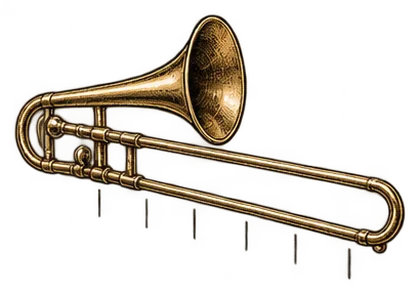 TromboneTrombone Slide Positions ExplainedEach position lowers the horn by a half step, and each one holds a whole stack of notes, which is why the same pitch can live in more than one place.Read the guide →