Most students who say they "practiced" spent the time playing the parts they already like. Real progress comes from a short plan, a metronome, and the honesty to stay on the measures that are still messy.
How long and how often
Researchers who study expert musicians use the term deliberate practice for work that is focused and effortful, aimed at an explicit goal, set at the right difficulty, and checked with feedback [1]. The famous 1993 study of violin students linked accumulated practice to skill level. A 2019 replication found that practice still explained about 26% of the differences in performance, a real effect but smaller than the original claim [1]. So practice matters a lot, and the kind of practice matters as much as the hours.
Spread it out. A review of research on music practice concludes that practice distributed over time is generally more efficient than massed practice, and that relatively short sessions tend to beat long ones because intense concentration is limited, even for experts [2]. One band director puts it in practical terms: four hours spread across a week does more good than the same four hours crammed into one sitting [3].
For a middle school player, that means 20 minutes a day, five or six days a week, is a better plan than a two-hour Sunday. High school players and adults returning to an instrument can move to 30 minutes, or two 20-minute sessions on busy days.
The 20-minute routine
| Minutes | Block | What to do |
|---|---|---|
| 0 to 3 | Long tones | 4 to 6 notes held for 8 counts each, soft to loud and back |
| 3 to 6 | Flexibility | Brass: lip slurs on open and 2nd valve. Woodwinds: finger patterns across the break or between register keys |
| 6 to 9 | Scale | One scale your band is using this month, slurred once, tongued once |
| 9 to 15 | Hard passage | The one spot that falls apart, slowed with a metronome |
| 15 to 19 | Band music | Play the piece through the section you just fixed |
| 19 to 20 | Fun piece | Something you chose, no stopping |
The 30-minute routine
| Minutes | Block | What to do |
|---|---|---|
| 0 to 4 | Long tones | Same as above, with a tuner on the stand for a few of them |
| 4 to 8 | Flexibility | Lip slurs or finger exercises, with the metronome on |
| 8 to 12 | Scales | Two scales, plus the arpeggio of each |
| 12 to 20 | Hard passage | Chunk, slow down, and chain (see below) |
| 20 to 22 | Break | Stand up, put the instrument down, drink water |
| 22 to 28 | Band music or solo | Full sections, at a tempo you can play cleanly |
| 28 to 30 | Fun piece | Your own choice |
The break is not wasted time. A published 30-minute routine from a band director builds in a 4-minute rest between the hard work and the lighter material [3]. It also fits what research says about attention: uninterrupted, intense concentration only lasts so long [2].
Scales are the fastest win in any routine. The scale pages for clarinet and trumpet show every fingering, and most other instruments have the same page on the site. For the fun piece slot, the flute song list is a good place to find something that sits in the easy range.
How to practice a hard passage
Chunk it
Break the problem down until each piece is small enough to play correctly on the first or second try. For a longer piece, that might mean three or four large sections, each treated like its own solo, with no moving on until the current one is ready [4]. For a technical run, the chunk might be one beat. Include the dynamics and articulation from the start, because adding them later means relearning the passage [4].
Slow it down with the metronome
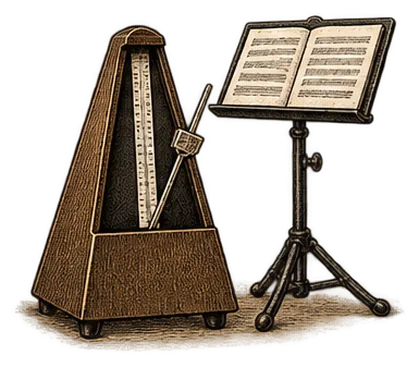
Yamaha's teaching guide gives a clear method: start well below the written tempo, play the difficult bar three or four times in a row, and if it is clean, raise the metronome by 5 bpm [4]. If you stumble, stay at that tempo or a couple of clicks slower. If you can't get pitch, rhythm, and dynamics right about four times out of five, drop back 15 to 20 bpm and rebuild [4]. A focused session like this usually takes only 10 to 15 minutes [4].
"Slow" means slow enough to get every element right every time: the notes, the rhythm, the tongue and slur markings, the dynamics, and the phrase shape [3]. Ten repetitions that fix the rhythm while the articulation stays wrong are ten repetitions of the wrong articulation [3].
Chain it backward
Backward chaining starts at the end. Practice the last two notes until they are smooth, then add the note before them, and keep adding one note at a time toward the beginning [5]. Every new note leads into material you already own, so the passage gets stronger toward the end instead of falling apart there [5]. Forward chaining (first two notes, then add the next) is the same idea in the other direction, and it is worth trying both [5].
Worked example: a 4-bar run from 60 to 120 BPM in a week
Say your band piece has a four-bar sixteenth-note run in 4/4, marked quarter note = 120. At 120 you are playing 8 notes per second. At 60 it is 4 per second, which most students can handle with good fingers.
Day 1. Backward-chain bar 4 at 60: last two notes, then the last three, until the whole bar is clean. Then bars 3 and 4 together. Take each tempo step of 5 bpm only after three or four clean runs in a row. Finish around 70 to 75 with bars 3 and 4 solid.
Day 2. Start 5 to 10 clicks under yesterday's best, at 65. Chain bars 1 and 2 the same way, then play all four bars. Aim to reach 85.
Day 3. Start at 80. Full run, four bars, stepping up by 5 to 95.
Day 4. Start at 90. Suppose you get to 100 and bar 2 falls apart twice. That is the signal to drop 15 to 20 bpm, to about 85, play bar 2 alone until it is clean, then climb back. Ending the day at 100 is fine.
Day 5. Start at 95, reach 110. Now play the measure before the run and the measure after it too, so the entrance and exit are practiced.
Day 6. Start at 105, reach 120. Do three clean runs at 120 and stop for the day while it's still good.
Day 7. Start at 110, then 120 three times. Play the whole section of the band piece at 120 with the run in context.
The plan has slack built in. If you reach 120 on Day 5, spend Days 6 and 7 at 120 and also at 115, so you have a cushion when nerves speed you up in rehearsal.
Keep a practice log
A log turns "I practiced" into data. One band director admits that his own old assignments, written as "practice scales," never said which scales, slurred or tongued, or at what tempo [3]. Write it down specifically:
- Date and minutes
- What you worked on (bar numbers, scale names)
- Metronome start and finish tempo for the hard passage
- One sentence on what went wrong and what to try tomorrow
That last line matters most. Research on music practice describes students who wrote self-evaluations and set their own goals reporting more independence and better planning, and a two-week practice diary study found that higher-achieving students practiced more [2]. A printable log sheet is in the printables section.
Set up a practice space
The setup that works is simple: a chair without arms, a real music stand at eye level, a tuner, a metronome, and good light, in a room without a TV or phone in reach [3]. Keep the case open and the stand up between sessions if your household allows it. When the instrument is already assembled, starting takes 20 seconds instead of five minutes.
Use a straight-backed chair so you sit the way you do in band. A phone can be the metronome and tuner, but put it in airplane mode first.
Common mistakes
- Starting from the top every time. The first page gets polished and the hard spot near the end never improves. Go straight to the problem bars after the warm-up.
- Raising the tempo after one good run. One clean take can be luck. Wait for three or four in a row before the next 5 bpm step [4].
- Practicing only one element. Fixing rhythm while ignoring articulation teaches the wrong articulation [3].
- Long, rare sessions. One 90-minute session on Saturday gives less than three 30-minute ones spread through the week [2] [3].
- Skipping long tones. They are the only block that works purely on sound. Three minutes is enough, but do them.
- No written goal. If the log entry reads "band music," you can't tell tomorrow whether anything changed.
- Leaving the metronome off once the passage feels good. Check it at the target tempo before rehearsal. Many runs that feel like 120 turn out to be 112 with a rush in the last bar.
When the run finally goes clean at 120, set the metronome to 60 and play it once more with the click on beats 2 and 4 only. If it still lines up, the tempo is yours and not the metronome's.
Sources
- The role of deliberate practice in expert performance: revisiting Ericsson, Krampe & Tesch-Römer (1993), Royal Society Open Science via PubMed Central
- Practicing, chapter in The Science and Psychology of Music Performance, UCL Discovery
- Answers About Practice, The Instrumentalist
- Practice Effectively, Yamaha Music Educators Hub
- Chaining, Practicing Guitar (Read the Docs)