What the number means
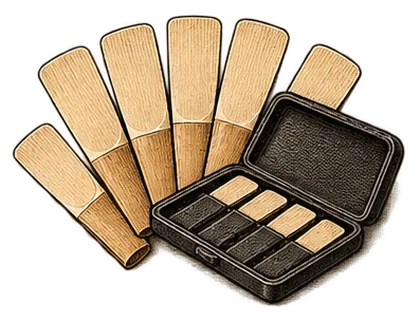
Clarinet and saxophone reeds are almost all cut from Arundo donax, a giant cane, or made from a synthetic material [1]. The number on the box rates stiffness. Most makers use a scale from about 1 (softest) to 5 (hardest). The scale isn't standardized, so strengths vary from one manufacturer to the next [1].
A stiffer reed takes more air and a firmer embouchure to get vibrating, and it gives back more resistance. D'Addario frames the goal as a reed with enough resistance to shape the sound without making you fight the instrument [2]. It also says it is a common mistake to treat the number as a skill rating, as if moving up proves you're better [2].
The number only makes sense alongside the mouthpiece. Wider tip openings usually pair with softer reeds, and narrower tip openings with harder ones [2]. If a teacher changes your mouthpiece, expect to revisit the reed too.
Why a 3 isn't always a 3
Brands measure and cut differently, and even lines from one company don't line up. Both Vandoren and D'Addario publish comparison charts, and reading them side by side is the fastest way to switch brands without guessing.
Some matches from D'Addario's current chart [3]:
| Instrument | Reed | Lines up with |
|---|---|---|
| B♭ clarinet | Rico 2.5 | Vandoren Traditional 2.0 |
| B♭ clarinet | Rico 3.0 | Vandoren Traditional 2.5 |
| Saxophone | Rico 3.5 | Vandoren Traditional 3.0 |
| Saxophone | Vandoren Java 3.0 | Vandoren Traditional 2.5 |
So a student who has been playing a box of Rico 3 clarinet reeds and buys Vandoren Traditional 3 is moving to a noticeably harder reed. In Vandoren terms, the Rico 3 sits nearer a Traditional 2½.
Vandoren's own comparison index shows the same thing inside a single brand [4]. On saxophone, its Java 4 sits at about the same stiffness as a Traditional 3½, and a Java 3 sits near a Traditional 2½ [4]. The two companies' charts don't agree on every row, which says something about how loose the numbers are. Treat any chart as a starting point, then trust what you hear.
Some lines split the numbers further. D'Addario's Select Jazz saxophone reeds come in soft, medium and hard versions of each strength from 2 to 4, such as 3S, 3M and 3H [5]. Many lines also offer a plus strength such as 3.5+, which falls between 3½ and 4 [3].
Signs a reed is too soft
- The tone turns bright, thin or honky [2][6].
- Pitch wanders and is hard to control [2].
- High notes pinch shut. On clarinet, if notes from high G upward won't respond and you don't even hear air, the reed is closing against the mouthpiece. The usual fix is a half strength harder [7].
- Squeaks show up more often. A reed tip that's too thin is a known cause of high-pitched squeaks [8].
A reed that is too soft can close the mouthpiece and stop resonating altogether [9].
Signs a reed is too hard
- The sound is airy or fuzzy, and you have to strain [2][10].
- You tire quickly. A reed that is too hard won't resonate if the player can't make it vibrate [9].
One caution from a Midwest Clinic session for band teachers: an airy sound can also come from a reed sitting off-center on the mouthpiece [6]. Check placement before you change strength. A small sliver of the mouthpiece tip should show above the reed. Raise the reed slightly if it plays too easy, and lower it a hair if it's too hard or buzzy [10].
Typical beginner strengths
Most beginners start soft because softer reeds let air through more easily [2]. A Yamaha educator article says most clarinet students should start on a 2½ [7]. One Midwest Clinic handout suggests a 2½ for about two weeks, then a move to 3 once embouchures are stable [6]. After the first few months, *The Instrumentalist* recommends medium reeds: 3 or 3½ on saxophone and 3½ on clarinet [11].
Those numbers come from teachers using particular brands. A Rico 2½ and a Vandoren 2½ are different reeds (see the table above). If your teacher names a strength, ask which brand they mean.
Reed cuts
The cut is how the cane is shaped: where it's thick, where it's thin, and how much bark is left on. Vandoren's diagrams show reeds as contour maps where every point on a line has the same thickness. A more pointed arch means a thicker spine and heart with thinner sides, and the company makes seven saxophone cuts ranging from bright to dark [4].
The most common split you'll see in a store is filed versus unfiled. D'Addario describes its Rico line as an unfiled cut for added support, aimed at beginners [12]. Its Royal line adds a French file to the same basic design for more resonance and clarity [13]. D'Addario says Rico's thinner vamp helps produce a clear tone early, while its Reserve reeds are cut from a thicker blank for a richer, warmer sound [10].
Synthetic or cane
Synthetic reeds are often more durable and more consistent than cane, though some players still prefer cane's sound [1]. D'Addario says its VENN synthetic reed is built for about 3 to 6 months of playing with proper tip care. It costs about what a box of ten cane reeds does and can last as long as three boxes [14].
For a student who loses reeds, chips them on music stands or forgets to wet them, a synthetic reed can save a lot of frustration. Synthetics have their own strength charts, and their numbers don't match cane either [3].
Rotating, storing, and how long reeds last
Keep four or more reeds in rotation and play a different one each day [11]. Vandoren gives the same advice and warns against getting used to one reed. As a favorite weakens, the rest start to feel too hard [15].
Break in new reeds gently. *The Instrumentalist* suggests about five minutes per reed on each of the first three days, avoiding extreme registers and dynamics [11]. Vandoren also says to play new reeds for a few minutes a day before normal use [15]. Wet them in the mouth for a few minutes or in a little water [11]. Vandoren notes that saliva acidity can wear reeds faster, but it also warns against leaving a reed in water too long [15].
After playing, wipe the reed between thumb and finger and put it in a holder [11]. Reeds that dry out completely tend to warp [11], and flat storage limits warping [15].
As for lifespan, a reed played hard from day one with no break-in can be finished in about a week and a half. A reed that's broken in and rotated lasts six to eight weeks [11]. The signs it's done are pitch that swings sharp and flat, a thinning tone, and having to bite harder to control it [11]. Reeds also lose strength as they age, so an old reed feels softer than its label [10].
Worked example: a flat, buzzy sound
A second-year clarinetist has been on Rico 2 reeds since the start of beginning band. The sound has turned buzzy, notes sag flat when she plays louder, and the upper clarion notes come out thin. Throat tones sound fine.
- Rule out an old reed. She has been playing the same reed for a month. Worn reeds drift sharp and flat and thin out [11], so she plays three fresh Rico 2s from a new box. The buzzy, sagging sound is the same on all three.
- Check placement. A sliver of tip shows above the reed, and the reed is centered [10]. Nothing to change there.
- Run the high-note test. She tries high G and the notes above it. They pinch off with no air sound behind them, which points to the reed closing up [7].
- Pick the next strength. The fix is a half size harder [7], so she buys a box of Rico 2½. Her teacher, who uses Vandoren, mentions Vandoren Traditional 2. According to D'Addario's chart that is about the same stiffness as a Rico 2½ [3]. Either box would be a half step up for her.
- Break them in and rotate. Five minutes each, three days, four reeds in the rotation [11].
- Recheck in two weeks. If the upper clarion now speaks and the pitch holds when she plays loud, she stays there. If it still closes up, she tries a 3 the next time she buys reeds.
She does not jump from a 2 to a 3½. That skips the useful steps, and the new reed will probably sound airy and wear her out [2].
Common mistakes
- Moving up because the number feels like a grade. Strength doesn't equal skill [2].
- Changing brands at the same number. A Vandoren 3 and a Rico 3 aren't the same stiffness [3].
- Playing one reed until it chips. By then it has been soft for weeks [11].
- Ignoring the room. Vandoren suggests a slightly softer reed in a dry, resonant, air-conditioned hall and a slightly harder one outdoors or in a damp, dead room [15].
- Blaming the reed for a mouthpiece or setup issue. Check reed placement first [6][10].
For tenor saxophone, the same logic holds with bigger reeds. Use the tenor saxophone chart and alto saxophone chart to pick test notes at the top of the staff, and the clarinet chart for the clarion notes in the example. If high notes on clarinet stay stubborn after the reed change, the problem may be the register crossing itself. That's covered in crossing the break.
Sources
- Reed (mouthpiece), Wikipedia
- How to Choose Your Reed Strength, D'Addario Woodwinds
- Clarinet and Saxophone Reed Comparison Chart, D'Addario Woodwinds
- Reeds Technical Elements (Reed Comparison Index), Vandoren
- Select Jazz Filed Tenor Saxophone Reeds, D'Addario
- Woodwind embouchure and beginner tone, Lorie Enloe, Midwest Clinic
- Clarinet Pedagogy, Yamaha Music Educator Hub
- Mysteries, Myths and Misconceptions, Charles West, Midwest Clinic
- Saxophones: Frequently Asked Questions, Thomann Online Expert
- Reed Anatomy, D'Addario Woodwinds
- Caring for Single Reeds, Andrew J. Allen, The Instrumentalist
- Rico by D'Addario B♭ Clarinet Reeds, D'Addario
- Royal by D'Addario Alto Saxophone Reeds, D'Addario
- How long do VENN reeds last?, D'Addario Support
- FAQ & Tips, Vandoren