Before the first note
On a trumpet the sound starts at your lips. Yamaha's guide puts it plainly: the player makes the trumpet sound by buzzing the lips [8]. So this guide starts where the sound starts, with the lips, then the mouthpiece, then the trumpet. James Madison University's brass pedagogy pages set the first goal low on purpose: any sound made by the lips vibrating, not a particular note [6].
Two quick checks on the trumpet first:
- Mouthpiece. Slide it into the leadpipe gently. Never smack it in, because a mouthpiece jammed in that way can get stuck and need a repair shop to remove it [2]. Most student trumpets come with a 7C mouthpiece [2].
- Valves. They should move freely. Sweetwater's advice is to keep them oiled at all times and to press each valve quickly a few times after oiling to work the oil through [2]. The brass care guide shows how to oil them.
Step 1: Buzz without the trumpet
Close your lips the way you would to hum. One textbook cue is to say "hmmmmpf," starting with your mouth open and closing your lips just until they touch [4]. Yamaha's educator site suggests saying the letter M [7].
Now buzz. JMU's method is to hold one hand in front of your mouth, which catches spit and gives the air something to aim at. Set your lips, breathe in through your nose, and blow [6]. Keep the opening between the lips as relaxed as you can so the lips are free to vibrate [6]. If nothing happens, firm up the corners of your mouth and press your lips together a little more, or start with your lips slightly apart and slowly bring them together while you blow [6]. The best buzz is the one that takes the least effort [6].
Keep your cheeks flat while you do this. Yamaha says not to puff them out and to keep the lips in the same lightly closed position [1].
Step 2: Buzz on the mouthpiece alone
Hold the mouthpiece by its shank, the thin end, between your thumb and first finger, and set it gently on your lips [4].
- Where it goes. Centered left to right, with roughly half on the top lip and half on the bottom [3]. Ideally the top and bottom edges of the rim rest just outside the red part of the lips [3]. Yamaha's guide also says the center of the lips [1].
- How hard. Barely at all. The mouthpiece should rest on your lips, not be pushed into them [4]. Pressing hard lets air leak out around the rim, and then the buzz can't form [4]. Yamaha gives the same warning: don't press the mouthpiece firmly against your lips [1].
- What you're after. A full, steady buzz. A fuzzy, thin buzz usually means not enough air, and beginners tend to underestimate how much air it takes [4].
Two mouthpiece exercises from Weidner's brass textbook work well on day one. The first is 4 on, 4 off: buzz a comfortable pitch for 4 counts, rest for 4 counts, and repeat [4]. The second is sirens: start on a low buzz and speed up the air so the pitch slides up, then slow the air to bring it back down. Keep the opening of your lips the same size so the air alone moves the pitch [4].
The mouthpiece does more than make noise. It gives your lips a surface and some resistance to push against, which helps center and focus the sound [6].
Step 3: Hold the trumpet
Get the grip right before the first note. A poor hand position leads to tension and to pressing the mouthpiece too hard [5].
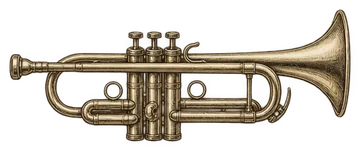
Left hand. It carries the weight of the trumpet [3]. Wrap it around the valve casing, put your thumb in the saddle on the first valve slide, and put your ring finger (or middle finger, if that's more comfortable) in the ring on the third valve slide [3][2][5]. Don't wrap your fingers underneath that slide. It adds tension and keeps the slide from moving [3].
Right hand. Your thumb sits loosely under the leadpipe, between the first and second valve casings [3][5]. The index, middle and ring fingers rest on valves 1, 2 and 3 [2][5]. Keep the fingers arched so only the fingertips touch the valve buttons [3]. The pinky sits on top of the little hook on the leadpipe or floats free, but it doesn't go inside the hook [3][5]. With the pinky in the hook, it's easy to pull the trumpet into your face [5].
Both hands should look like a relaxed letter C [3][2]. Sit or stand up straight and point the trumpet straight out, level with the floor [2]. Letting the bell droop toward the floor puts strain on the wrists [2].
Step 4: First notes: C, D and E
Put the mouthpiece in, set it on your lips exactly where it was in Step 2, and blow the same buzz into the trumpet with no valves pressed. The note you're looking for is open C, the C on the first ledger line below the treble staff (C4). Beginners usually play somewhere between that C and the C an octave above it [3].
JMU's course lists low concert B♭ or concert F as typical first notes [5]. On a B♭ trumpet those are the written C and G you read on your music, both played with no valves. The concert pitch guide explains why the names differ.
Open C and open G use the same fingering, so the trumpet can jump to G when you meant C. Faster air raises the pitch [4]. Yamaha's buzzing exercise uses the syllables "toh" for low, "tay" for middle and "tee" for high [1], so if a G pops out when you wanted C, think "toh" and slow the air. The guide to playing higher explains how one fingering can give several notes.
Then add the next two notes up, D and E. The valves add extra tubing, about 160 mm for the first valve, 70 mm for the second and 270 mm for the third, and a longer tube gives a lower note [8].
| Note | Valves | Watch for |
|---|---|---|
| C4 | none (open) | Same fingering as G above it |
| D4 | 1 and 3 | Naturally sharp. Push the third valve slide out about 1/3 inch with your left ring finger [3] |
| E4 | 1 and 2 | The chart also lists valve 3 alone as an alternate |
Weidner's textbook says the third valve slide should be taught as part of the fingering for low D, because without it the note is badly out of tune [3]. The trumpet chart shows every fingering, with a card you can tap to hear each note.
Worked example: a 10-minute first session
- Minute 0 to 1. Buzz with no mouthpiece, one hand in front of your mouth [6].
- Minutes 1 to 3. Mouthpiece alone. Do 4 on, 4 off on a comfortable pitch, then three slow sirens [4].
- Minute 3 to 4. Mouthpiece into the trumpet, gently [2]. Set your hands: left thumb in the saddle, left ring finger in the third slide ring, right pinky on top of the hook [3].
- Minutes 4 to 6. Open C, held as long as it's comfortable. Then take the trumpet off your face and rest for as long as you played, the same on-and-off pattern Weidner uses for long tones [4].
- Minutes 6 to 8. D with valves 1 and 3, third slide pushed out about 1/3 inch [3], then E with valves 1 and 2. Check them on the trumpet tuner.
- Minutes 8 to 10. Play Hot Cross Buns. The site's trumpet version uses exactly these three notes: E, D, C.
If a step doesn't work, go back one step and get it working there first.
When only air comes out
Weidner's textbook lists the usual reasons [4]:
- Too much pressure. The rim is pushed into the lips, air escapes around it, and nothing buzzes. Let the mouthpiece rest [4].
- One lip doing all the work. Pressing harder into one lip, usually the bottom one, stops it from buzzing fully [4].
- Pinching the middle. Puckering or squeezing the center of the lips blocks the air [4].
- Puffed cheeks. Control comes from the corners of the mouth, and the cheeks stay flat [4][1].
- Not enough air. A fuzzy buzz is often an air problem, not a lip problem [4].
If none of those fix it, go back to the hum-and-buzz setup from Step 1 and rebuild from there [6].
Common mistakes
- Smacking the mouthpiece in. It can stick [2].
- Pinky in the finger hook. It invites pulling the trumpet into your face [5].
- Flat fingers. Pressing the valves with the finger joints instead of the tips takes more movement and tightens the hand [3].
- Left fingers wrapped under the third slide. It stops the slide from moving [3].
- Bell pointing at the floor. It stresses the wrists [2].
- Leaving the third slide in on low D [3].
- Rushing to high notes. Weidner warns that pushing for range too early leads to pressure, throat strain and pinching [3].
- Emptying the water key during a quiet part [2].
Students with braces may find trumpet painful [3], so tell your band director if it hurts. And if your first low D reads sharp on the tuner, that's the trumpet, not you: Weidner calls low D and C♯ extremely sharp, and the fix is the third valve slide, out about 1/3 inch for D and about 1/2 inch for C♯ [3].
Sources
- How to Play the Trumpet, Yamaha Musical Instrument Guide
- Trumpet Quickstart Guide, Sweetwater
- The Trumpet, Brass Techniques and Pedagogy (Brian N. Weidner), LibreTexts
- Tone Production Fundamentals on the Mouthpiece, Brass Techniques and Pedagogy (Brian N. Weidner), PALNI Open Press
- Trumpet Set-up, Brass Pedagogy, James Madison University
- Free Buzzing, Brass Pedagogy, James Madison University
- Trumpet Pedagogy, Yamaha Music
- The Structure of the Trumpet: How Does the Trumpet Generate Sound?, Yamaha Musical Instrument Guide