A clarinet, flute or saxophone never goes in water [1]. (Brass is a different story, covered in brass care.) All three are covered in pads, and water ruins pads [1][2]. So the daily job is getting moisture out before the case closes. Moisture left inside a flute wears out its pads faster [2], and on a wooden clarinet, water sitting at the joints can lead to cracks [3].
After every session
Two steps apply to all three. First, if there's a reed, take it off, wipe it and put it in a reed guard or case [4][5]. A reed left on the mouthpiece can grow mold [1]. Reed rotation is covered in choosing reed strength.
Second, blot the pads that stay shut when you aren't pressing them, using cleaning paper or a corner of the swab, because they trap water [6]. Yamaha's list is the trill keys on clarinet, the rear G♯ and trill keys on flute, and the G♯ and C♯ keys on saxophone [6].
Clarinet
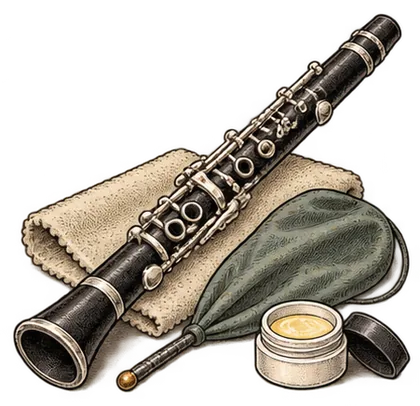
Use a pull-through swab. Silk absorbs well and is less likely to jam than cheap felt [7]. With the mouthpiece off, drop the weight into the bell and pull the swab out through the barrel. Buffet recommends that direction because a swab pulled the other way can catch on a tube inside the upper joint [8]. If it snags, pull slowly instead of yanking [3]. Keep going until the bore is dry [8].
A small swab goes through the mouthpiece from the cork end, with care around the tip [3]. Go easy, though. D'Addario notes that swabbing gradually wears the inside of a mouthpiece [5]. Then take the clarinet apart (rings pressed, as in putting a clarinet together), dry each tenon and wipe off extra cork grease [3]. A dry cloth over the keys keeps corrosion off [8]. Wash silk swabs now and then [9], and replace one that's dirty or shedding, since lint ends up in tone holes [8]. The key diagram on the clarinet chart shows where the four side trill keys are.
Flute
Take the flute apart, lifting each section by its ends rather than the keys [1]. Thread a corner of a soft cloth through the slot in the cleaning rod and wrap it so no metal shows [10][2]. A cotton cloth about the size of a handkerchief works [11], and so does flannel [2]. Turn the rod the same way the cloth is wrapped as it goes through [10].
Be gentle in the headjoint. A cork and metal plate inside it set the flute's pitch, and a rod pushed hard against them can shift them [12].
Wipe the outside with a soft polishing cloth [10]. Wipe the tenons clean, and never grease or oil them [2][1]. Skip silver polish [2] and silver-treated cloths, whose chemicals can harm pads [11]. On the flute fingering chart, the G♯4 fingering shows where the G♯ key sits under your left pinky.
Saxophone
Take off the reed, then the mouthpiece. Buffet says to store the mouthpiece off the neck so the cork lasts longer and both parts stay dry [8]. Run a small swab through the mouthpiece and through the neck [13]. For the body, drop the swab's weight into the bell and pull it up and out of the top, where the neck fits [13]. Wipe fingerprints off with a polishing cloth [13].
Lift the body by the bell or the main tube, not the keys or rods, which bend [8]. If you use a pad saver, swab first. A damp pad saver left inside the instrument holds moisture against the pads [14]. The G♯4 and C♯4 fingerings on the alto saxophone chart show the two keys to blot.
Mouthpieces
Clean clarinet and saxophone mouthpieces once a week [15]. Use mild soap and lukewarm or cold water at the sink [5][16]. Cotton swabs reach the inside edges [5]. On a clarinet mouthpiece, wrap the cork in tape before washing and grease it again once it's dry [16].
Hard rubber (ebonite) needs extra care:
- No hot water. It can discolor the rubber, and above 60 °C (140 °F) it can permanently warp the facing [16].
- No dishwasher, for the same reason [16].
- No scouring pads. They damage the mouthpiece [16]. D'Addario also calls mouthpiece brushes abrasive and suggests silk instead [9].
- Short vinegar contact. A toothbrush dipped in white vinegar removes white mineral deposits, but don't soak hard rubber for more than a minute [16].
- Not in the sun. Vandoren names UV light as the main cause of discolored ebonite [16].
Put the cap on whenever you stop playing. It protects the tip and keeps the reed from drying out during rests [9].
Sticky pads
A sticky pad grabs its tone hole and makes the key slow to open [17]. The most common cause is playing without rinsing your mouth, which blows dissolved sugar onto the pads. Drink only water before you play, and rinse or brush your teeth [17].
To dry or clean a pad, slide cleaning paper between the pad and the tone hole and press the key lightly a few times. Move the paper and repeat two or three times [3]. Open the key before you pull the paper out, since dragging it from under a closed pad can damage the pad [3][17]. Don't use a dollar bill, and never put oil or any other treatment on a pad [17]. Yamaha suggests powder paper for a sticky pad [3], but Pimentel treats powder as an emergency fix, not a daily habit [7].
A pad that makes a small kissing sound but still opens freely can be left alone. One that suddenly starts sticking should go to a technician [17].
Key oil
Sources disagree. Yamaha's clarinet manual has owners put one or two drops at each oiling point once a month [4]. Pimentel calls key oiling "a job for a professional," partly because cheap oil drips onto fingers and pads [7]. On a school instrument, let the technician oil the keys at the yearly check-up. If your teacher shows you how to do it in between, use tiny amounts and wipe off whatever runs out [4].
Weekly and monthly
Weekly
- Clean the mouthpiece (above) [15].
- Check the corks. Grease any that are stiff, then wipe off the excess [15].
Monthly
- Dust around the keys and springs with a small soft brush or a cotton swab [15]. Skip wire-core tone hole cleaners, which can damage tone holes and pads [7]. Wagner's rule is never to clean with anything harder than the instrument [15].
- Look for loose screws and wobbly keys. Take them to a music store or your teacher instead of tightening them yourself [1].
- Vacuum the case and wipe the inside with a disinfecting wipe [15].
Flute players should also check the headjoint cork from time to time [12]. Slide the marked end of the cleaning rod into the headjoint, and the line should sit in the center of the embouchure hole [12][6]. If it doesn't, have your teacher or a technician reset the cork.
The case
Keep only the instrument and its accessories in the case, since anything extra can bend keys [1]. A wet swab or damp cloth stays out [8][4]. Keep the instrument closed in its case whenever you aren't playing [2], and keep the case out of direct sun and hot trunks, which can warp the lining [18].
Heat, cold and wooden clarinets
Never leave a woodwind in a hot car. Even 20 minutes in a parked car on a summer day can push a flute past what its pads and corks can handle [18]. Keep instruments away from heaters, air conditioning and strong sun [8][4][2].
Cold is the bigger danger for a wooden clarinet. Your breath, at about 36 to 37 °C, warms the bore of a cold clarinet quickly while the outside stays cold, and the wood can crack under the strain [19]. The upper joint is most at risk because it warms first [19]. Sudden swings in humidity can crack the wood too [4]. Yamaha notes that these cautions don't apply to plastic clarinets [20].
Before you play a wooden clarinet that came in from the cold:
- Open the case and let room air reach the instrument [21].
- Warm the joints inside your coat or against your body [19].
- Wait for it to reach room temperature, which can take up to 15 minutes. If the wood feels cold to the touch, it's too cold to play [21].
In dry winter air, a small humidifier in the case helps; Estrin suggests a violin or viola size Dampit for a soprano clarinet [21]. Break in a new wooden clarinet slowly: Yamaha and Buffet both cap it at 30 minutes a day or less for the first two to four weeks [4][8]. Leave bore oil alone. Buffet says its new clarinets don't need it [8], and Pimentel leaves bore oiling to the technician [7].
When to see a repair technician
Plan on a check-up once a year [15][1][7]. The technician replaces worn pads and adjusts keys and springs, work Wagner says students shouldn't attempt [15]. Buffet suggests every six months for saxophones [8].
Go sooner for any of these:
- A crack in a wooden clarinet, even a fine one. Cracks spread [19].
- A loose metal ring on a clarinet joint [21].
- A tenon cork that's loose or flaking [19]. Yamaha suggests new corks every year or two [19].
- Bent keys or deformed pads [4].
- A pad that suddenly starts sticking [17].
- Keys that feel sluggish, or notes that used to speak easily and now resist [18].
Worked example: three end-of-practice routines
Clarinet, about 4 minutes
0:00 to 0:30. Reed off, wiped, into the reed guard [4].
0:30 to 1:00. Mouthpiece off. Small swab through it from the cork end [3]. Cap on [9].
1:00 to 2:00. Swab weight into the bell, pull it out through the barrel, and repeat until the bore is dry [8].
2:00 to 2:30. Blot the trill key pads with cleaning paper [6][3].
2:30 to 3:30. Take it apart with the rings pressed. Dry each tenon and wipe off extra grease [3].
3:30 to 4:00. Dry cloth over the keys [8]. Everything into the case except the damp swab [8].
Flute, about 3 minutes
0:00 to 0:30. Take it apart, holding each section by its ends [1].
0:30 to 2:00. Cloth on the rod with no metal showing. Swab the foot joint, the body, then the headjoint, gently [10][12].
2:00 to 2:30. Blot the G♯ and trill key pads if they're wet [6].
2:30 to 3:00. Soft cloth over the outside and the tenons [10][1]. Into the case.
Alto saxophone, about 5 minutes
0:00 to 0:30. Ligature off, reed wiped and into its guard [15].
0:30 to 1:15. Mouthpiece off the neck. Small swab through it [13][8].
1:15 to 2:00. Neck off the body. Swab through the neck [13].
2:00 to 3:30. Weight in at the bell, pull the swab out the top [13].
3:30 to 4:15. Blot the G♯ and C♯ pads [6][13].
4:15 to 5:00. Polishing cloth over the keys and body [13]. The mouthpiece goes in the case off the neck [8].
Common mistakes
- Running water through a flute. Water ruins pads [1][2].
- Hot water or the dishwasher for a hard rubber mouthpiece. It discolors and can warp [16].
- A wet swab in the case [8].
- A damp pad saver left in the saxophone [14].
- Pulling paper out from under a closed pad, or using a dollar bill [3][17].
- Oiling pads, or oiling keys by guesswork [17][7].
- Playing a wooden clarinet while it's still cold [19][21].
On a long rehearsal day, Yamaha suggests swabbing a wooden clarinet during breaks as well as at the end [20].
Sources
- Instrument Maintenance, FIU Bands
- Cleaning and Care, Gemeinhardt
- Care and Maintenance of a Clarinet: After Playing, Yamaha
- Clarinet Owner's Manual, Yamaha
- Clarinet Survival Guide, D'Addario Woodwinds
- Bare-bones of Instrument Maintenance, Yamaha Australia
- Woodwind Instrument "Care Kits" Are Bad News, Bret Pimentel
- Maintain Your Instrument, Buffet Crampon
- Mouthpiece Care, D'Addario Woodwinds
- Care and Maintenance of a Flute: After Playing, Yamaha
- Cleaning and Care Tips, Indy Flute Shop at Paige's Music
- Care and Maintenance of a Flute: Check the Reflective Plate, Yamaha
- Care and Maintenance of a Saxophone: After Playing, Yamaha
- Pad Savers: Facts and Myths, Paige's Music
- Saving Money on Repairs, Sally Wagner, The Instrumentalist
- How to Clean a Clarinet or Saxophone Mouthpiece, Vandoren
- Why Do Pads Stick, Jeff Dening, At the Woodwindfixer's Bench
- Summer Flute Care: Protecting Your Flute From Heat and Humidity, Flute Center
- Care and Maintenance of a Clarinet: Seasonal Care, Yamaha
- Care and Maintenance of a Clarinet: Points to Remember About the Body, Yamaha
- A Clarinetist's Guide to "Winterize", Mitchell Estrin, DANSR