A school concert band normally seats two E♭ altos, one B♭ tenor and one E♭ baritone, and when a piece calls for B♭ soprano, the first alto player picks it up [1]. A jazz section can be bigger. Stan Kenton's big band of the 1940s had five saxophones: two altos, two tenors and a baritone [2].
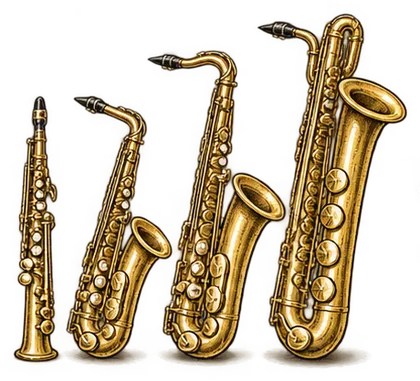
Those four are one instrument built at four sizes. The modern saxophone family is made up entirely of B♭ and E♭ instruments, and soprano, alto, tenor and baritone are the ones in widest use [1]. Size sets the pitch, from the small, high soprano down to the big, low baritone [3].
The four side by side
| Soprano | Alto | Tenor | Baritone | |
|---|---|---|---|---|
| Key | B♭ | E♭ | B♭ | E♭ |
| Sounds compared with written | Major 2nd lower [4] | Major 6th lower [5] | Octave and a major 2nd lower [6] | Octave and a major 6th lower [7] |
| Bottom note on this site's chart sounds | A♭3, 208 Hz | D♭3, 139 Hz | A♭2, 104 Hz | C2, 65 Hz (low A) |
| Top note on this site's chart sounds | E6, 1319 Hz | A5, 880 Hz | E5, 659 Hz | A♭4, 415 Hz |
| Shape | Usually straight [3] | J shape, neck runs straight to the mouthpiece [3][6] | Crook in the neck [6] | Loop at the top of the body [7] |
| Example weight | 1.5 kg (Yanagisawa S-WO20) [8] | 2.40 kg (Yamaha YAS-280) [9] | 3.19 kg (Yamaha YTS-280) [10] | 5.0 to 9.1 kg [7] |
| Concert band seats | Played by first alto when used [1] | Two [1] | One [1] | One [1] |
The two range rows come from the play buttons on this site's soprano, alto, tenor and bari charts. The weights are single models, and baritones alone run from 11 to 20 lb depending on material and design [7].
Why one set of fingerings works on all four
Saxophone music is written in treble clef and transposed for each size, so a written note takes the same fingering on every saxophone [1]. Yamaha says the arrangement was set up to make saxophone fingering easier [11]. You read a written G, press the same keys on any of the four, and get a different concert pitch from each. The transposition absorbs the difference so your fingers don't have to, and the arithmetic is in concert pitch vs written pitch.
The written range is shared as well. Most saxophones run from the written B♭ below middle C up to the F two and a half octaves higher, and many add a key for high F♯ [1]. Yamaha's YAS-280 alto and YTS-280 tenor both have it [9][10]. The YBS-480 baritone is listed without it [12], and this site's bari chart also stops at high F.
Low A is the exception. Nearly all baritones are now built with an extra key for it [1]: finger low C and press the low A key below the left thumb [13]. Most new baritones had the low A bell by the 1980s, and only a few makers still build low B♭ models [7].
How each one is shaped and held
Soprano. The smallest and lightest of the four [3]. A fully straight soprano has to be held up and out from the body, while a curved neck lets you hold it downward, closer to a clarinet [4]. Many sopranos made since the 1990s come with two detachable necks, one straight and one curved [4], and some are built in a curved alto shape with a bow [1]. Straight or curved, the keys and range are the same [4]. A curved soprano sits closer to the body and the neck strap carries more of its weight [14]. Use a strap on a straight one too: it takes strain off the right hand and wrist [15].
Pitch is the soprano's weak point. Its higher range makes it more sensitive to intonation than the lower saxophones [4], and Yamaha calls it harder to keep in tune than the other three [3].
Alto. Standing, play it in front of you. Seated, a smaller player can hold it to the side until they are tall enough to play in front without resting the right hand on the leg [16].
Tenor. Seated, it can go to the side or in front, whichever is more comfortable, and taller players often prefer the front [16].
Baritone. The weight decides most things. Some players swap the neck strap for a harness, and some baritones take a floor peg for seated playing [7]. A harness is worth trying for smaller students [15].
Mouthpieces and reeds
Each size takes its own size of mouthpiece and reed [1], and the tenor's mouthpiece, reed and ligature are all larger than the alto's [6]. Model names can fool you. The YAS-280 and YTS-280 both come with a mouthpiece called 4C [9][10], but they are two different parts, sized for two different instruments [1].
Reed strength carries over better than reed size. A saxophone teacher writing in The Instrumentalist finds that a strength 3 works for almost all middle and high school players on nearly any saxophone [15]. Brands do not agree on what a 3 is, though, so read choosing reed strength before you buy a box for the new horn.
Which saxophone beginners start on
Almost always the alto. It is the most common saxophone [5], and Beginband calls the E♭ alto the most popular and best beginning saxophone [17]. The same page says a student with very large hands can do well on tenor, though alto is usually preferred, and that soprano and bari players are advanced players who probably started on alto [17]. The Instrumentalist article also names alto as the most common saxophone among students, while noting that some start on tenor [15].
The reasons are mostly physical. Some beginners do not yet have hands large enough to fit around the keys [17], and the weight climbs with every size [3]. If tenor or bari appeals to you, ask the band director whether the school owns one before you rent or buy.
Switching sizes: embouchure and air
The fingers need no retraining. The mouth and the air do.
- How much mouthpiece. Going from alto to tenor, take in a bit more mouthpiece than you expect, and back off if the sound turns harsh or squeaks [15]. Students new to bari usually take in far too little. Students new to soprano usually take in far too much and should start with less than feels necessary [15]. To find a starting point, slide a piece of paper between reed and mouthpiece: where it stops is about where your lip should meet the reed [18].
- Angle. On tenor and bari the mouthpiece is angled less and goes almost straight into the mouth [19]. A soprano mouthpiece should go in at about the same angle as an alto's [15].
- Air. Baritones take the most lung power and an open, relaxed embouchure [3], with much more breath support than the higher saxophones [20].
- The first day's sound. An alto player on tenor or bari for the first time often gets a thin, weak tone that sits sharp. A tenor player trying alto, or anyone new to soprano, may hear a tubby tone that sags flat [18]. Correct either one with mouthpiece position and voicing, not by biting [18].
Most problems after a switch show up in the sound rather than the fingers, and players usually get comfortable on a new size in a short time [15].
Sopranino and bass
Two more sizes appear mostly in larger saxophone choirs [1]. The E♭ sopranino is the second-smallest saxophone. It sounds an octave above the alto, a minor third above written, and is usually built straight [21]. Its best-known part, in Ravel's Boléro, is usually played on either sopranino or B♭ soprano [21]. The B♭ bass saxophone sits an octave below the tenor and sounds two octaves and a major second below written [22]. It turns up on some 1920s jazz recordings and is occasionally called for in concert band music [22].
Worked example: alto to tenor for jazz band
A second-year alto player is moved to second tenor in jazz band. Here is a realistic first week.
- Before Monday's rehearsal. Ask for the tenor part and buy tenor reeds, since alto reeds are the wrong size [1]. The concert B♭ tuning note changes from a written G on alto [5] to a written C on tenor, because a tenor's written C sounds B♭ [11]. On tenor that is the C in the third space, C5.
- Day 1, setup. Lengthen the strap until your top teeth reach the mouthpiece without your neck leaning forward or back [16]. Choose side or front. Let the mouthpiece come in straighter than it did on alto [19].
- Days 1 and 2, mouthpiece depth. Use the paper test [18], then take in a little more than feels natural [15]. If it squeaks, ease back.
- Days 2 and 3, low long tones. Hold written G4, then step down through D4 to low B♭3, four slow counts each. On this site's charts that low B♭ sounds A♭2, about 104 Hz, on tenor. The same fingering on alto sounds D♭3, about 139 Hz, a fourth higher. If the sound is thin and sharp, which is normal for an alto player on day one [18], blow warmer air to bring the pitch down instead of pinching [18].
- Day 4, a note that won't speak. If the embouchure looks right and a note still comes out wrong, check your left hand. Students new to tenor often bump the left-hand side keys open without noticing, simply because the horn is bigger [15].
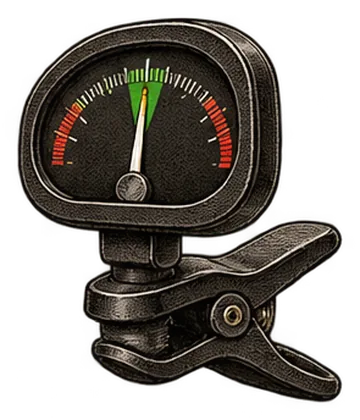
- Day 5, tune. Play written C5 against a tuner set to concert B♭ and adjust the way tuning with a tuner describes for saxophone.
By Friday the fingerings are the same ones you used on alto, and scales and the band's warm-up all sound a fourth lower than they did [5][6]. The sound and the air are what take the practice. The tenor has long been a solo instrument in jazz [6], so work through any improvised sections at slow tempo that first week too.
Common mistakes
- Reading the alto part on tenor. The fingerings work, but every note sounds a perfect fourth lower than the alto would sound it, which puts you in a different key from the band [5][6].
- Biting to fix pitch on a new size. Change the air and the mouthpiece position instead [18].
- Leaving the strap where it was. A misplaced neck strap is a common problem for young players [23], and the right height changes with the instrument and with sitting or standing [16].
- Resting the bari on the floor or on your feet. Directors should watch for it [15]. A peg or a harness takes the weight instead [7].
- Twisting toward the bari. Turning the torso lets the instrument's weight drag the mouthpiece to the wrong angle [16].
- Expecting a soprano to hold pitch like an alto. It is more sensitive to intonation [4], so check it with a tuner more often.
The low A card is the one place the bari chart parts ways with the alto chart: the low C fingering plus the key under the left thumb [13]. If the school's bari has no key there, it is a low B♭ model, and any low A in the part has to be taken up an octave or left out, which is the director's call.
Sources
- Saxophone, Wikipedia
- Big band, Wikipedia
- What's the Difference Between Soprano, Alto, Tenor and Baritone Saxophones?, Jake Uitti, Yamaha Music
- Soprano saxophone, Wikipedia
- Alto saxophone, Wikipedia
- Tenor saxophone, Wikipedia
- Baritone saxophone, Wikipedia
- Yanagisawa S-WO20 Elite Soprano Saxophone, Thomann
- Yamaha YAS-280 Alto Saxophone, Thomann
- Yamaha YTS-280 Tenor Saxophone, Thomann
- How to Play the Saxophone: The saxophone is a transposing instrument, Yamaha Musical Instrument Guide
- Yamaha YBS-480 Baritone Saxophone, Thomann
- How to Play the Saxophone: Saxophone fingering, Yamaha Musical Instrument Guide
- Learning About the Curved Soprano Saxophone, Jacob Swanson, DANSR
- The Easy Move from Alto Sax, De'Shun Iverson, The Instrumentalist
- The Backbone of Your Sound, Part Two: Instrument Posture, Nicholas Bissen, DANSR
- Beginning Band: Alto Saxophone Information, Beginband
- Switching between saxophones, Bret Pimentel
- Embouchure Pressure and Mouthpiece Placement for Classical and Jazz Saxophonists, Tracy Heavner, Bandworld
- 4 Tips to a Stronger Low Saxophone Section, Dale Ramirez, Yamaha Music
- Sopranino saxophone, Wikipedia
- Bass saxophone, Wikipedia
- Saxophone Survival Guide, Thomas Kmiecik, D'Addario Woodwinds