The chromatic scale is the one audition item you can have finished before you walk in, because the notes never change. What separates a clean one from a smeared one is usually a few fingering choices and the way the tempo was built up.
What a chromatic scale is
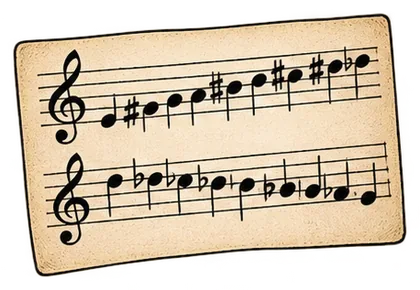
A chromatic scale uses all twelve pitches in the octave, each a half step from its neighbor [1]. From C going up, that is C, C♯, D, D♯, E, F, F♯, G, G♯, A, A♯, B, C. Two octaves span 24 half steps, so a two-octave chromatic has 25 notes going up and 24 coming back down, 49 in all.
On paper it is usually spelled with sharps going up and flats coming down [1], so the descent from C reads C, B, B♭, A, A♭, G, G♭, F, E, E♭, D, D♭, C. No one spelling is required [1], so play what your sheet prints. A C♯ and a D♭ sound the same [2]. Which fingering works best for a note depends on its neighbors, not its spelling.
How audition sheets ask for it
Requirements usually name a rhythm, a tempo, an articulation and a range [3], and the details vary from state to state. Four current examples:
| Audition | Range | Tempo and rhythm | Articulation | Memorized |
|---|---|---|---|---|
| Alabama all-state, middle school [4] | Set for each instrument on the association's scale sheet | Eighth notes, suggested quarter = 120 | Not stated | Yes |
| Colorado All-State Band [5] | "Your best low note to your best high note" | All eighth notes, quarter = 104 | Ascending and descending, tongued both ways | No |
| Kansas all-state, 2026-27 [6] | Shown on the scale sheet | Quarter = 60, in the printed rhythm | Slurred up, tongued down | No |
| Connecticut regional and all-state [7] | Listed per instrument (below) | A printed rhythm pattern | Slurred up and down | Yes |
Connecticut's ranges: flute A to A, two octaves (C to C, three octaves, for all-state only); clarinet E to G, more than three octaves; alto saxophone B to F, more than two octaves; trumpet C to C, two octaves; trombone, euphonium and tuba B♭ to B♭, two octaves [7].
Articulation can flip. Kansas wants slurred up and tongued down [6], while a prep sheet for Mississippi's Lions All-State Band calls tonguing up and slurring down a standard approach [8]. Time can also be tight. Alabama's middle school audition allows 4 minutes, counted from the first note of the concert G scale, for eight major scales plus the chromatic [4].
Learn it one octave at a time
Start slowly and add notes as they get comfortable [3]. Two band directors writing in The Instrumentalist have students play only as much of the chromatic as they can play well [2]. For two octaves, that means four chunks, each played up and down, slurred, until it is clean three times in a row:
- The lower octave.
- The upper octave.
- The joint, four notes on either side of the middle note.
- The turnaround: the last four notes up, the top note, and the first four down.
Clarinetists should add a fifth chunk for A, B♭, B (crossing the break covers it). Every full chart on this site, such as the flute chart, lists the notes in chromatic order with a play button, so you can finger along from the bottom and hear each pitch first.
Fingering choices by instrument
The alternate fingerings guide explains why these options exist. Here is what matters in a chromatic scale.
Flute
In a chromatic scale B♭ and B♮ sit side by side, so thumb B♭ would mean sliding the thumb between its two keys on every pass. Use the one-and-one B♭ that the flute chart shows first, or lever B♭, which flutist Patricia George recommends for chromatic passages [9]. She also flags two smaller habits: F♯ in the first two octaves takes the right ring finger, not the middle, and E in those octaves needs the right pinky down [9].
Clarinet
Pinky notes come in chains: E, F, F♯ at the bottom and B, C, C♯ above the break. Alternate hands along a chain, since sliding one pinky between keys is very hard to do cleanly at speed [10]. That gives left E, right F, left F♯, and the same pattern for B, C and C♯, in both directions [11] [12]. The clarinet chart shows both pinky options on each of those notes.
Two chromatic fingerings smooth out F to F♯. In the throat, keep the thumb down from F and add two right-hand side keys, instead of swapping the thumb for the first finger [11]. Above the break, keep F's right first finger down and add the sliver key [12]. The same sliver key, without the register key, gives a chromatic B3 after B♭3 [11].
Saxophone
Use side B♭, fingered as A plus the right-hand side key. It is the B♭ recommended for chromatic A, A♯, B [13], and the alto saxophone chart lists it first. Save bis B♭ for leaps into and out of B♭ [13]. For F♯, keep F down and add the chromatic F♯ key (the chart's alternate F♯ key), which suits any chromatic run through F♯ [13]. Side C splits teachers. The two band directors from The Instrumentalist teach it for the chromatic [2], while a saxophone teacher writing for DANSR avoids it there, because side C plus side B♭ causes coordination trouble at speed [13].
Trumpet
Low D (1-3) is sharp and low C♯ (1-2-3) is very sharp [14]. Most players lower both with the third valve slide, which can bring the pitch down further than the first slide [14], though modern trumpets let you move the first and third slides while playing and extend either or both [15]. To set the distances, match 1-3 G to open G with the third slide and use that spot for D, then match 1-2-3 F♯ to F♯ on valve 2 for C♯ [14]. The trumpet chart gives low F♯ and G the same treatment. A slide only affects notes that use its valve [14]. E♭, right next to D, is fingered 2-3, so bring the slide back in for E♭ unless your tuner says that note needs it too.
Trombone
On the trombone chart, the slide moves in one position per half step from B2 in 7th to F3 in 1st, then jumps back out to 5th for F♯3. A BANDWORLD article gives the generally accepted rule for choosing positions: keep them as close together as possible, since a change of direction of more than one position can cause a break or jerk in the line [16]. Its example, a 5th-position G♭ approached and left from 6th rather than 1st [16], works out to F3 in 6th in a chromatic scale. At the top of a B♭ chromatic, the chart lists F♯4 in a raised 3rd and G4 in a raised 2nd, with 5th and 4th as alternates. Practice B♭2 to B2 by itself, because it is the full reach from 1st to 7th.
Worked example: 60 to 120 in four weeks
Take a two-octave chromatic in eighth notes, such as written C4 to C6 on flute or alto saxophone, or B♭2 to B♭4 on trombone. At quarter = 60 that is two notes per click. At 120 it is four notes per second, and the whole 49-note scale takes about 12 seconds. Quarter = 120 is Alabama's suggested tempo [4], and Colorado's 104 [5] arrives in week 3.
Give it about 10 minutes a day inside your regular practice; the home practice routine covers the slow-to-fast method. The rule all month is three clean runs in a row before the click goes up, since speed should only rise when the playing is flawless [3]. Clean means even eighths, the fingerings above, your sheet's articulation and no stray notes between half steps.
| Week | Start each day near | Target by day 7 | Notes per second at target | Focus |
|---|---|---|---|---|
| 1 | 60 | 72 | 2.4 | The four chunks, slurred |
| 2 | 66 | 88 | 2.9 | Whole scale, sheet's articulation, accents |
| 3 | 80 | 104 | 3.5 | One recorded cold run each day |
| 4 | 96 | 120 | 4.0 | Mock auditions |
Week 1. Days 1 and 2, lower octave at 60. Days 3 and 4, upper octave at 60. Day 5, the joint and turnaround, then the whole scale. Days 6 and 7, climb 2 to 4 clicks at a time to 72.
Week 2. Switch to your sheet's articulation, then put an accent on every third note for a few runs, then every fourth. DANSR's chromatic-scale article recommends groups of 2, 3, 4 and 6 [3], and a moving accent shows which finger is late. Finish at 88.
Week 3. Open each session with one cold run, no scale warm-up, about 8 clicks under yesterday's best, and record it. Fix whatever wobbles (often a register change or the turnaround) as a slow chunk, then climb to 104.
Week 4. Reach 120 by day 4 or 5. After that, play one run each at 112, 120 and 126, then finish with one more at 120. Days 6 and 7 are for mock auditions. If a target doesn't come, repeat the week. A clean 112 beats a messy 120, and Colorado's sheet says its tempos are targets, not requirements [5].
Keeping it even under nerves
- Hear the tempo first. Think four clicks before the first note, at a tempo a few clicks under your best from week 4.
- Breathe in the same place every time. A prep sheet for Mississippi's Lions All-State audition marks breaths followed by a repeated note, so players don't get lost in long chromatic runs [8].
- Slow your breathing. In a trial with 46 trained musicians, one 30-minute session of slow breathing reduced anxiety before a stressful performance for those who started out most anxious [17], with or without biofeedback [18]. Co-author Andrew Kemp later credited the long out-breath with lowering heart rate [18]. Two slow breaths with a long exhale take seconds at the stand.
- Rehearse the pressure. In a small study, a simulated audition with virtual judges produced anxiety comparable to a real one, and players rated it useful for building performance skills [19]. At home, announce yourself as if to a panel and play the scale once for a family member or a phone camera, with no restarts.
Common mistakes
- Practicing only the way up. Start some runs at the top so the descent gets its own repetitions.
- Learning the wrong articulation. Kansas wants slurred up and tongued down [6], Colorado tongued both ways [5]. Use your sheet's version from week 2 on.
- Habits that don't fit a chromatic. Thumb B♭ on flute, bis B♭ on saxophone, and sliding one clarinet pinky between keys [9] [13] [10].
- Leaving the trumpet's third slide out after low D. E♭ sits right beside it and uses the same valve.
- Reaching for range you can't play cleanly. Colorado's full range means your best low note to your best high note [5], and the Mississippi sheet warns that its rubric gives less credit for a third octave than it deducts for missed notes [8].
- Using the sheet when scales must be memorized. Alabama disqualifies students found using scale sheets during auditions [20].
Once a week, play the scale slowly with a tuner on the stand. The two Instrumentalist band directors have every student do this several times a year to check for in-tune half steps [2], and the tuning guide explains what the needle is telling you. If one half step reads off every time, check that note's fingering or slide before blaming your ear.
Sources
- Chromatic scale, Wikipedia
- Beginners and the Chromatic Scale, The Instrumentalist
- Revisiting the Chromatic Scale, DANSR
- Middle School Scale Requirements, Alabama Bandmasters Association
- Colorado All-State Band Audition, Flute/Piccolo Set 4B, Colorado All-State Band (hosted by CSU Pueblo)
- Audition Excerpts, KMEA All-State Band, Kansas Music Educators Association
- High School Audition Repertoire, Woodwinds and Brass, 4-Year Rotation, CMEA (Connecticut)
- Mississippi Lions All-State Band Audition Scales "Option 1": Tuba, University of Mississippi Low Brass
- Sensitive Flute Fingerings, The Instrumentalist
- Those Pesky Pinkies: Strategies for Clarinetists, The Instrumentalist
- Chalumeau Register: Alternate Fingering Chart for Boehm-System Clarinet, The Woodwind Fingering Guide
- Clarion Register: Alternate Fingering Chart for Boehm-System Clarinet, The Woodwind Fingering Guide
- Alternate Fingerings: Utilizing Situational Rules to Simplify Difficult Passages, DANSR
- Why Should I Extend My Third Slide On Low D?, The Trumpet Blog
- Trumpet, Wikipedia
- Advantages of Alternate Slide Positions, BANDWORLD Magazine
- Matter over mind: a randomised-controlled trial of single-session biofeedback training on performance anxiety and heart rate variability in musicians, PLoS ONE (DOAJ record)
- Performance Anxiety? Take a Deep Breath, Pacific Standard
- Simulating and stimulating performance: introducing distributed simulation to enhance musical learning and performance, Frontiers in Psychology
- All-State Audition General Information, 2027 High School, Alabama Bandmasters Association