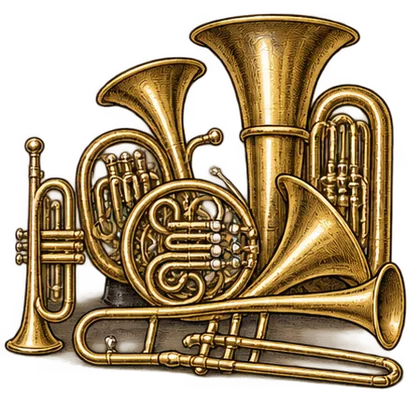
Valves or a slide add tubing to a brass instrument, and a longer tube plays lower [1][2]. The six brass instruments in a school band differ mostly in the length and shape of that tubing.
Side by side
| Instrument | Key and open tubing | Bore | Valves or slide | Mouthpiece | Usual part |
|---|---|---|---|---|---|
| Trumpet | B♭, about 1.48 m [3] | Mostly cylindrical [1] | 3 piston, right hand [3][4] | Cup, 16.46 mm inside the rim (Yamaha 11C4) [5] | Top of the brass section [4] |
| Mellophone | F, half the length of a horn [6] | Conical [6] | 3 piston, right hand [6] | Cup more conical than a trumpet's [7] | Horn parts in marching band [6] |
| French horn | F, about 3.6 m; a double horn adds a B♭ side [8][9] | Conical [1] | Rotary, left hand, plus a thumb valve on a double [9] | Conical, 17.28 mm (Yamaha 30C4) [1][10] | Alto voice [11] |
| Trombone | B♭, 9 ft (2.7 m) [12] | Mostly cylindrical [12] | Slide, 7 positions [12] | Cup, close to a euphonium's [13] | Tenor range, an octave below trumpet [12] |
| Euphonium | B♭, 9 ft (2.7 m) [14] | Wide conical [14] | 3 piston, often a 4th [14] | 25.23 mm (Yamaha SL-51S) [15] | Tenor solo voice [14] |
| Tuba | BB♭, 18 ft (5.5 m) [16] | Wide conical [17] | 3 to 6, piston or rotary [17] | Cup, 32 to 34 mm [17] | Main bass voice [17] |
The trombone and euphonium are both 9-foot B♭ instruments an octave below the trumpet, and the tuba sits an octave below them [12][14]. The BB♭ is the standard school tuba [18].
How the valves and slide work
Each valve adds its own length of tubing: valve 2 lowers the pitch a half step, valve 1 a whole step, and valve 3 a step and a half [1]. Piston valves are the norm on brass instruments except for the orchestral horn and the tuba [1]. On trumpet, the right hand works valves 1, 2 and 3, numbered from the mouthpiece out [4], and the mellophone is also played with the right hand [6].
The horn reverses that. Its rotary valves are worked by the left hand, and the right hand sits in the bell [9][11]. A double horn adds a thumb valve that switches between an F side and a B♭ side [9]. Yamaha gives the F horn about 360 cm of tubing and the B♭ horn about 270 cm, so the B♭ side is roughly 90 cm (3 feet) shorter [8].
Euphoniums have three top-action piston valves, and many add a fourth [14]. Tubas come with three to six valves, piston or rotary [17], and for beginners a 3- or 4-valve BB♭ is preferred [18]. The trombone uses a slide with seven chromatic positions, each a half step lower than the last [12]. Trombone slide positions maps every note, and the trombone chart shows each one.
Bore and mouthpiece
Bore is the inside shape of the tubing. Trumpet and trombone are mostly cylindrical, while horn, euphonium and tuba widen steadily along their length [1]. Cylindrical tubing tends to sound direct and bright, and conical tubing warmer and less direct [2].
Mouthpiece shape is a separate question from bore. Trumpets, trombones and tubas use a cupped mouthpiece, and horns use a conical one [1]. Rim size alone says little here: Yamaha's standard 30C4 horn mouthpiece measures 17.28 mm across the inside of the rim [10], barely more than the 16.46 mm of its 11C4 trumpet mouthpiece [5]. The difference is the shape of the cup.
The low brass jump in size. Yamaha's standard SL-51S euphonium mouthpiece is 25.23 mm [15], and a tuba cup usually measures 32 to 34 mm across [17]. Euphonium and trombone mouthpieces are close relatives [13]. One brass pedagogy text lists the Bach 6½AL for both instruments [19], and Yamaha makes euphonium models in both small and large shank [20].
Treble clef or bass clef
On this site's charts, trumpet, mellophone and horn read treble clef, while trombone, euphonium and tuba read bass clef. Those three bass clef instruments read at concert pitch [12][14][17], and trombonists also meet tenor clef in high passages [12]. Horn players should be able to read both treble and bass clef [11].
Euphonium parts come two ways. In American bands a part may be written in bass clef at concert pitch, in treble clef, or both, while British-style brass bands write it in treble clef as a B♭ part that sounds a major ninth lower [14]. Experienced players read both but usually prefer bass clef, and the treble clef version lets a trumpet player use trumpet fingerings [21]. How each key transposes is covered in concert pitch vs written pitch.
Mellophone or French horn
Mellophone and horn are both pitched in F and sound a perfect fifth below written [6][9], so a marching band can hand the horn part to mellophones [6]. Past that, they behave like different instruments.
- Tubing. An F mellophone has half the tubing of a French horn, so its overtone series sits an octave higher [6]. A given written note lands on a lower, wider-spaced partial on the mellophone, much as it does on trumpet [6]. On the horn the partials are close together, and it is easy to land a second or third away from the intended note [11].
- Hands and valves. The mellophone uses trumpet fingerings on piston valves under the right hand [6]. The horn uses rotary valves under the left hand [9].
- Bell. A marching mellophone's bell faces forward, so the sound goes where the player faces [6]. Marching mellophones are also usually built with a smaller bore than marching French horns, for more volume [6].
Outside of marching season, the French horn is everywhere and the mellophone is rarely used [6]. On this site, the mellophone chart covers the trumpet's written range, F♯3 to C6, and the horn chart runs from E3 to C6 with both F and B♭ fingerings.
Euphonium or baritone horn
Both are pitched in 9-foot B♭, an octave below the trumpet [13][14]. The euphonium has a wider conical bore and a larger bell. The baritone horn is narrower, has a smaller bell, and often lacks a fourth valve [13][14]. Yamaha describes the euphonium's sound as fuller and more mellow, and the baritone's as brighter and more direct [22].
In the United States the names blur. For much of the 20th century, "baritone" there meant a wider-bore instrument closer to the euphonium, and American musicians often used the two names interchangeably [13]. Both have three top-action piston valves [13][14], so if your school calls it a baritone and the part is in bass clef, the euphonium chart is the one to use. Marching versions point the bell forward and drop the fourth valve, partly to save weight [14].
Why trumpet players end up on mellophone
When a marching band needs mellophones, the trumpet section is the obvious place to look. The fingerings match the trumpet's for the printed note, which makes the switch an easy one for a trumpet player [23]. The forward bell suits the field, and the wider-spaced partials are easier to hit than a horn's [6]. Even the embouchure fits: the usual marching angle pushes the mouthpiece toward the top lip, much like a trumpet setup [7]. The flip side is that concert horn players who march mellophone can carry embouchure habits back into horn playing unless someone teaches them the difference [7].
The mouthpiece is the one thing to change. A trumpet mouthpiece on a mellophone gives a harsh tone and keeps the instrument from playing as it should [23], and it risks major intonation and tone problems [7]. A mellophone mouthpiece has a cup more conical than a trumpet's, though not as deep as a horn's [7].
Worked example: trumpet to mellophone or euphonium
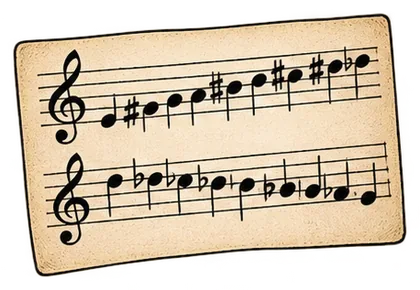
Start with the first five notes of the concert B♭ major scale: B♭, C, D, E♭ and F. A trumpet reads them as written C4, D4, E4, F4 and G4, fingered open, 1-3, 1-2, 1 and open [24].
Mellophone
- The part is in F and sounds a fifth below written [6], so the same concert notes are written a fifth above: F4, G4, A4, B♭4 and C5.
- Finger them as you would on trumpet: F4 is 1, G4 is open, A4 is 1-2, B♭4 is 1, and C5 is open. A4 and B♭4 come from open C5, lowered a step and a half with 1-2 and a whole step with valve 1 [24].
- Every fingering carries over, read straight from the page [23]. What changes is where the notes sit: the warm-up is now a fourth higher on the staff than your trumpet part, even though the band hears the same concert pitches.
- On this site's charts, mellophone and trumpet share the written range F♯3 to C6, but the mellophone's bottom card sounds B2, about 123 Hz, where the trumpet's sounds E3, about 165 Hz.
Euphonium
- The bass clef part is at concert pitch [14]: B♭2, C3, D3, E♭3 and F3.
- A treble clef euphonium part is written a major ninth above the sound and uses trumpet fingerings [21]. So each bass clef note takes the trumpet fingering of the note a ninth above it: B♭2 is fingered like C4 (open), C3 like D4 (1-3), D3 like E4 (1-2), E♭3 like F4 (1), and F3 like G4 (open).
- The trumpet's open, 1-3, 1-2, 1, open carries over unchanged. On a four-valve euphonium, valve 4 can stand in for 1-3 on the C3 [21].
- Everything sounds an octave below the trumpet [14]. This site's euphonium chart has 31 notes from E2 to B♭4, exactly an octave below the 31 sounding pitches on the trumpet chart, E3 to B♭5.
- The mouthpiece is the big change: 25.23 mm inside the rim on Yamaha's standard euphonium model against 16.46 mm on its 11C4 trumpet mouthpiece [5][15]. The bigger mouthpiece puts less pressure on the face, one reason high brass players with braces often become strong euphonium players [21]. Most players find the first sound comes easily, while range takes longer to build [21].
Common mistakes
- Playing mellophone on a trumpet mouthpiece. The tone turns harsh and the tuning suffers [7][23].
- Assuming F means the same fingerings. Horn and mellophone are both in F, but their overtone series sit an octave apart [6], so the horn's valve choices for a written note often differ. Use the chart for the instrument in your hands.
- Reading a treble clef baritone part from a bass clef chart. Treble clef parts sound a major ninth below written [14]. Finger them from the trumpet chart.
- Buying a euphonium mouthpiece without checking the shank. Euphonium models come in small and large shank [20], so find out which one your instrument takes first.
- Ignoring the fourth valve. It substitutes for 1-3 [21], and on most models it is a compensating valve that fixes intonation below E2 [14].
- Starting a small player on a full-size tuba. Scaled 1/2 and 3/4 size tubas exist for exactly that reason [18]. Tubas in the same key have the same length of tubing [18], so a 3/4 BB♭ uses the same tuba chart as a full-size one.
For the first week on either new instrument, practice from music you already know. Any handy trumpet music works for early mellophone practice [23], and a treble clef euphonium part does the same job for a trumpet player while bass clef reading catches up [21].
Sources
- Brass instrument, Wikipedia
- Brass Acoustics, Brass Techniques and Pedagogy, Brian Weidner, PALNI Open Press
- Trumpet, Wikipedia
- The Trumpet, Brass Techniques and Pedagogy, Brian Weidner, PALNI Open Press
- Trumpet Mouthpieces, Yamaha
- Mellophone, Wikipedia
- Mellophone Mouthpieces, Russell Greene, The Instrumentalist
- The Structure of the Horn, Yamaha Musical Instrument Guide
- French horn, Wikipedia
- French Horn Mouthpieces, Yamaha
- The Horn, Brass Techniques and Pedagogy, Brian Weidner, PALNI Open Press
- Trombone, Wikipedia
- Baritone horn, Wikipedia
- Euphonium, Wikipedia
- Baritone Mouthpieces (Standard and GP Series), Yamaha
- What Are the Different Kinds of Tubas?, Jake Uitti, Yamaha Music
- Tuba, Wikipedia
- The Tuba, Brass Techniques and Pedagogy, Brian Weidner, PALNI Open Press
- Recommended Equipment, Brass Techniques and Pedagogy, Brian Weidner, PALNI Open Press
- Trombone Mouthpieces, Yamaha
- The Euphonium, Brass Techniques and Pedagogy, Brian Weidner, PALNI Open Press
- What's the Difference Between Baritone Horn and Euphonium?, Jake Uitti, Yamaha Music
- From the Mailbag: Trumpet to Mellophone, an Easy Switch, John Ericson, Horn Matters
- The Structure of the Trumpet, Yamaha Musical Instrument Guide