Every note in a band part answers two questions: what pitch, and for how long. The clef and key signature settle the pitch. The time signature, the shape of the note and your counting settle the length. The other marks tell you how loud to play and where to go next.
The staff and the clefs
Music sits on a staff of five lines and four spaces [1], counted from the bottom up.
The clef fixes what those lines mean. The treble clef is a G clef: the line through its curl is G4, the G above middle C [2]. The bass clef is an F clef, and the line between its two dots is F3, the F below middle C [2].
Flute, oboe, all clarinets and all saxophones read treble clef, and so do trumpet and horn [2]. Bassoon, trombone and tuba read bass clef [2]. Concert band euphonium parts are usually in bass clef, though publishers often add a treble-clef part [3]. In the percussion section, xylophone reads treble and timpani read bass [2].
If you play a B♭ or E♭ instrument that reads treble clef, your part is written higher than it sounds [4][5]. The concert pitch guide explains why, and the transposition chart lists the offset for every instrument.
Note names on the lines and spaces
Notes use the letters A to G, then start over, one letter per line or space going up [6]. The standard memory aids [2]:
| Clef | Lines, bottom to top | Spaces, bottom to top |
|---|---|---|
| Treble | E G B D F: Every Good Boy Does Fine | F A C E: spells FACE |
| Bass | G B D F A: Good Boys Do Fine Always | A C E G: All Cows Eat Grass |
The treble staff runs from E4 on its lowest line to F5 on its top line, and the bass staff from G2 to A3 [6]. This site writes notes that way, with middle C as C4.
Ledger lines
Notes beyond the staff sit on short ledger lines, spaced like the staff lines [7]. Lines and spaces still alternate, so keep counting letters [6]. Middle C is on the first ledger line below the treble staff and the first ledger line above the bass staff [8]. Above the treble staff, A5 is the first ledger line and C6 the second. Below the bass staff, E2 is the first [6].
A trumpet's low C, written as middle C, and the flute's top octave both live out here. The fingering chart guide shows how a ledger-line note on a chart becomes a fingering.
Sharps, flats and naturals
A sharp (♯) raises a note a half step, also called a semitone. A flat (♭) lowers it a half step, and a natural (♮) cancels either one [9].
Written in front of a note, any of these signs is an accidental, and it lasts to the end of the bar: every later note on that same line or space in the bar gets it too [9]. The bar line cancels it, except when the altered note is tied across the bar line [9].
So if bar 5 has an F♯ on the top line and, two beats later, a plain F on that line, the second F is also F♯. In bar 6 it is F natural again unless the key signature says otherwise. Publishers sometimes print a reminder there anyway, often in parentheses, called a courtesy or cautionary accidental [9].
Key signatures
The sharps or flats right after the clef are the key signature, and they are printed again at the start of every line [10]. Each one applies to that letter in every octave [11], so a B♭ there makes every B a B♭, except in a bar where a natural sign cancels it [9].
They always appear in a fixed order [12]:
- Sharps: F C G D A E B, or "Father Charles Goes Down And Ends Battle"
- Flats: B E A D G C F, the same sentence backward: "Battle Ends And Down Goes Charles' Father"
To name the major key:
- With sharps, go up a half step from the last sharp. F♯ and C♯ mean D major [10][11].
- With flats, the second-to-last flat is the key. B♭, E♭ and A♭ mean E♭ major [10][11].
- One flat is F major, where that trick has nothing to work with, and no sharps or flats is C major [12][10].
Time signatures
The two stacked numbers at the start are the time signature. The bottom number names the note value being counted, and the top number says how many of them fill a bar [13].
- 4/4: four quarter-note beats, also called common time and sometimes written as a C [13]
- 3/4: three quarter-note beats [13]
- 2/4: two quarter-note beats [13]
- 6/8: two beats, each a dotted quarter that splits into three eighth notes [13][14]
6/8 is the one that fools people. In compound meters you divide the top number by three to get the beats, so six eighths make two beats [14]. Count it "1 & a 2 & a" [15] or "1-la-li 2-la-li" [16].
Note and rest values
In 4/4, 3/4 and 2/4 the quarter note gets the beat, and each value lasts twice as long as the next shorter one [17][13]:
| Note | Matching rest | Beats | Count syllables |
|---|---|---|---|
| Whole note | Whole rest | 4 | 1 2 3 4 |
| Half note | Half rest | 2 | 1 2 |
| Quarter note | Quarter rest | 1 | 1 |
| Eighth note | Eighth rest | ½ | 1 or & |
| Sixteenth note | Sixteenth rest | ¼ | 1, e, & or a |
Each rest is named for the note value it matches [18]. The whole rest hangs down from a line, and the half rest sits on top of one [17]. A whole rest also means a full bar of rest in any time signature, so in 3/4 it lasts three beats [18].
Dots and ties
A dot adds half of the note's value [17]. A dotted half note in 4/4 lasts 2 + 1 = 3 beats. A dotted quarter lasts 1½ beats, so the note after it starts halfway through a beat.
A tie joins two notes of the same pitch: play the note once and hold it for both values added together [17]. A slur looks almost the same but joins different pitches, which you play smoothly [17].
Counting out loud
Say the beats: "1, 2, 3, 4" in 4/4. Halve each beat with "&" ("1 & 2 & 3 & 4 &") and split it into quarters with "e" and "a" ("1 e & a 2 e & a") [15]. The "a" is said "uh" [16].
Keep counting through held notes and rests. An ear-training text from Sierra College suggests counting the full subdivision while clapping the rhythm, or saying only the syllables that have sound [16].
For a dotted quarter followed by an eighth, count "1 & 2 &". The dotted quarter starts on 1 and holds through 2, and the eighth lands on the "&" of 2.
Repeats and endings
A repeat sign is a bar line with two dots beside it, facing the music to be repeated [19]. At an end-repeat, go back to the matching start-repeat, or to the beginning if there isn't one [19].
First and second endings are numbered brackets over the last bars of a repeated section. Play the first ending, take the repeat, then skip the first ending and play the second [20][21].
Longer jumps use Italian abbreviations [20]:
- D.C. (da capo): back to the beginning
- D.S. (dal segno): back to the sign
- al Fine: after the jump, stop at the word Fine
- al Coda: after the jump, play to the coda sign, then skip to the section marked Coda
Dynamics
The six common markings, from softest to loudest [22][21]:
| Marking | Italian name | Meaning |
|---|---|---|
| pp | pianissimo | very soft |
| p | piano | soft |
| mp | mezzo piano | moderately soft |
| mf | mezzo forte | moderately loud |
| f | forte | loud |
| ff | fortissimo | very loud |
They are relative, not fixed volumes [22]. A crescendo (cresc., or a hairpin that opens to the right) means get louder. A decrescendo or diminuendo (decresc., dim., or a hairpin that closes to the right) means get softer [22][21].
Worked example: Ode to Joy, flute part
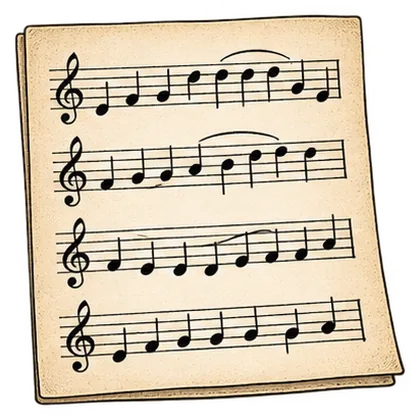
This line is the opening of the "Ode to Joy" melody from the last movement of Beethoven's Ninth Symphony [23]. On a piano's white keys, its first phrase is E E F G G F E D C C D E E D D [24], and the tune uses a dotted quarter and eighth [25]. The flute songs page puts it in concert B♭ major. Its two four-bar phrases differ only in the last bar, so here they are written as three bars, a repeat and two endings, marked mf.
- Read the signs first. Treble clef. Two flats, and the second-to-last is B♭, so the key is B♭ major [10][11] and every B and E is flat. 4/4 means four quarter-note beats per bar [13], and mf means moderately loud [22].
- Bar 1. D5, D5, E♭5, F5, quarter notes, one beat each. D5 is on the fourth line, E♭5 in the fourth space and F5 on the top line [2][6]. Count "1, 2, 3, 4."
- Bar 2. F5, E♭5, D5, C5, quarter notes. C5 is in the third space. Count "1, 2, 3, 4."
- Bar 3. B♭4, B♭4, C5, D5, quarter notes. B♭4 is on the middle line. Count "1, 2, 3, 4."
- Bar 4, under the first-ending bracket. D5 dotted quarter (1½ beats), C5 eighth (½ beat), C5 half note (2 beats). Count "1 & 2 & 3 & 4 &": D5 starts on 1 and holds through 2, C5 lands on the "&" of 2, and the half-note C5 takes beats 3 and 4.
- The repeat. The end-repeat sends you back to bar 1, since there is no start-repeat [19].
- Second time through. Play bars 1 to 3, skip the first ending and play the second [20]: C5 dotted quarter on 1, B♭4 eighth on the "&" of 2, B♭4 half note on 3 and 4.
Five written bars make eight bars of music. Students often play the dotted quarter too short [25], so say the "2" out loud before the eighth.
Other sections read the same tune differently:
- Clarinet and trumpet. Parts are written a major second higher, so concert B♭ major loses both flats and becomes C major [4]. The line starts on E4, the lowest staff line, and the second ending finishes on middle C, the ledger line below the staff [2][8]. The clarinet songs page shows each fingering.
- Alto sax. Parts are written a major sixth higher, so two flats become one sharp, F♯ [5]. A half step above F♯ is G, which makes it G major [11]. The line starts on B4, the middle line [2].
- Trombone, euphonium and bassoon. Bass clef, B♭ major, starting on D3, the middle line. The fourth note is F3, the line between the clef's dots [2]. The trombone chart gives the slide positions.
Common mistakes
- Reading bass clef with treble-clef names. The lowest line is E in treble but G in bass, so every note comes out two letters off [2].
- Letting an accidental run past the bar line, or forgetting that it still applies later in the same bar [9].
- Losing the key signature after the first line. It is printed on every line, so glance left each time you start a new one [10].
- Cutting dotted quarters short [25].
- Playing 6/8 like 3/4. Both hold six eighth notes per bar, but 3/4 groups them in three pairs and 6/8 in two groups of three [14].
- Treating a slur as a tie. Matching pitches mean a tie [17].
- Counting four beats for a whole rest in 3/4. It fills one bar, which is three beats there [18].
For a bar that keeps falling apart, pencil the count under the notes ("1 & 2 & 3 & 4 &") and circle the syllable where each note starts. Erase it once you can say the count without looking, so you end up reading the rhythm and not the pencil.
Sources
- The Staff, Grand Staff, and Clefs, Introduction to Music Theory and Rudiments, MacEwan Open Books
- Clef, Wikipedia
- Euphonium, Wikipedia
- How to Transpose for a B-flat Instrument, FluteTunes
- How to Transpose for an E-flat Instrument, FluteTunes
- How to Read Ledger Lines, Music Theory Practice
- Ledger line, Wikipedia
- Middle C, North Tyneside Brass in Schools
- Accidental (music), Wikipedia
- Major Key Signatures, Music Theory for the 21st-Century Classroom, Robert Hutchinson, University of Puget Sound
- Key signature, Wikipedia
- Order of Sharps and Flats, Music Theory Practice
- Time signature, Wikipedia
- Compound Meters, Fundamentals, Function, and Form, Andre Mount, Milne Open Textbooks
- Counting (music), Wikipedia
- Counting, Equipping the Musical Ear, Lauren C. Sharkey, Sierra College, LibreTexts
- Notating Rhythm, Open Music Theory, Gotham, Hamm and Hughes
- Rest (music), Wikipedia
- Repeat sign, Wikipedia
- Repeats, Introduction to Music Theory and Rudiments, MacEwan Open Books
- Other Aspects of Notation, Open Music Theory 2e, Gotham et al., LibreTexts
- Dynamics (music), Wikipedia
- Ode to Joy, Wikipedia
- How to Play Beethoven's Ode to Joy, Paula Chantree, Music-Scores.com
- The Dotted Quarter Note-Eighth Note Lesson, MakingMusicFun.net