
Bari Sax · treble clef
Christmas Songs for Bari Sax
Fourteen Christmas carols for bari sax, easiest first, with the letter names, the words and the fingering for every note. Tap a letter to see how to finger it, or press play and follow the highlighted notes.
Thirteen of them are written in G major for bari sax, which sounds in concert B♭ with the rest of the band; Silent Night is in D major (concert F) to keep its wide range comfortable.
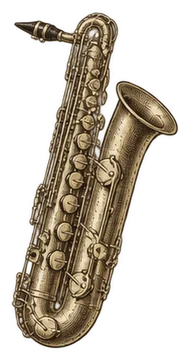
Printable PDF of all 14 carols US Letter, 6 pages, free to copy for students
Jolly Old Saint Nicholas
Tip: Each line opens with the same note four times. Players tend to rush repeated notes, so keep them even and let the last note of each line ring for its full length.
The widest jump is a fifth, down from B4 to E4 in line 4.
The busiest finger change is B4 to E4, where 4 keys or holes move at once. Practice that pair slowly on its own until both notes speak cleanly.
Words: Emily Huntington Miller (1865). Music: attributed to James R. Murray (1874). About this carol
Fingering chart for every note, line by line
Line 1
Line 2
Line 3
Line 4
Good King Wenceslas
Tip: Nearly every note is a quarter note or longer, so the rhythm is the easiest on this page. Play it like a sturdy march and give each half note its full two beats.
The widest jump is a fifth, up from G4 to D5 in line 3.
The busiest finger change is D5 to C5, where 6 keys or holes move at once. Practice that pair slowly on its own until both notes speak cleanly.
Words: John Mason Neale (1853). Music: “Tempus adest floridum”, from Piae Cantiones (1582). About this carol
Fingering chart for every note, line by line
Line 1
Line 2
Line 3
Line 4
Up on the Housetop
Tip: Pairs of quick notes (“on the”, “lit-tle”) sit in the middle of the verse lines. Tongue them lightly without speeding up, then give the three “Ho, ho, ho” notes their full length.
The widest jump is a fifth, down from D5 to G4 in line 4.
The busiest finger change is D5 to B4, where 6 keys or holes move at once. Practice that pair slowly on its own until both notes speak cleanly.
Words and music: Benjamin Hanby (1864). About this carol
Fingering chart for every note, line by line
Line 1
Line 2
Line 3
Line 4
Away in a Manger
Tip: It is a slow waltz with a long note at the end of every line. Hold those for all their beats and breathe after them, never in the middle of a line.
The widest jump is a minor seventh, up from D4 to C5 in line 4.
The busiest finger change is D5 to C5, where 6 keys or holes move at once. Practice that pair slowly on its own until both notes speak cleanly.
Words: anonymous (1880s, American). Music: “Mueller” by James Ramsey Murray (1887). About this carol
Fingering chart for every note, line by line
Line 1
Line 2
Line 3
Line 4
Auld Lang Syne
Tip: The tune uses only five pitch names (a pentatonic scale), so nothing falls outside the key. The long-short dotted rhythm comes back in almost every bar; keep the short note crisp and late.
The widest jump is a sixth, up from G4 to E5 in line 3.
The busiest finger change is B4 to D5, where 6 keys or holes move at once. Practice that pair slowly on its own until both notes speak cleanly.
Words: Robert Burns (1788). Music: traditional Scottish. About this carol
Fingering chart for every note, line by line
Line 1
Line 2
Line 3
Line 4
The First Noel
The first Noel the angel did say
Was to certain poor shepherds in fields as they lay;
In fields where they lay keeping their sheep,
On a cold winter’s night that was so deep.
Noel, Noel, Noel, Noel,
Born is the King of Israel.
Tip: Every second line ends on the same note, so it is easy to lose your place; follow the words. The two quick notes that start most lines are a pickup: play them lightly into the strong beat.
The busiest finger change is C5 to D5, where 6 keys or holes move at once. Practice that pair slowly on its own until both notes speak cleanly.
Words and music: traditional English (Cornish), first printed in the 1820s. About this carol
Fingering chart for every note, line by line
Line 1
Line 2
Line 3
Line 4
Line 5
Line 6
O Come, All Ye Faithful
Tip: The three “O come, let us adore him” lines each start a little higher than the one before. Save some air and some volume for the third.
The widest jump is an octave, up from D4 to D5 in line 3.
The busiest finger change is D5 to C5, where 6 keys or holes move at once. Practice that pair slowly on its own until both notes speak cleanly.
Words: Latin hymn “Adeste Fideles”, English by Frederick Oakeley (1841, current wording printed 1852). Music: attributed to John Francis Wade. About this carol
Fingering chart for every note, line by line
Line 1
Line 2
Line 3
Line 4
Line 5
Line 6
Joy to the World
Tip: The first line walks straight down the scale, one note at a time, which makes it a good test of clean finger changes. Later the repeated “and heaven and nature sing” notes need light, even tonguing.
The widest jump is a minor sixth, up from B4 to G5 in line 7.
The busiest finger change is D5 to C5, where 6 keys or holes move at once. Practice that pair slowly on its own until both notes speak cleanly.
Words: Isaac Watts (1719). Music: “Antioch”, arranged by Lowell Mason. About this carol
Fingering chart for every note, line by line
Line 1
Line 2
Line 3
Line 4
Line 5
Line 6
Line 7
O Christmas Tree
Tip: The long-short dotted rhythm at the start of each line gives the carol its lilt. Make the short note quick and light so it does not turn into two even notes.
The widest jump is a sixth, down from B4 to D4 in line 3.
The busiest finger change is D5 to B4, where 6 keys or holes move at once. Practice that pair slowly on its own until both notes speak cleanly.
Words: Ernst Anschütz (1824), shown in the original German. Music: traditional German. About this carol
Fingering chart for every note, line by line
Line 1
Line 2
Line 3
We Wish You a Merry Christmas
Tip: It moves quickly in three, with a jump of a sixth at the start of the second line and a drop of a full octave in the last line. Think of the landing note before you leave the first one.
The widest jump is an octave, down from D5 to D4 in line 4.
The busiest finger change is D4 to B4, where 5 keys or holes move at once. Practice that pair slowly on its own until both notes speak cleanly.
Music: English traditional (West Country). Words not shown. About this carol
Fingering chart for every note, line by line
Line 1
Line 2
Line 3
Line 4
Deck the Halls
Tip: The third line climbs to the highest note of the carol in one long run of fa-las. Take a full breath before it and play it as one phrase.
The widest jump is a sixth, up from G4 to E5 in line 4.
One note falls outside the key: C♯5 in line 3, played with every key open.
Words: Thomas Oliphant (1862), as revised in 1877. Music: Welsh traditional (“Nos Galan”). About this carol
Fingering chart for every note, line by line
Line 1
Line 2
Line 3
Line 4
Hark! The Herald Angels Sing
Tip: It is long, with five lines and no rests to speak of. Breathe at the commas in the words, and save air for the last two lines, which sit highest.
The widest jump is an octave, up from D4 to D5 in line 3.
The busiest finger change is D5 to C5, where 6 keys or holes move at once. Practice that pair slowly on its own until both notes speak cleanly.
Words: Charles Wesley (1739), altered by George Whitefield. Music: Felix Mendelssohn (1840). About this carol
Fingering chart for every note, line by line
Line 1
Line 2
Line 3
Line 4
Line 5
Angels We Have Heard on High
Tip: The Gloria run is the hard part: 16 notes on one syllable. Slur it, learn it slowly in groups of four, and take a full breath just before it starts.
The widest jump is a fifth, down from A4 to D4 in line 5.
The busiest finger change is B4 to D5, where 6 keys or holes move at once. Practice that pair slowly on its own until both notes speak cleanly.
Words: James Chadwick (1862), after the French carol “Les Anges dans nos campagnes”. Music: “Gloria”, French traditional. About this carol
Fingering chart for every note, line by line
Line 1
Line 2
Line 3
Line 4
Line 5
Line 6
Silent Night
Tip: This has the widest range on the page and the slowest tempo. The work is in the air, not the fingers: play each line in one breath and keep the long notes steady to the very end.
The widest jump is a minor seventh, up from F♯4 to E5 in line 5.
The busiest finger change is C♯5 to D5, where 7 keys or holes move at once. Practice that pair slowly on its own until both notes speak cleanly.
Words: Joseph Mohr (1816), English by John Freeman Young (1859). Music: Franz Xaver Gruber (1818). About this carol
Fingering chart for every note, line by line
Line 1
Line 2
Line 3
Line 4
Line 5
Line 6
Looking for Jingle Bells? It is with the other easy songs: Jingle Bells on bari sax, in G major with 5 notes.
These 12 cards cover every note in all 14 carols on bari sax, from D4 up to G5. Tap a card to see it larger with the fingering in words, alternates and a play button. The full bari sax fingering chart has every other note.
Use the alternate F♯ key when moving quickly between F and F♯.
Side C is easier when moving between B and C.
No keys pressed; this open note can sound thin, so keep steady air.
Same fingering as low D, plus the octave key.
| Carol | Level | Written key | Notes | Range | Watch for |
|---|---|---|---|---|---|
| Jolly Old Saint Nicholas | Easy | G | 6 | D4 to B4 | No octave key |
| Good King Wenceslas | Easy | G | 8 | D4 to D5 | Uses the octave key |
| Up on the Housetop | Easy | G | 6 | G4 to E5 | Uses the octave key |
| Away in a Manger | Easy | G | 8 | D4 to D5 | Uses the octave key |
| Auld Lang Syne | Medium | G | 7 | D4 to E5 | Uses the octave key |
| The First Noel | Medium | G | 8 | G4 to G5 | Uses the octave key |
| O Come, All Ye Faithful | Medium | G | 8 | D4 to D5 | Uses the octave key |
| Joy to the World | Medium | G | 8 | G4 to G5 | Uses the octave key |
| O Christmas Tree | Medium | G | 8 | D4 to E5 | Uses the octave key |
| We Wish You a Merry Christmas | Medium | G | 8 | D4 to D5 | Uses the octave key |
| Deck the Halls | Harder | G | 10 | F♯4 to G5 | Uses the octave key |
| Hark! The Herald Angels Sing | Harder | G | 9 | D4 to E5 | Uses the octave key |
| Angels We Have Heard on High | Harder | G | 7 | D4 to E5 | Uses the octave key |
| Silent Night | Harder | D | 11 | D4 to G5 | Uses the octave key |
Getting the carols ready
Thirteen of the carols use the octave key on bari sax, and one stays below it. Roll the left thumb onto the octave key instead of lifting it off the thumb rest; small movements keep the change clean.
Bari sax reads the same written notes as alto sax and sounds an octave lower, so an alto and a bari can play these pages together. The low notes need a lot of air and a loose jaw. If a note grunts or will not start, ease the pressure on the reed and blow a little warmer.
Start with the first carol and work down; the order goes from the fewest notes and the simplest rhythm to the widest range. Learn each one in three passes: listen to it with the play button while you read the letters, play it with the Slow button, then play along at full speed. If you know the words, sing the line in your head as you play; it is the quickest way to get the rhythm right.
If you are caroling outside, keep the instrument in its case until the last minute and warm it with your breath before tuning. Cold air inside the instrument makes it play flat, so tune again after a few minutes of playing, and keep reeds or the head joint warm in a pocket between carols.
Printable carols for bari sax
Common questions
What is the easiest Christmas song to play on bari sax?
Jolly Old Saint Nicholas. On bari sax it uses 6 different notes, from D4 to B4, and most of each line repeats one note. If you know the notes in the first lesson pages of your band book, you can play it.
Can a bari sax play these with other instruments?
Yes. Every band instrument page here uses the same concert key for each carol (concert B♭, and concert F for Silent Night), so a bari sax and, say, a trumpet reading their own pages play in tune together. The chart on the main Christmas page lists the written key for every instrument.
Why is Silent Night in a different key?
Silent Night spans an octave and a fourth, the widest range on the page. In concert B♭ its top or bottom notes fall outside the easy range of at least one band instrument, so every band page uses concert F for it instead.
Are these carols free to play and share?
Yes. Every melody here is traditional or was published long ago, and every set of words shown was in print before 1929, so they are in the public domain in the United States. We Wish You a Merry Christmas is shown without words because its familiar text was first printed later.
For holiday concerts on bari sax
As an Amazon Associate we earn from qualifying purchases. These are paid links that search Amazon; prices are the same for you. Disclosure.
 PracticeA Home Practice Routine That Actually WorksHow long to practice, what to do with each minute, and how to take a hard passage from slow to performance tempo in a week.Read the guide →
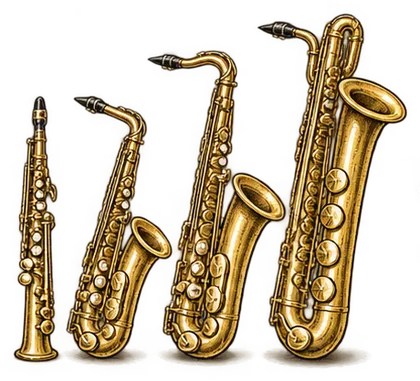 SaxophoneSoprano, Alto, Tenor and Baritone Saxophones ComparedThe four saxophones in a school band share one set of fingerings, so what changes from one to the next is the size of the horn and what it asks of your embouchure and air.Read the guide →