
Recorder · treble clef
Baroque and Renaissance Music for Recorder
Ten pieces of medieval, Renaissance and Baroque music for soprano recorder, easiest first, from L’Homme armé and Greensleeves to Bach’s Air on the G String, with the letter names and the fingering for every note. Tap a letter to see how to finger it, or press play and follow along.
Nine of the ten are in their original key; Canon in D (opening) is moved to a key that fits the soprano recorder.
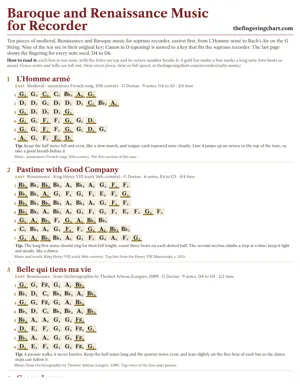
Printable PDF of all 10 pieces US Letter, 5 pages, free to copy for students
L'Homme armé anonymous French song, 15th century
Tip: Keep the half notes full and even, like a slow march, and tongue each repeated note cleanly. Line 4 jumps up an octave to the top of the tune, so take a good breath before it.
The widest jump is an octave, up from G4 to G5 in line 4.
The busiest finger change is E5 to D5, where 5 keys or holes move at once. Practice that pair slowly on its own until both notes speak cleanly.
Music: anonymous French song, 15th century. The first section of the tune. About this piece
Fingering chart for every note, line by line
Line 1
Line 2
Line 3
Line 4
Line 5
Line 6
Pastime with Good Company King Henry VIII (early 16th century)
Tip: The long first notes should ring for their full length; count three beats on each dotted half. The second section climbs a step at a time; keep it light and steady, like a dance.
The busiest finger change is A4 to F4, where 6 keys or holes move at once. Practice that pair slowly on its own until both notes speak cleanly.
Music and words: King Henry VIII (early 16th century). Top line from the Henry VIII Manuscript, c. 1513. About this piece
Fingering chart for every note, line by line
Line 1
Line 2
Line 3
Line 4
Line 5
Line 6
Line 7
Belle qui tiens ma vie from Orchésographie by Thoinot Arbeau (Langres, 1589)
Tip: A pavane walks; it never hurries. Keep the half notes long and the quarter notes even, and lean slightly on the first beat of each bar so the dance steps can follow it.
The busiest finger change is B♭4 to D5, where 5 keys or holes move at once. Practice that pair slowly on its own until both notes speak cleanly.
Music: from Orchésographie by Thoinot Arbeau (Langres, 1589). Top voice of the four-part pavane. About this piece
Fingering chart for every note, line by line
Line 1
Line 2
Line 3
Line 4
Line 5
Line 6
Line 7
Line 8
Greensleeves traditional English tune, 16th century
Tip: Swing the dotted rhythm gently: long, short, long. G♯ comes up in every other line and F♯ in the second half; practice those two fingerings on their own first.
The widest jump is a minor tenth, up from E4 to G5 in line 7.
Music: traditional English tune, 16th century. About this piece
Fingering chart for every note, line by line
Line 1
Line 2
Line 3
Line 4
Line 5
Line 6
Line 7
Line 8
Come Again John Dowland, from The First Booke of Songes or Ayres (London, 1597)
Tip: Treat the rests as part of the music: stop cleanly, breathe, and come back in exactly on the beat. Hold the long high note at the start of line 6 for its whole length, with steady air to the end.
The widest jump is a fifth, down from A4 to D4 in line 4.
The busiest finger change is D5 to E5, where 5 keys or holes move at once. Practice that pair slowly on its own until both notes speak cleanly.
Music: John Dowland, from The First Booke of Songes or Ayres (London, 1597). Top voice. About this piece
Fingering chart for every note, line by line
Line 1
Line 2
Line 3
Line 4
Line 5
Line 6
Canon in D (opening) Johann Pachelbel (1653–1706)
Tip: The first two lines are the famous slow tune; play them smoothly, with no gaps between the notes. Lines 3 and 4 run in eighth notes and cover almost the whole recorder, so practice them slowly first.
The widest jump is an octave, down from D6 to D5 in line 4.
The busiest finger change is D6 to D5, where 7 keys or holes move at once. Practice that pair slowly on its own until both notes speak cleanly.
It goes up to D6, one of the high notes where you pinch the thumb hole partly open. The recorder chart shows how.
Music: Johann Pachelbel (1653–1706). The first violin part, bars 3 to 10 of the Canon. About this piece
Fingering chart for every note, line by line
Line 1
Line 2
Line 3
Line 4
Minuet in G Christian Petzold (1720), from the 1725 Notebook for Anna Magdalena Bach (BWV Anh
Tip: A minuet is a dance in three, so feel one strong beat at the start of each bar and keep the eighth notes light and even. The second half goes up to the high notes, so check those fingerings before you start.
The widest jump is a tenth, up from G4 to B5 in line 5.
C♯5 in line 5 is outside the key: fingered with left first finger and left second finger.
It goes up to B5, one of the high notes where you pinch the thumb hole partly open. The recorder chart shows how.
Music: Christian Petzold (1720), from the 1725 Notebook for Anna Magdalena Bach (BWV Anh. 114). About this piece
Fingering chart for every note, line by line
Line 1
Line 2
Line 3
Line 4
Line 5
Line 6
Line 7
Line 8
Minuet in G Minor Christian Petzold (1720), from the 1725 Notebook for Anna Magdalena Bach (BWV Anh
Tip: It starts on its highest note, so get that fingering ready before you begin. The F♯ in the last lines is the note that pulls the tune home to G minor; practice its fingering on its own first.
The widest jump is a minor ninth, up from A4 to B♭5 in line 3.
It goes up to B♭5, one of the high notes where you pinch the thumb hole partly open. The recorder chart shows how.
Music: Christian Petzold (1720), from the 1725 Notebook for Anna Magdalena Bach (BWV Anh. 115). About this piece
Fingering chart for every note, line by line
Line 1
Line 2
Line 3
Line 4
Line 5
Line 6
Line 7
Line 8
Sheep May Safely Graze Johann Sebastian Bach, from the Hunting Cantata, BWV 208 (1713)
Tip: Keep it calm and singing: slow, smooth air and no hurry on the eighth notes. The dotted quarter notes should be held full length before the short note that follows.
The widest jump is an octave, up from F4 to F5 in line 4.
A♭4 in line 3 is outside the key: fingered with thumb hole, left first finger, left second finger, right first finger, right second finger and right third finger (larger hole only).
Music: Johann Sebastian Bach, from the Hunting Cantata, BWV 208 (1713). The opening of the soprano part. About this piece
Fingering chart for every note, line by line
Line 1
Line 2
Line 3
Line 4
Line 5
Air on the G String Johann Sebastian Bach, the Air from Orchestral Suite No
Tip: Very long notes followed by quick runs: hold each long note with steady air, then play the run evenly without rushing. Practice the fast notes slowly with the Slow button until your fingers know them.
The widest jump is an octave, down from A5 to A4 in line 7.
A♯4 in line 5 is outside the key: fingered with thumb hole, left first finger, left third finger and right first finger.
It goes up to C6, one of the high notes where you pinch the thumb hole partly open. The recorder chart shows how.
Music: Johann Sebastian Bach, the Air from Orchestral Suite No. 3 in D, BWV 1068. The first violin part. About this piece
Fingering chart for every note, line by line
Line 1
Line 2
Line 3
Line 4
Line 5
Line 6
Line 7
Line 8
Line 9
These 23 cards cover every note in all 10 pieces, from D4 up to D6. Tap a card to see it larger with the fingering in words and a play button. The full recorder fingering chart has every other note.
Like low C with the pinky lifted.
Fork fingering: lift only the right middle finger.
Like D with the right first finger lifted.
Left ring finger up; the right ring finger covers only the larger of its two holes.
Skip the left middle finger.
Thumb off; first two fingers down.
Thumb off; only the left middle finger stays down.
Thumb and left first finger off; the other fingers stay down, but keep the right pinky up.
Pinch the thumb: bend it so a small gap opens at the top of the thumb hole.
Like low F with the thumb pinched and the pinky up: right middle finger up, right ring finger down.
Pinched thumb; only the right middle finger stays down.
Same as low G with the thumb pinched; blow a little faster.
Same as A with the thumb pinched; keep the thumb gap small.
Small thumb gap and fast, steady air.
| Piece | Period | Level | Key | Notes | Range |
|---|---|---|---|---|---|
| L'Homme armé | Medieval | Easy | G Dorian | 9 | G4 to A5 |
| Pastime with Good Company | Renaissance | Easy | G Dorian | 6 | E4 to C5 |
| Belle qui tiens ma vie | Renaissance | Easy | G Dorian | 9 | D4 to D5 |
| Greensleeves | Renaissance | Medium | A minor | 12 | E4 to G5 |
| Come Again | Renaissance | Medium | G major | 9 | D4 to E5 |
| Canon in D (opening) | Baroque | Medium | G major | 12 | E4 to D6 |
| Minuet in G | Baroque | Medium | G major | 14 | D4 to B5 |
| Minuet in G Minor | Baroque | Medium | G minor | 15 | D4 to B♭5 |
| Sheep May Safely Graze | Baroque | Harder | B♭ major | 10 | F4 to G5 |
| Air on the G String | Baroque | Harder | D major | 14 | A4 to C6 |
The recorder was one of the main instruments of the Renaissance and Baroque, so this music was written for it, or for voices and instruments it often played with. Each melody here comes from a published score; where a second edition exists, the two were compared note for note.
L'Homme armé
L’Homme armé (“the armed man”) is a French song from the late Middle Ages, from the Burgundian court. It was the most popular tune of its time for building a Mass on: more than 40 Masses called Missa L’homme armé survive, two of them by Josquin des Prez. The words warn that the armed man is to be feared and that everyone should arm himself with a coat of mail. The tune moves in long, steady notes, which is why composers could stretch it under the other voices.
Source of this version: Wikipedia score of the tune (the Mellon Chansonnier version), first 22 bars. Background: L’homme armé, Wikipedia.
Pastime with Good Company
Pastime with Good Company, also called The King’s Ballad, was written by King Henry VIII early in his reign. The oldest copy, in a manuscript from about 1513 now in the British Library, gives it in three voices. It is the best known of the king’s own pieces, and the words are a young king’s list of pleasures: good company, hunting, singing and dancing. It became popular across England and the rest of Europe in the Renaissance.
Source of this version: Wikipedia score from the Henry VIII Manuscript (c. 1513), top voice, note values halved. Background: Pastime with Good Company, Wikipedia.
Belle qui tiens ma vie
Belle qui tiens ma vie (“Beautiful one who holds my life”) is a pavane, a slow, stately Renaissance dance for couples. It comes from Orchésographie, a dance manual printed in France in 1589 by Thoinot Arbeau, the pen name of the priest Jehan Tabourot. Arbeau wrote out the dance steps alongside the music and gave this pavane in four voices with a drum part. Recorder groups often play it, because the four parts suit soprano, alto, tenor and bass recorders.
Source of this version: Mutopia Project edition from Arbeau's Orchésographie (1589, Library of Congress copy), top voice. Edition: Mutopia Project edition (from the Library of Congress copy).
Greensleeves
Greensleeves is an English tune from the 16th century. A ballad called “A Newe Northen Dittye of ye Ladye Greene Sleves” was registered in London in September 1580, and the tune turns up in several lute books from the late 1500s and early 1600s. It is often said that Henry VIII wrote it, but that is a myth. In 1865 William Chatterton Dix set new words to it as the Christmas carol What Child Is This?
Source of this version: Mutopia Project editions (two independent engravings, which agree except for F or F♯ in the refrain). Background: Greensleeves, Wikipedia.
Come Again
John Dowland was the best known English lute player and songwriter of his time. Come Again, Sweet Love Doth Now Invite comes from his First Booke of Songes or Ayres, printed in 1597. Like the other songs in the book, it was printed so that it could be sung by one voice with a lute or by four voices together. The second half climbs a step at a time on short notes, then holds a long high note at the top, which is the moment everyone remembers.
Source of this version: Mutopia Project edition from Dowland's First Booke of Songes or Ayres (1597), top voice (cantus), note values halved. Background: Come Again (Dowland), Wikipedia.
Canon in D (opening)
Pachelbel’s Canon was written for three violins and continuo, over a bass line that repeats every two bars. Each violin plays the same music, two bars apart, so this line is all three parts. No one knows when it was written; suggested dates run from 1680 to 1706. It was almost forgotten until a 1968 recording by Jean-François Paillard’s chamber orchestra, and it is now one of the most played pieces at weddings.
Source of this version: First violin part, bars 3 to 10: Wikipedia score, checked against the Mutopia Project edition of the Canon per 3 violini e basso. Background: Pachelbel’s Canon, Wikipedia.
Minuet in G
For more than two centuries this minuet was credited to Johann Sebastian Bach, because it is in the notebook he gave his wife, Anna Magdalena, in 1725. In 1979 the Bach scholar Hans-Joachim Schulze showed that it comes from a harpsichord suite by Christian Petzold, an organist in Dresden. It is one of the first pieces many pianists learn, and the 1965 pop song A Lover’s Concerto is built on it.
Source of this version: Mutopia Project editions from the Bach-Gesellschaft edition (two engravings, identical), checked against the Wikipedia score. Background: Minuets in G major and G minor, Wikipedia.
Minuet in G Minor
This is the partner of the Minuet in G. The two come one after the other in the Notebook for Anna Magdalena Bach and in Petzold’s suite, and players usually learn them as a pair, with the G minor minuet in the middle and the G major one played again at the end.
Source of this version: Mutopia Project editions from the Bach-Gesellschaft edition (two engravings). Background: Minuets in G major and G minor, Wikipedia.
Sheep May Safely Graze
Bach wrote this aria in 1713 for a birthday celebration for Christian, Duke of Saxe-Weissenfels. In the original the soprano is accompanied not by the full orchestra but by two recorders and continuo, so this is real recorder music from the start. Today it is played at weddings almost as often as Jesu, Joy of Man’s Desiring.
Source of this version: Mutopia Project edition from Breitkopf & Härtel (1881), soprano part, bars 1 to 10 of the voice; checked against the Wikipedia score. Background: Sheep May Safely Graze, Wikipedia.
Air on the G String
This is the slow second movement of Bach’s third orchestral suite, written in the early 1730s. Its nickname comes from an 1871 arrangement by the violinist August Wilhelmj, who moved it down so the whole tune could be played on the violin’s lowest string, the G string. It is one of the most played pieces of Bach, at weddings, in films and in advertising.
Source of this version: First violin part from the Mutopia Project edition of the Bach-Gesellschaft score, checked against a second Mutopia engraving. Background: Air on the G String, Wikipedia.
Printable early music for recorder
Common questions
What is the easiest early music to play on recorder?
L’Homme armé, Pastime with Good Company and Belle qui tiens ma vie. They move in long, even notes and stay in the middle of the recorder. Greensleeves is a good next step once the dotted rhythm feels easy.
Can I play these on alto or tenor recorder?
On tenor recorder, yes: it uses the same fingerings as the soprano and sounds an octave lower, so read this page as it is. An alto recorder is in F: the finger patterns are the same, but each one plays a note a fourth higher, so the letters here would not match. The alto recorder version of this page has all ten pieces in alto fingering, and the alto recorder fingering chart shows every alto note; most Baroque recorder music, such as Handel’s and Telemann’s sonatas, is written for alto.
Why are some of the pieces moved to another key?
A soprano recorder’s comfortable range is about an octave and a half, from low C up to A. Canon in D (opening) would go below the lowest note in its original key, so it is written in a key that fits. Everything else is in the key the composer wrote.
Which pieces use the high notes?
Canon in D (opening), Minuet in G, Minuet in G Minor and Air on the G String go above A, into the notes where you pinch the thumb hole partly open. The fingering chart for each piece shows exactly which ones.
Are these the complete pieces?
Most are complete melodies. Canon in D is the opening eight bars of the first violin part, Sheep May Safely Graze is the first ten bars of the soprano part, and L’Homme armé is the first section of the song. Grace notes and trills are left out so the letters stay easy to read.
For early music on recorder
As an Amazon Associate we earn from qualifying purchases. These are paid links that search Amazon; prices are the same for you. Disclosure.
More to play: the easy recorder songs, the Christmas songs and the patriotic songs use the same letter-note format. Playing alto? The alto recorder version of this page has the same pieces in alto fingering.