A squeak is the instrument jumping to a higher resonance than the one your fingers asked for. Normally a saxophone plays at its lowest resonance, as acoustics researchers at UNSW put it [1]. On clarinet, Charles West even practices squeaks on purpose: from open G, the first one lands near the D a twelfth above [2].
Whatever knocks the instrument off its normal resonance is in the setup, the player or the instrument itself. The first two are cheap to fix, so check them first.
Setup: reed, ligature and mouthpiece
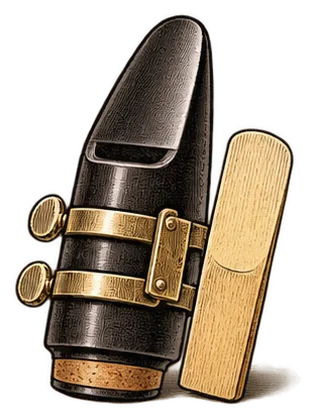
Reed position. Center the reed at both ends, with its tip level with the mouthpiece tip or a hair below it, so a very thin dark line of mouthpiece shows [3][4][5]. Set well below the tip, the reed can cave in and sound brittle, or not sound at all. Set above it, the reed plays stiff and fuzzy [5].
Ligature. Put the ligature on first and slide the reed in under it, so the ligature can't catch the tip [6]. It sits on the smooth part of the reed, with its top edge below the shaved part [6][4]. It should hold the reed without crushing it, and moisture seeping out along the reed's sides means it isn't gripping or the reed is warped [5].
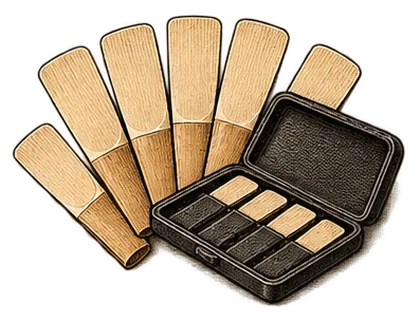
Reed condition. A reed that is too soft or worn out can close up under normal pressure, and dried-out or warped reeds squeak too [7]. A tip that is too thin gives high-pitched squeaks [2]. If the strength is wrong, see choosing reed strength.
Mouthpiece. Badly worn side rails give high-pitched pressure squeaks [2]. For sax students, an extreme tip opening or lay brings squeaking with it, so a moderate mouthpiece is the safer pick [7].
Player causes
Too much mouthpiece
Tracy Heavner's guideline for saxophone is about half an inch of mouthpiece, and more makes the tone harsh and uncontrolled [8]. Andrew Allen's test is a loud written G♯5, taking in a little more mouthpiece each time until the tone is fullest. Past that point it turns harsh and squeaks [7].
To mark the spot, slide paper between reed and mouthpiece to find where they meet, and mark that point lightly on the reed as a guide for the lower lip [9]. Clarinet students often take too little, which leaves too little reed in the mouth to vibrate [4][10].
Biting
Too much jaw pressure pinches the tone and pushes the upper register sharp [8]. On sax, play middle A and flick the octave key: the pitch should jump up and come straight back down. If it stays high, the player may be biting or raising the tongue too much. If it doesn't move, the embouchure may be too loose or the tongue too low [9].
Open tone holes on clarinet
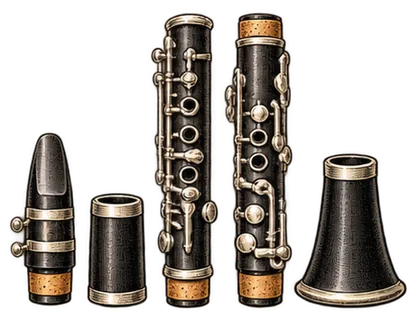
Seven clarinet tone holes are covered directly by the fingertips [11]. Woodwind teacher Bret Pimentel blames unsealed holes for about 95% of clarinet squeaks and suggests covering them with the soft pads of the fingers, checked in a mirror [12]. Christine Damm names two habits that pull fingers off the holes: a right hand curving up toward the upper joint, and pinkies resting under their keys instead of on them [13].
Side keys on saxophone
Side keys opened by accident are a frequent cause, and the fix is posture: hold the sax upright, not tilted, with the main keys roughly in line with the embouchure [7].
Voicing
Mouth and tongue shape change how the instrument responds [1]. If sax low notes keep jumping to the octave, Kenneth Tse suggests checking where the tongue sits after the attack and the shape of the oral cavity, which can send the air through too fast [14]. Clarinet voicing over the break is covered in crossing the break.
Instrument causes
Leaky pads
Players often blame themselves for a leak, hearing it as weak tone or notes that are slow to speak [15]. On clarinet, the large pads near the bottom are frequent offenders [13]. Three ways to find one:
- Blow test (clarinet). Cover the holes of one joint, seal the bottom with your palm and blow just hard enough to puff out your cheeks, closing the low E/B key with your pinky on the lower joint. A hiss is a leak. Blowing too hard can push spring-loaded keys open and fake one, so use light suction if in doubt [16].
- Feeler. Lay a strip of cigarette paper over the tone hole, close the key with normal pressure and slowly draw the strip out. Even drag all the way around means a seal, and the back of the cup is where the worst leaks often hide [15].
- Leak light. On larger instruments, a light inside the body shows a leak as a sliver of light around the closed pad [17].
Bent keys and rods
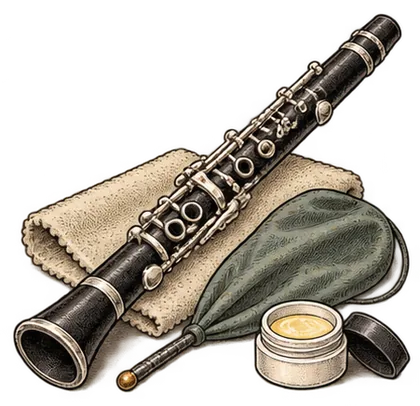
Keys bend easily, so assemble the instrument by holding the body, not the keywork [3]. On clarinet, hold the upper-joint rings down as the joints go together so the bridge key lines up [3][18]. A misaligned bridge key causes tuning and response problems [18]. The slightest bend in the crow's foot on the lower joint can stop notes speaking clearly, so hold that joint between the C/F and B/E key cups, where no linking levers sit [18].
Lift a saxophone by the bell or body tube, never the keys, since even a small bend changes the regulation [19]. Keys that rise and fall in a wave as you press them point to a bent rod [20], and a knock to the bow can twist it enough to make low notes hard to get [19].
Octave and register keys
A saxophone has two octave vents worked by one thumb key [21]. The body vent opens for D5 through G♯5 and the neck vent for A5 and up [22], with the G key switching between them [20]. A bent neck key that leaves its pad open makes the sax squawk and kills the low register [23][19]. Loosen the neck screw before fitting the neck, and keep your hand off the octave key while you do it [19].
The clarinet has a single register vent [2]. West notes that a register key opening too far makes upper notes grunt, and that it should open about a nickel's thickness [2].
Clarinet and saxophone compared
| Clarinet | Saxophone | |
|---|---|---|
| Tone holes | Seven covered by the fingertips, the rest by keys [11] | All closed by padded keys [21] |
| Overblows at | The twelfth [11] | The octave [21] |
| Register vents | One register key [2] | Two vents, one thumb key [21] |
| First suspects | Fingers not sealing [12] | Mouthpiece depth, reed, side keys [7] |
| Mouthpiece check | Mouthpiece and barrel: concert F♯ [4][10] | Alto mouthpiece alone: concert A [24] |
Diagnosing a squeak step by step
- List the notes that squeak, and whether they always do.
- Swap in a reed you trust and check its position and the ligature.
- Play the mouthpiece alone (with the barrel on clarinet). A clarinet setup that misses F♯ points to the embouchure, tongue or air [4]. On alto, a pitch above or below concert A points to the air or the embouchure [24].
- Check mouthpiece depth, then biting [7][9].
- Watch the fingers in a mirror on clarinet [12], and the side keys on sax [7].
- Hand it to a strong player. If the same notes squeak for them, the instrument needs work.
- Leak-test the notes that fail. If the instrument passes and the squeaks continue, the fix is practice [16].
When it's a repair job
Book a technician when a good player gets the same squeak, when you find a leak, when a key won't close fully, or when an octave pad stays open. Seating pads takes experience and specialist tools [15], and bending a key arm so a pad seats evenly is careful work [17].
Worked example: a clarinet squeaks only on low E
The clarinet plays cleanly down to low F (F3). Low E (E3) squeaks, and clarion B4 is unreliable.
- Compare the neighbors. G3 uses the thumb and all six finger holes with no pinky key. F3 adds the F/C pinky key, and E3 uses the E/B pinky key instead [25]. A clean G3 means the fingers are sealing, so the suspect is the E/B key.
- Swap the reed anyway. E3 still squeaks on a good reed, so the setup is cleared.
- Switch pinkies. E3 works with either pinky [25], and both versions close the same tone holes [26]. The clarinet chart lists the right-pinky version as an alternate. If the right pinky gives a clean E3 and the left doesn't, the left lever is out of adjustment. David Cook calls the left B lever "notorious" for that [27].
- Hold the pad shut. If both pinkies fail, have a friend press the low E pad cup closed while you finger E3. If the note clears, the key isn't closing fully. If it still squeaks, the pad leaks. Dawkes describes the same check for a sax octave pad [23].
- Feeler-test that pad, starting at the back of the cup [15].
- Check B4 last. The clarinet overblows at the twelfth [11], so B4 is low E plus the register key and fails along with it. Don't drill it as a break problem: leaky bottom pads can make the break almost impossible [13], and the crossing the break drill assumes a sealed low E.
- Book the repair. A lever adjustment or a pad reseat is technician work [15][18]. Until then, use the right pinky for low E and clarion B, as Cook does for B where he can [27].
Worked example: a saxophone squeaks only with the octave key
An alto plays cleanly from low B♭ up to C♯5. Add the octave key and notes squeak. The alto sax chart shows which notes take it.
- Map it. Play each low note, then add the octave key: D4 to D5, E4 to E5, and so on up to A4 to A5. D5 to G♯5 use the body vent and A5 and up use the neck vent [22], so note which group fails.
- Test the player first with the middle-A flick [9]. If the pitch stays up, relax the jaw and lower the tongue before going on.
- Check mouthpiece depth with the G♯5 test [7], which uses one of the problem notes.
- Try a fresh reed, since a soft or worn one can close up under normal pressure [7].
- Watch the keys without playing. Finger G5 and press the octave key: the body octave key should rise freely. Release it, and both octave pads should drop fully closed [20].
- Check the gap. With nothing pressed, there should be about a millimetre of clearance between the pin on the body and the ring at the end of the neck key. Much past 3 mm, something is wrong [20].
- Read the result. D5 to G♯5 failing with a body key that barely lifts means it isn't opening far enough, which shows up as hissing and resistance on those notes [20][22]. A5 and up failing with a neck key that doesn't lift points to the neck mechanism. Either way it goes to a repairer [20]. If every key moves correctly and your teacher plays the notes cleanly, go back to steps 2 to 4.
Common mistakes
- Buying harder reeds to cure a leak. No reed can seal a pad. Find the cause, then see choosing reed strength.
- Cranking the ligature down until it crushes the reed [5].
- Sliding the reed on before the ligature, risking the tip [6].
- Bending keys back yourself. Dawkes gives a home method only for players with no technician nearby [23].
- Blowing hard in a leak test, which forces keys open and fakes a leak [16].
- Drilling the clarinet break while low E squeaks. Fix the leak first [13].
When you drop the instrument off, give the technician your note list from the steps above, such as "low E and clarion B squeak with the left pinky, fine with the right," and agree on the cost in writing before any work starts [17].
Sources
- Saxophones and the vocal tract: the acoustics of saxophone players, Music Acoustics, UNSW Sydney
- Mysteries, Myths and Misconceptions, Charles West, Midwest Clinic
- Clarinet Assembly, D'Addario Woodwinds
- Clarinet Survival Guide, D'Addario Woodwinds
- Correct Reed Placement and Ligature Positioning, Rory Mazzela, Yamaha
- 10 Tips for Reed Success (for Students AND Parents), Betty Bley, DANSR
- Stop Sax Squeaks, Andrew J. Allen, The Instrumentalist
- Embouchure Pressure and Mouthpiece Placement for Classical and Jazz Saxophonists, Tracy Heavner, Bandworld
- Saxophone Survival Guide, D'Addario Woodwinds
- 10 Steps to Better Clarinet Performance, Robert Spring, Bandworld
- Clarinet, Wikipedia
- Woodwind doubling and clarinet problems, Bret Pimentel
- Tips for the Clarinet Break, Christine Damm, The Instrumentalist
- Saxophone Low Notes, Tips from the Masters, Sean Murphy, The Instrumentalist
- Testing for leaky pads on woodwind instruments, Stephen Howard Woodwind
- In Need of Repair, Jim Snyder, Halftime Magazine
- How to Talk to Your Instrument Tech, Josiah Sytsma, Peabody Institute of Johns Hopkins University
- Technician Tales: Common Clarinet Faults and How to Avoid Them, Dawkes Music
- Technician Tales: Common Saxophone Faults and How to Prevent Them, Dawkes Music
- The SHWoodwind F.O. Guide to Octave Key Mech Problems, Stephen Howard Woodwind
- Saxophone, Wikipedia
- Fixing a Saxophone Octave Hiss, Music Medic
- Bent Octave Mechanism, Dawkes Music
- Alto Saxophone Mouthpiece Warm-Up Exercise, Zander Westphal, Bandworld
- Basic Fingering Chart for Clarinet, Chalumeau Register, The Woodwind Fingering Guide
- Clarinet pinky fingerings, Bret Pimentel
- Those Pesky Pinkies: Strategies for Clarinetists, David Cook, The Instrumentalist