
Flute · treble clef
How to Play High C on Flute
High C on the flute is the C written on the second ledger line above the staff. Here is the fingering, with alternates if there are any.
Concert pitch
C
Press: left first finger and right pinky on the D♯ key.
Same fingering as the C in the staff (C5); blow faster air.
Nearby notes
Uses the same fingering as the lower B♭; blow faster air.
Uses the same fingering as the lower B; blow faster air.
Same fingering as the C♯ in the staff (C♯5); blow faster air.
Like the D in the staff (D5), but lift the right index, middle and ring fingers and put the pinky down.
About this note
On the flute this note is written as C. The flute plays at concert pitch, so it sounds as written. The sound you hear is C6, about 1046 Hz.
The high C of each instrument, compared
Sorted from lowest to highest sounding pitch. The written note is what you read; the sounding note is what you'd hear on a piano. Pitch names use the system where middle C is C4.
| Instrument | Written | Sounds as | Pitch | Frequency |
|---|---|---|---|---|
| Bassoon | C | As written | C4 | 262 Hz |
| Euphonium | C | As written | C4 | 262 Hz |
| Trombone | C | As written | C4 | 262 Hz |
| Tuba | C | As written | C4 | 262 Hz |
| Baritone sax | C | concert E♭ | E♭4 | 311 Hz |
| Bass clarinet | C | concert B♭ | B♭4 | 466 Hz |
| Tenor sax | C | concert B♭ | B♭4 | 466 Hz |
| Alto sax | C | concert E♭ | E♭5 | 622 Hz |
| French horn | C | concert F | F5 | 698 Hz |
| Mellophone | C | concert F | F5 | 698 Hz |
| Clarinet | C | concert B♭ | B♭5 | 932 Hz |
| Soprano sax | C | concert B♭ | B♭5 | 932 Hz |
| Trumpet | C | concert B♭ | B♭5 | 932 Hz |
| Flute (this page) | C | As written | C6 | 1046 Hz |
| Oboe | C | As written | C6 | 1046 Hz |
| Recorder | C | An octave higher than written | C6 | 1046 Hz |
| Piccolo | C | An octave higher than written | C7 | 2093 Hz |
Tips for playing it
High notes on flute come from a smaller lip opening and faster air aimed slightly more across the embouchure hole, not from blowing harder. Keep the lips relaxed and the head steady. Many top-register notes are naturally sharp, so check them with a tuner.
Always check a new note against a tuner or a reference pitch. The play button above gives you the note to match.
See every note on one page in the flute fingering chart.
Tuning this note
High notes on the flute tend to go sharp, especially when loud. Relax the lips and direct the air a little lower to bring them down.
The play button above gives the pitch it should be. To check it, use the flute tuner, which shows the written note.
Getting there from the notes next to it
In music, this note is usually approached from a neighbor a half step away. Here is what changes on flute:
- Half step below: B5. 1 key change from this note. Press: left thumb on the B key, left first finger and right pinky on the D♯ key.
- Half step above: C♯6. 1 key change from this note. Press: right pinky on the D♯ key.
Practice the move slowly between the two notes, back and forth, until both sound clean at the same volume.
Where you will play C6
Patriotic songs: The Star-Spangled Banner.
Major scales: B♭, E♭, F, A♭, C, D♭, G. It is also in the chromatic scale.
Common questions
What does this note sound like on flute?
It sounds exactly as written, because the flute plays at concert pitch. The play button plays that pitch.
Is there more than one way to finger it?
This chart lists one standard fingering for it on flute. Advanced players sometimes use special fingerings for tuning; your teacher can show you any that suit your instrument.
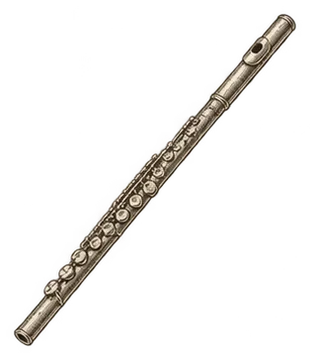 FluteHow to Put a Flute Together and Take It ApartWhere your hands go on each of the three pieces, how to line them up, and a quick tuning check before the first song.Read the guide →
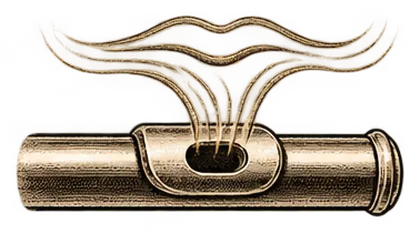 FluteGetting a First Sound on the FluteStart on the headjoint alone, find where the air splits on the far edge of the hole, then carry that setup onto B, A and G.Read the guide →