
Piccolo · treble clef
How to Play High E (E6) on Piccolo
High E on the piccolo is the E written on the third ledger line above the staff (E6 in octave numbers). Here is the fingering, with the alternates players use.
Sounds an octave higher
E
Press: left thumb on the B key, left first finger, left second finger, right first finger, right second finger and right pinky on the D♯ key.
Left ring finger is lifted, unlike the lower E.
Alternate fingering
Nearby notes
Like the D in the staff (D5), but lift the right index, middle and ring fingers and put the pinky down.
Every finger down plus the G♯ key; not the same as the lower D♯ fingerings.
Left middle finger is lifted.
Piccolo F♯ uses the right middle and ring fingers with the pinky up; it responds better than the flute fingering.
See every note on one page in the piccolo fingering chart.
Getting there from the notes next to it
In music, this note is usually approached from a neighbor a half step away. Here is what changes on piccolo:
- Half step below: D♯6. 3 keys change from this note. Press: left thumb on the B key, left first finger, left second finger, left third finger, left pinky on the G♯ key, right first finger, right second finger, right third finger and right pinky on the D♯ key.
- Half step above: F6. 3 keys change from this note. Press: left thumb on the B key, left first finger, left third finger, right first finger and right pinky on the D♯ key.
Practice the move slowly between the two notes, back and forth, until both sound clean at the same volume.
Where you will play E6
Major scales: F, C, G, D, B, A, E. It is also in the chromatic scale.
Common questions
What does this note sound like on piccolo?
It sounds an octave higher than written. The play button plays the sounding pitch.
Is there more than one way to finger it?
Yes. The alternate is shown above; most players use the main fingering for long notes and the alternate in fast passages where it saves a finger move.
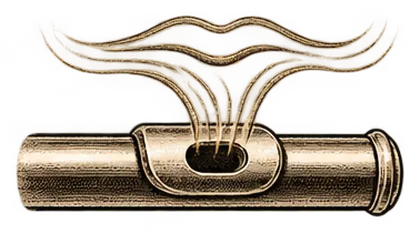 FluteGetting a First Sound on the FluteStart on the headjoint alone, find where the air splits on the far edge of the hole, then carry that setup onto B, A and G.Read the guide →
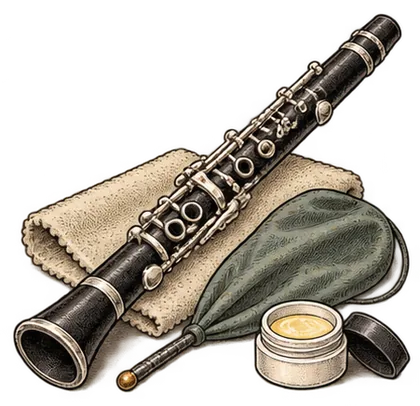 Woodwind careHow to Clean a Clarinet, Flute and SaxophoneWhat to do after every practice, and which jobs to leave to a repair technician.Read the guide →