
Mellophone · treble clef
Irish Songs for Mellophone
Ten Irish tunes for mellophone, easiest first, from The Rakes of Mallow and Danny Boy to The Irish Washerwoman, with the letter names and the fingering for every note, and the words under Danny Boy and The Last Rose of Summer. Tap a letter to see how to finger it, or press play and follow the highlighted notes.
Most are written with the key signature of F major for mellophone, which sounds in concert B♭, the same concert key the rest of the band uses.
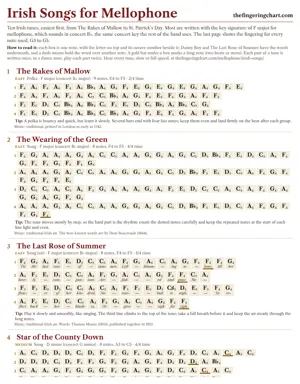
Printable PDF of all 10 tunes US Letter, 6 pages, free to copy for students
The Rakes of Mallow
Tip: A polka is bouncy and quick, but learn it slowly. Several bars end with four fast notes; keep them even and land firmly on the beat after each group.
E4 and A4 have the same fingering: valves 1 and 2. Only your air and lips change between them, so listen for the jump in pitch rather than waiting for your fingers to do it.
The widest jump is an octave, up from F4 to F5 in line 3.
Music: traditional, printed in London as early as 1742. About this tune
Fingering chart for every note, line by line
Line 1
Line 2
Line 3
Line 4
The Wearing of the Green
Tip: The tune moves mostly by step, so the hard part is the rhythm: count the dotted notes carefully and keep the repeated notes at the start of each line light and even.
F4, B♭4, D5 and F5 have the same fingering: valve 1. Only your air and lips change between them, so listen for the jump in pitch rather than waiting for your fingers to do it.
The widest jump is an octave, up from F4 to F5 in line 2.
Music: traditional Irish air. The best-known words are by Dion Boucicault (1864). About this tune
Fingering chart for every note, line by line
Line 1
Line 2
Line 3
Line 4
The Last Rose of Summer
Tip: Play it slowly and smoothly, like singing. The third line climbs to the top of the tune; take a full breath before it and keep the air steady through the long notes.
F4, D5 and F5 have the same fingering: valve 1. Only your air and lips change between them, so listen for the jump in pitch rather than waiting for your fingers to do it.
The widest jump is an octave, down from F5 to F4 in line 3.
C♯5 in line 3 is outside the key: played with valves 1 and 2.
Music: traditional Irish air. Words: Thomas Moore (1805), published together in 1813. About this tune
Fingering chart for every note, line by line
Line 1
Line 2
Line 3
Line 4
Star of the County Down
Tip: It is in a minor key, so listen for the low notes at the end of each line that pull it home. Lines 3 and 5 start high; get their first note ready before you reach them.
A3 and A4 have the same fingering: valves 1 and 2. Only your air and lips change between them, so listen for the jump in pitch rather than waiting for your fingers to do it.
The widest jump is a fifth, up from D4 to A4 in line 4.
Music: traditional (the tune also known as Dives and Lazarus). Words: Cathal MacGarvey (1866–1927). About this tune
Fingering chart for every note, line by line
Line 1
Line 2
Line 3
Line 4
Line 5
Line 6
Brian Boru's March
Tip: It is in 6/8, so count two big beats in each bar. The first part is built on a short dotted figure (long, short, long); keep it crisp and march-like rather than lazy.
F4, B♭4 and D5 have the same fingering: valve 1. Only your air and lips change between them, so listen for the jump in pitch rather than waiting for your fingers to do it.
The widest jump is a sixth, up from F4 to D5 in line 2.
Music: traditional. A version was published in the Dublin Monthly Magazine in 1842. About this tune
Fingering chart for every note, line by line
Line 1
Line 2
Line 3
Line 4
Line 5
Line 6
Line 7
Line 8
Danny Boy (Londonderry Air)
Tip: The last line starts on the highest note of the song (“here in sunshine or in shadow”). Practice that line on its own, and keep the air flowing through the long notes so they don’t fade.
B3 and E♭5 have the same fingering: valve 2. Only your air and lips change between them, so listen for the jump in pitch rather than waiting for your fingers to do it.
The widest jump is a sixth, up from B♭4 to G5 in line 4.
B3 in line 2 is outside the key: played with valve 2.
Music: the Londonderry Air, first published in 1855. Words to Danny Boy: Frederic Weatherly (1910), set to this tune in 1913. About this tune
Fingering chart for every note, line by line
Line 1
Line 2
Line 3
Line 4
Sí Bheag, Sí Mhór
Tip: Think of it as a slow waltz: one strong beat at the start of each bar. The long notes give you time to breathe; use them, and let the tune float rather than march.
B♭3, F4, B♭4, D5 and F5 have the same fingering: valve 1. Only your air and lips change between them, so listen for the jump in pitch rather than waiting for your fingers to do it.
The widest jump is a tenth, up from B♭3 to D5 in line 7.
Its range is too wide for mellophone in the band’s key (concert F), so this version is in concert E♭. It will not match the other band pages for this tune unless everyone changes key.
Music: usually credited to Turlough O’Carolan (1670–1738), as his first composition. About this tune
Fingering chart for every note, line by line
Line 1
Line 2
Line 3
Line 4
Line 5
Line 6
Line 7
Line 8
The Irish Washerwoman
Tip: A jig runs in steady groups of three eighth notes. Keep all three even, start well below full speed, and only speed up once you can play the whole tune without stopping.
G3 and D4 have the same fingering: valves 1 and 3. Only your air and lips change between them, so listen for the jump in pitch rather than waiting for your fingers to do it.
The widest jump is an octave, up from C4 to C5 in line 5.
Its range is too wide for mellophone in the band’s key (concert B♭), so this version is in concert F. It will not match the other band pages for this tune unless everyone changes key.
Music: traditional jig, in print by 1790. About this tune
Fingering chart for every note, line by line
Line 1
Line 2
Line 3
Line 4
Line 5
Line 6
Line 7
Line 8
The Kesh
Tip: The second part jumps around more than the first. Practice it two bars at a time, and keep the groups of three even even when the notes skip.
B3, F♯4 and B4 have the same fingering: valve 2. Only your air and lips change between them, so listen for the jump in pitch rather than waiting for your fingers to do it.
F♯4 in line 7 is outside the key: played with valve 2.
Music: traditional jig. About this tune
Fingering chart for every note, line by line
Line 1
Line 2
Line 3
Line 4
Line 5
Line 6
Line 7
Line 8
St. Patrick's Day
Tip: The dotted rhythm (long, short, long) at the start of most bars is what makes it dance; keep it springy. Count the bars in the longer second part so you don’t lose your place.
C4, G4, C5 and E5 have the same fingering: open (no valves). Only your air and lips change between them, so listen for the jump in pitch rather than waiting for your fingers to do it.
The widest jump is a fifth, up from F4 to C5 in line 5.
Music: traditional set dance and march. About this tune
Fingering chart for every note, line by line
Line 1
Line 2
Line 3
Line 4
Line 5
Line 6
Line 7
Line 8
Line 9
Line 10
Line 11
These 22 cards cover every note in all 10 tunes on mellophone, from G3 up to G5. Tap a card to see it larger with the fingering in words and a play button. The full mellophone fingering chart has every other note.
This fingering plays sharp. Lip it down, or push the first valve slide out if your mellophone has a trigger or saddle on that slide.
Open, no valves.
This fingering plays sharp. Lip it down, or push the first valve slide out if your mellophone has a trigger or saddle on that slide.
Open, the same as low C. Faster air and firmer lips raise the pitch.
Open, the same as low C and G, one step higher in the overtone series.
Open fingering on the top space. It can sit a little flat; listen and adjust.
| Tune | Type | Level | Written key | Notes | Range |
|---|---|---|---|---|---|
| The Rakes of Mallow | Polka | Easy | F major | 9 | E4 to F5 |
| The Wearing of the Green | Song | Easy | F major | 8 | F4 to F5 |
| The Last Rose of Summer | Song (air) | Easy | F major | 8 | F4 to F5 |
| Star of the County Down | Song | Medium | D minor | 8 | A3 to C5 |
| Brian Boru's March | March | Medium | G Dorian | 6 | F4 to D5 |
| Danny Boy (Londonderry Air) | Song (air) | Medium | E♭ major | 13 | B3 to G5 |
| Sí Bheag, Sí Mhór | Harp tune | Medium | B♭ major | 12 | B♭3 to G5 |
| The Irish Washerwoman | Jig | Harder | C major | 12 | G3 to E5 |
| The Kesh | Jig | Harder | C major | 11 | B3 to E5 |
| St. Patrick's Day | Set dance (jig) | Harder | F major | 11 | C4 to F5 |
Learning the tunes
Start with The Rakes of Mallow and work down the list; the order goes from the fewest notes and the simplest rhythm to the widest range and the fastest notes. Learn each tune in three passes: listen with the play button while you read the letters, play it with the Slow button, then play along at full speed. Irish dance tunes are learned by ear as much as from the page, so hum the tune before you play it.
Printable Irish songs for mellophone
Common questions
What is the easiest Irish song to play on mellophone?
Brian Boru's March. On mellophone it uses 6 different notes, from F4 to D5. The Wearing of the Green and The Last Rose of Summer are good next steps, because they move slowly and mostly by step.
What is the difference between a jig, a polka and a march?
A jig is in 6/8: each bar has two beats, and each beat is split into three quick notes (The Irish Washerwoman, The Kesh). A polka is in 2/4 with a bouncy two-beat feel (The Rakes of Mallow). Marches and songs here are in 4/4, 6/8 or 3/4 and are usually played more slowly.
Can a mellophone play these with other instruments?
Yes. Every band instrument page here uses the same concert key for each tune, so a mellophone and a trumpet reading their own pages play in tune together. The exception on mellophone is Sí Bheag, Sí Mhór and The Irish Washerwoman, which need a different key to fit its range; each tune says so. The table on the main Irish songs page lists the written key for every instrument.
Are these tunes in the public domain?
Yes. They are traditional tunes, or were published long ago: The Rakes of Mallow in 1742, the Londonderry Air (Danny Boy) in 1855, and Carolan’s Sí Bheag, Sí Mhór in the early 1700s. Danny Boy and The Last Rose of Summer have their first verse under the notes: Frederic Weatherly’s words (1913) and Thomas Moore’s (1813). The other tunes are given as melodies only.
Why do the tunes play each part only once?
In Irish music the parts of a dance tune are usually each played twice (AABB), and the whole tune is repeated. Here each part is written out once so the page stays short; when you know a tune, play each part twice.
For Irish music on mellophone
As an Amazon Associate we earn from qualifying purchases. These are paid links that search Amazon; prices are the same for you. Disclosure.
More in the same letter-note format: the easy mellophone songs (including The Minstrel Boy and Molly Malone), the Christmas songs and the patriotic songs.