
Bass Clarinet · treble clef
Irish Songs for Bass Clarinet
Ten Irish tunes for bass clarinet, easiest first, from The Rakes of Mallow and Danny Boy to The Irish Washerwoman, with the letter names and the fingering for every note, and the words under Danny Boy and The Last Rose of Summer. Tap a letter to see how to finger it, or press play and follow the highlighted notes.
Most are written with the key signature of C major for bass clarinet, which sounds in concert B♭, the same concert key the rest of the band uses.
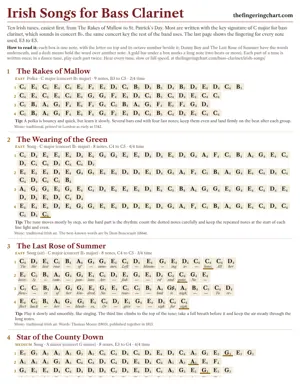
Printable PDF of all 10 tunes US Letter, 6 pages, free to copy for students
The Rakes of Mallow
Tip: A polka is bouncy and quick, but learn it slowly. Several bars end with four fast notes; keep them even and land firmly on the beat after each group.
The widest jump is an octave, up from C4 to C5 in line 3.
The busiest finger change is B4 to A4, where 10 keys or holes move at once. Practice that pair slowly on its own until both notes speak cleanly.
Music: traditional, printed in London as early as 1742. About this tune
Fingering chart for every note, line by line
Line 1
Line 2
Line 3
Line 4
The Wearing of the Green
Tip: The tune moves mostly by step, so the hard part is the rhythm: count the dotted notes carefully and keep the repeated notes at the start of each line light and even.
The widest jump is an octave, up from C4 to C5 in line 2.
The busiest finger change is B4 to A4, where 10 keys or holes move at once. Practice that pair slowly on its own until both notes speak cleanly.
Music: traditional Irish air. The best-known words are by Dion Boucicault (1864). About this tune
Fingering chart for every note, line by line
Line 1
Line 2
Line 3
Line 4
The Last Rose of Summer
Tip: Play it slowly and smoothly, like singing. The third line climbs to the top of the tune; take a full breath before it and keep the air steady through the long notes.
The widest jump is an octave, down from C5 to C4 in line 3.
G♯4 in line 3 is outside the key: fingered with G♯ key.
Music: traditional Irish air. Words: Thomas Moore (1805), published together in 1813. About this tune
Fingering chart for every note, line by line
Line 1
Line 2
Line 3
Line 4
Star of the County Down
Tip: It is in a minor key, so listen for the low notes at the end of each line that pull it home. Lines 3 and 5 start high; get their first note ready before you reach them.
The widest jump is a fifth, up from A3 to E4 in line 4.
The busiest finger change is A3 to E4, where 4 keys or holes move at once. Practice that pair slowly on its own until both notes speak cleanly.
Music: traditional (the tune also known as Dives and Lazarus). Words: Cathal MacGarvey (1866–1927). About this tune
Fingering chart for every note, line by line
Line 1
Line 2
Line 3
Line 4
Line 5
Line 6
Brian Boru's March
Tip: It is in 6/8, so count two big beats in each bar. The first part is built on a short dotted figure (long, short, long); keep it crisp and march-like rather than lazy.
The widest jump is a sixth, up from C4 to A4 in line 2.
The busiest finger change is C4 to A4, where 5 keys or holes move at once. Practice that pair slowly on its own until both notes speak cleanly.
Music: traditional. A version was published in the Dublin Monthly Magazine in 1842. About this tune
Fingering chart for every note, line by line
Line 1
Line 2
Line 3
Line 4
Line 5
Line 6
Line 7
Line 8
Danny Boy (Londonderry Air)
Tip: The last line starts on the highest note of the song (“here in sunshine or in shadow”). Practice that line on its own, and keep the air flowing through the long notes so they don’t fade.
The widest jump is a sixth, up from F4 to D5 in line 4.
F♯3 in line 2 is outside the key: fingered with left thumb over the thumb hole, left first finger, left second finger, left third finger, left pinky F♯/C♯ key, right first finger, right second finger and right third finger.
Music: the Londonderry Air, first published in 1855. Words to Danny Boy: Frederic Weatherly (1910), set to this tune in 1913. About this tune
Fingering chart for every note, line by line
Line 1
Line 2
Line 3
Line 4
Sí Bheag, Sí Mhór
Tip: Think of it as a slow waltz: one strong beat at the start of each bar. The long notes give you time to breathe; use them, and let the tune float rather than march.
The widest jump is a tenth, up from G3 to B4 in line 7.
The busiest finger change is A4 to B4, where 10 keys or holes move at once. Practice that pair slowly on its own until both notes speak cleanly.
Music: usually credited to Turlough O’Carolan (1670–1738), as his first composition. About this tune
Fingering chart for every note, line by line
Line 1
Line 2
Line 3
Line 4
Line 5
Line 6
Line 7
Line 8
The Irish Washerwoman
Tip: A jig runs in steady groups of three eighth notes. Keep all three even, start well below full speed, and only speed up once you can play the whole tune without stopping.
The widest jump is an octave, up from C4 to C5 in line 5.
The busiest finger change is B4 to A4, where 10 keys or holes move at once. Practice that pair slowly on its own until both notes speak cleanly.
Music: traditional jig, in print by 1790. About this tune
Fingering chart for every note, line by line
Line 1
Line 2
Line 3
Line 4
Line 5
Line 6
Line 7
Line 8
The Kesh
Tip: The second part jumps around more than the first. Practice it two bars at a time, and keep the groups of three even even when the notes skip.
The busiest finger change is A4 to B4, where 10 keys or holes move at once. Practice that pair slowly on its own until both notes speak cleanly.
C♯4 in line 7 is outside the key: fingered with left thumb over the thumb hole, left first finger, left second finger, left third finger and left pinky C♯/G♯ key.
Music: traditional jig. About this tune
Fingering chart for every note, line by line
Line 1
Line 2
Line 3
Line 4
Line 5
Line 6
Line 7
Line 8
St. Patrick's Day
Tip: The dotted rhythm (long, short, long) at the start of most bars is what makes it dance; keep it springy. Count the bars in the longer second part so you don’t lose your place.
The widest jump is a fifth, up from C4 to G4 in line 5.
The busiest finger change is A4 to B4, where 10 keys or holes move at once. Practice that pair slowly on its own until both notes speak cleanly.
Music: traditional set dance and march. About this tune
Fingering chart for every note, line by line
Line 1
Line 2
Line 3
Line 4
Line 5
Line 6
Line 7
Line 8
Line 9
Line 10
Line 11
These 21 cards cover every note in all 10 tunes on bass clarinet, from E3 up to E5. Tap a card to see it larger with the fingering in words and a play button. The full bass clarinet fingering chart has every other note.
Cover every hole fully and use lots of slow, warm air; small leaks make low notes squeak.
Finger C and add the C♯/G♯ key with the left pinky.
Thumb comes off the hole; only the first finger stays down.
Open G: nothing pressed, but keep your fingers close to the holes.
Press the side of the first finger against the G♯ key.
Roll the first finger up to the A key instead of lifting it.
Press the A key and the register key together; keep the right ring finger up so the correct vent opens.
Crossing the break: same as low E plus the register key. Seal every hole and keep the throat open; don't pinch.
Same as low F plus the register key. Voice it low, as if you were still playing low F.
Same as low G plus the register key.
| Tune | Type | Level | Written key | Notes | Range |
|---|---|---|---|---|---|
| The Rakes of Mallow | Polka | Easy | C major | 9 | B3 to C5 |
| The Wearing of the Green | Song | Easy | C major | 8 | C4 to C5 |
| The Last Rose of Summer | Song (air) | Easy | C major | 8 | C4 to C5 |
| Star of the County Down | Song | Medium | A minor | 8 | E3 to G4 |
| Brian Boru's March | March | Medium | D Dorian | 6 | C4 to A4 |
| Danny Boy (Londonderry Air) | Song (air) | Medium | B♭ major | 13 | F♯3 to D5 |
| Sí Bheag, Sí Mhór | Harp tune | Medium | G major | 12 | G3 to E5 |
| The Irish Washerwoman | Jig | Harder | C major | 12 | G3 to E5 |
| The Kesh | Jig | Harder | G major | 11 | F♯3 to B4 |
| St. Patrick's Day | Set dance (jig) | Harder | C major | 11 | G3 to C5 |
Learning the tunes
Start with The Rakes of Mallow and work down the list; the order goes from the fewest notes and the simplest rhythm to the widest range and the fastest notes. Learn each tune in three passes: listen with the play button while you read the letters, play it with the Slow button, then play along at full speed. Irish dance tunes are learned by ear as much as from the page, so hum the tune before you play it.
Printable Irish songs for bass clarinet
Common questions
What is the easiest Irish song to play on bass clarinet?
Brian Boru's March. On bass clarinet it uses 6 different notes, from C4 to A4. The Wearing of the Green and The Last Rose of Summer are good next steps, because they move slowly and mostly by step.
What is the difference between a jig, a polka and a march?
A jig is in 6/8: each bar has two beats, and each beat is split into three quick notes (The Irish Washerwoman, The Kesh). A polka is in 2/4 with a bouncy two-beat feel (The Rakes of Mallow). Marches and songs here are in 4/4, 6/8 or 3/4 and are usually played more slowly.
Can a bass clarinet play these with other instruments?
Yes. Every band instrument page here uses the same concert key for each tune, so a bass clarinet and a trumpet reading their own pages play in tune together. The table on the main Irish songs page lists the written key for every instrument.
Are these tunes in the public domain?
Yes. They are traditional tunes, or were published long ago: The Rakes of Mallow in 1742, the Londonderry Air (Danny Boy) in 1855, and Carolan’s Sí Bheag, Sí Mhór in the early 1700s. Danny Boy and The Last Rose of Summer have their first verse under the notes: Frederic Weatherly’s words (1913) and Thomas Moore’s (1813). The other tunes are given as melodies only.
Why do the tunes play each part only once?
In Irish music the parts of a dance tune are usually each played twice (AABB), and the whole tune is repeated. Here each part is written out once so the page stays short; when you know a tune, play each part twice.
For Irish music on bass clarinet
As an Amazon Associate we earn from qualifying purchases. These are paid links that search Amazon; prices are the same for you. Disclosure.
More in the same letter-note format: the easy bass clarinet songs (including The Minstrel Boy and Molly Malone), the Christmas songs and the patriotic songs.